
If you’ve followed along with some of my other posts, you’ll know that I’m making a point to try to spend the bear market doing deep dives into projects/platforms that I’ve heard briefly about, but never really took the time before to get into. Haru Invest is one of those platforms — advertising consistent eye-popping yields at around 25% APR on $BTC, 21,5% on $ETH, and up to 22.5% on $USDT:
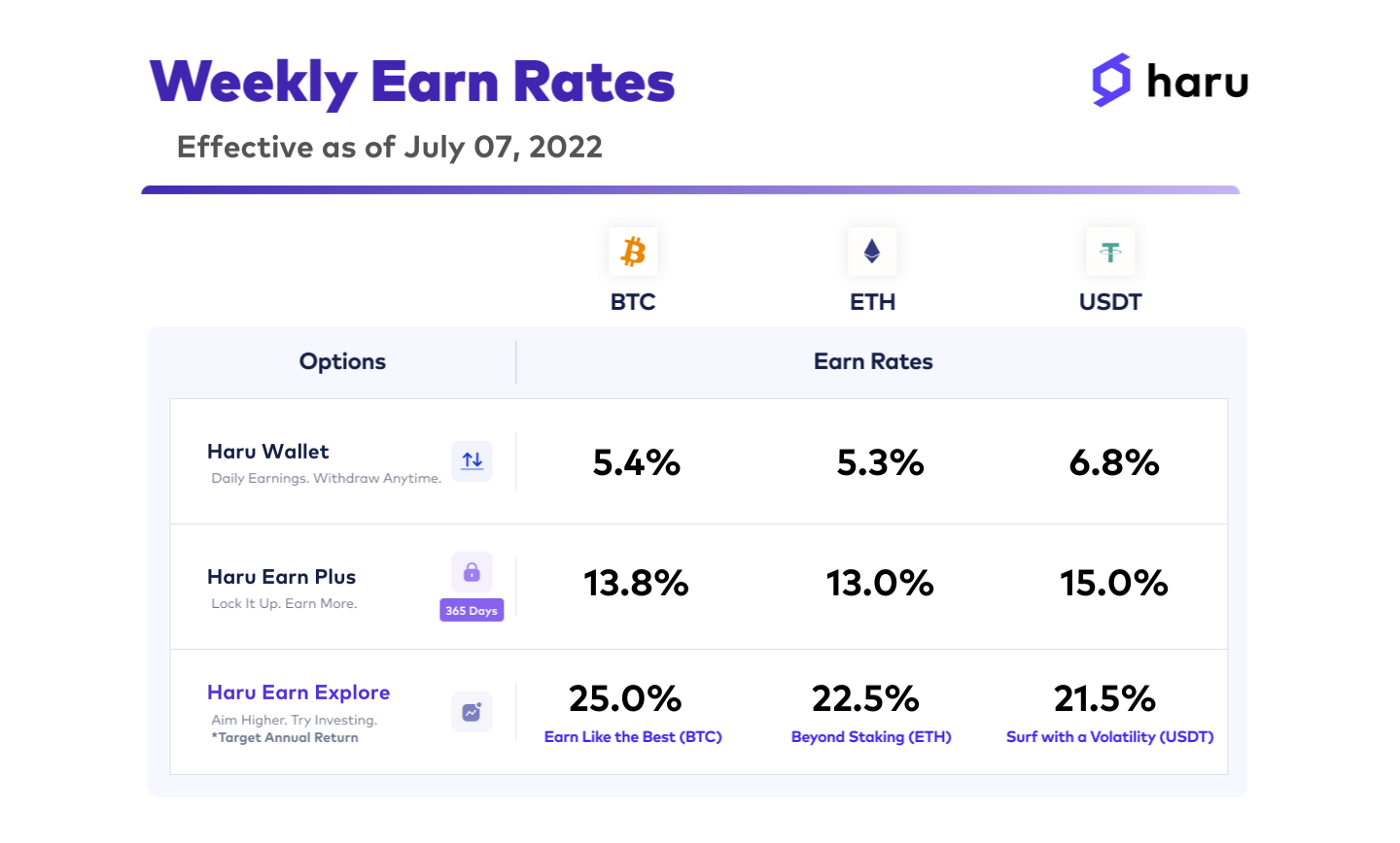
As you can see from their tiered earning rates, they basically can go from standard yield-bearing to degen-like returns. Ultimately, this unique partitioning of risk vs. yield is what led me to figure that it’d be worth it at least to take a bit of a closer look.
Now if you’re like me, the contagion from 3AC, Celsius, Voyager, and so forth has gotten me extremely skeptical and frankly just straight up risk-tolerance-exhausted. Hopefully the bear market is making everyone think a little bit harder and smarter about where to put their assets at, so I’ll share some of the information about what I found out about Haru, and whether or not I decided to choose it as an option to place some of my stables and bluechips.
Why haven’t you heard of Haru Invest?
Probably because you don’t live in Asia. Longevity can exemplify legitimacy in the crypto space, so the first question I asked myself is why I’m just hearing about Haru Invest now. And although Haru Invest (or also known as “Haru” or “One Day” in Korean) has been around since 2019, it took a bit of extra digging to find out information about who or what they are. Pretty quickly it became clear as to why — its primary user base is in South Korea and Asia:
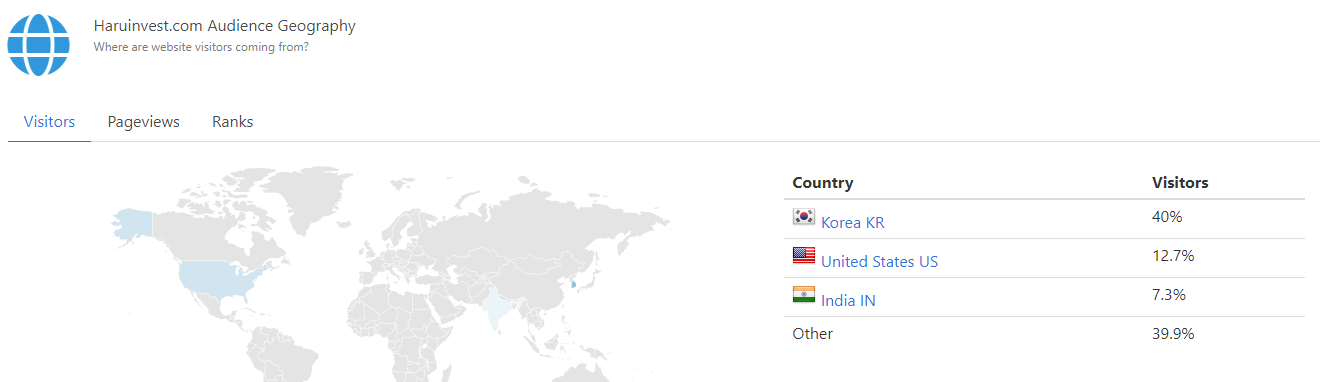
This is also reflected in their staff, as their entire leadership team (who are doxxed) are also mostly based in South Korea, with the company itself headquartered in Singapore. And even though they were able to hit the $1 billion mark in total transaction volume late last year, and then $2 billion just this past month, they have had relatively pretty low marketing and presence that’s non-Asian based…at least up until a couple months ago.
With their parabolic growth in transactional volume, I found it interesting that despite their success, they had very minimal social media influence. For instance, even though they’ve been around since 2019 on Medium.com, they have less than 200 followers. Also, even though they perhaps tweeted at least once every couple of days over the last few years, they barely have 2,000 followers on Twitter, which is pale in comparison to the likes of Celsius (259k), Nexo (223k), or BlockFi (158k). However despite their shortcomings in twitter presence, their history and timeline was relatively easy to track. To give a quick timeline of how the company has evolved:
September 2019 — HaruBank is launched by their parent company, Block Crafters
June 2020 — Harubank partners with BitGo to use as their crypto custodian
September 2020 — Harubank changes its name to Haru Invest
December 2020 — Haru reaches $100 million in total transaction volume
November 2021 — Surpasses total $1 Billion in transaction volume
December 2021 — Haru Invest partners with Keith Haring for an NFT sale
June 2022 — Conducts workshop at Consensus 2022
July 2022 — Haru Invest reaches $2 billion in transaction volume
In addition to this timeline, what I found impressive was Haru gives out at least bi-monthly reports on their overall platform’s performance as well as they’re adjusted yield rates. Aggregating all their earnings for the past year, you can tell that they’re pretty impressive. Take their earn rates for $BTC for instance:
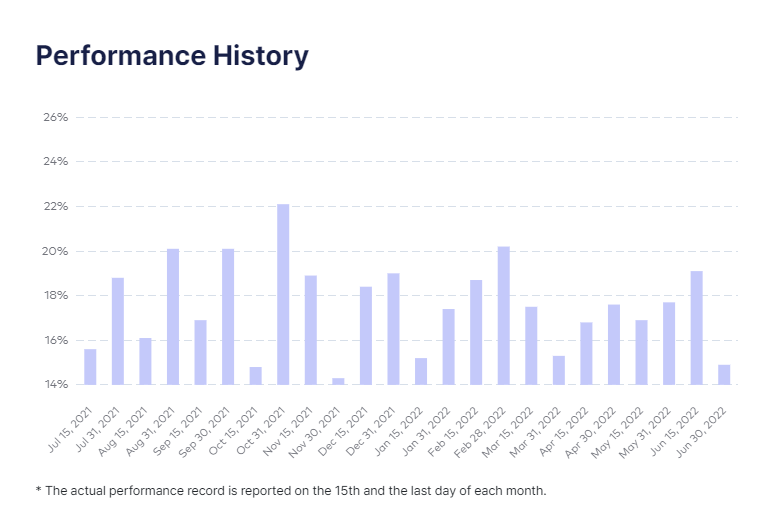
Alternatively if you’re diligent enough, you could track exactly what their yield rates were paying out going even further back (or at least closer to when they first started years ago), all earnings posted on medium.com/haruinvest.
Transparency and Risk:
Even though I think it’s great that they show regular updates on earnings and performance, in the time of this bear market, it’s hard to believe that any platform is able to generate 20%+ returns on stables and bluechips without taking a significant degree of risk. Therefore, it was no surprise that probably the major theme of their recent AMA done in June was flooded with questions asking for more transparency, especially with risk mitigation. I invite you to check it out yourself, but in a nutshell, although they didn’t reveal the exact process of how they produce their yields, they did highlight some things that put me a bit more at ease, but also some things that made me want to ask more questions:
Haru’s has no interactions with other DeFi or CeFi platforms— this means no lending out to people like 3AC, no exposure to any stETH holdings or staked ETH, and no interactions with protocols like Anchor. However if you do check out their weekly posted Earn Rates they did have exposure to KRT on the terra ecosystem, this however was discontinued in August 2021. The reasons behind the delisting was because they saw “serious risks when [they] looked into it. [They] felt that UST lacked reliability vs. USDT so [they] focused on USDT.” (Good move I must say)
Haru hasn’t been independently audited, but they do have some compliance and controls in place — reportedly not a single person with Haru Invest (not even the CEO) has full control over transfers and how assets are allocated are moved. In addition as an “Approved Fund” with the British Virgin Islands, they are they are bound to at least some regulations. It appears that they have done public audits based on their TradFi/Fiat-side of business, but not the Crypto-side; however, Hugo Lee indicated that there were conversations with auditors, but finding a specific audit for their business model was “extremely difficult.”
How does Haru make money? — This one is quite transparent, and it’s through fees. And to clarify, their moneymaker isn’t off of withdraw fees (which are .0001 BTC, .005 ETH, or 1 USDT), but instead they shave off interest earnings from their “Earn Explore” options where take a 15% fee off of your total profit if you earned greater than a 15% APR return. Conversely, if you earned less than 15% APR, then there is no fee.
Haru takes user funds and create yields off of algorithmic arbitrage trading — This is perhaps where the least transparency is, but ultimately Haru makes deals off of algorithmic arbitrage trading over multiple different derivatives exchanges and hammering the efficiencies of the market. This also is fundamentally why they are most likely able to be so consistently profitable both in bull and bear markets. In other words, it doesn’t matter if $BTC is at 40k or 20k, it only matters that there continue to be market inefficiencies across different exchanges that they can capitalize on. Assuming this is true, this is why it actually makes sense when the CEO says that “the biggest risk for Haru Invest is the total collapse of Bitcoin and Ethereum” — in other words, if they had no price action going to zero, at that point Haru wouldn’t be able to capitalize on any market inefficiencies.
Not your keys, not your crypto — this is of course the biggest risk. If you’re like me and currently have funds locked up in CeFi platforms such as Celsius or Voyager, you’ve already learned just how big a risk not having control of your assets is, and trust me, I know it sucks. Learning those lessons moving forward, that’s why you can probably tell (if you’ve made it so far in this article) why I’ve done so much research on every platform/cryptocurrency I’ve contemplated going into. That being said, does doing homework negate all risk? Of course not, so I know that this is a deal breaker for some. However, as I’ll get into more detail in my next section, I’ll lay out why Haru I personally have decided why it might be worth the risk.
Haru has 5 different ways to earn
Haru has 5 different sets of rates at which you can earn yield: the Haru Wallet, Earn Plus, Freeze, Earn Explore, and lastly Switch. As I go into detail for each one, each plan has their own published performance history for their earnings across the last 12 months. And as you’ll see, they actually do publish rates at times when they go into the red, which for me gives a little bit more credence to the data.
Haru Wallet —is the lowest plan which has no withdrawal penalties or lock-ups. These are the current rates at time of writing, and can change (albeit minutely) every bi-monthly period:

These are definitely the lowest risk because there’s no lock-up period, but I personally don’t think that these rates alone would want me to invest in Haru — there are just too many other options with equal or less risk that offer much better returns.
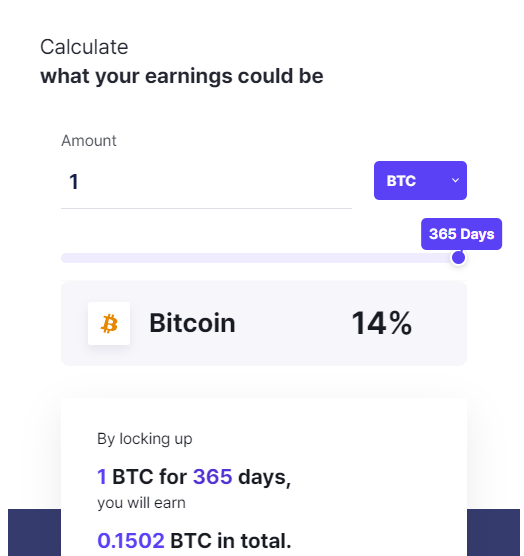
Haru Earn Plus — is the next level-up on the degen spectrum. Haru Earn Plus allows the user to earn a rate that corresponds with the designated amount of time (15–365 days) they are willing to lock-up their BTC. By using their earnings calculator, you can determine to the exact day and the exact interest rate you are wanting to accrue. For example by locking up 1 $BTC for 1 year, you could earn 14% APR, or accrue approximately 0.1502 $BTC:
From what I’ve gathered, although your principal is locked up, your earnings are withdrawable, or alternatively you can choose to compound them. Also a final consideration about the Earn Plus plan is that they actually make a guarantee on your initial principal. Now I’m not sure what this “guarantee” is necessarily backed by, but this guarantee is not given to the Earn Explore plan.
Freeze — The Haru Earn Plus plan connects with the newest (and my most favorite) feature of Haru, and that’s with the Freeze marketplace. Basically if your funds are somewhere in that 15–365 day lock-up period you can place your liquidation price on the “Freeze” marketplace with hopes that someone else is willing to buy you out at your set price. Therefore, not only can you buy crypto at essentially a lower price, but you can earn interest on top of it too! Here are some examples of ones that have been recently bought up:
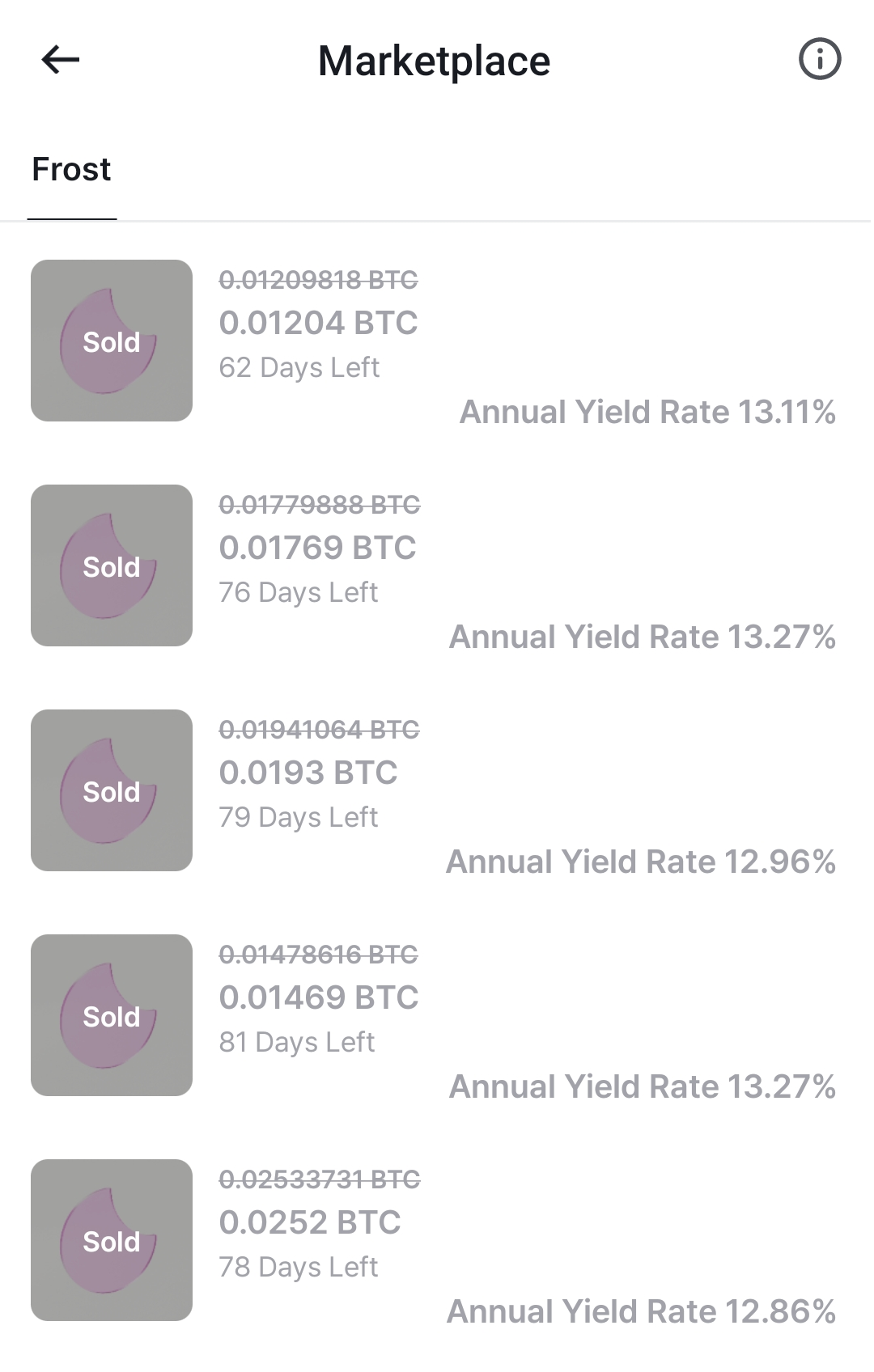
One thing to note is that for some reason, the Freeze feature is only available on the Haru mobile app, and not the actual Haru website. Also, if you do decide to put a list price for a holding you want to liquidate, be extra careful you don’t end up like this guy who accidentally listed a 2457 $USDT holding for 49 $USDT. #fatfingerssuck
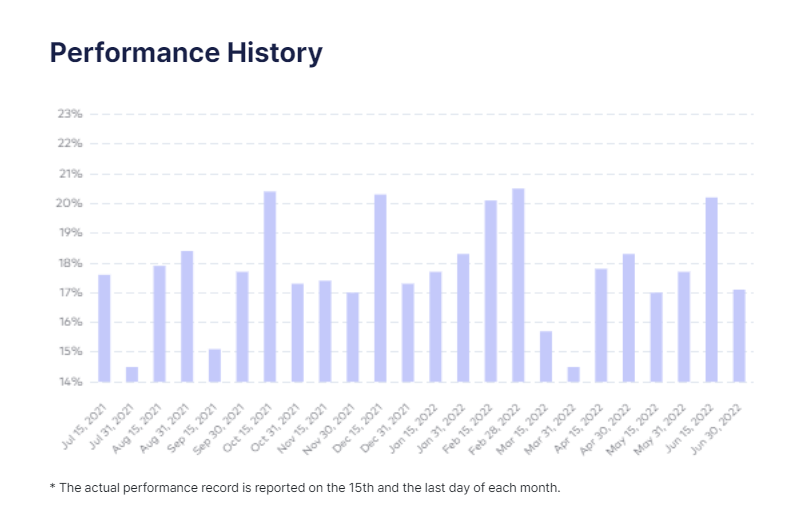
Earn Explore — is the plan that appears to be the most degen (and the most lucrative) plan for it has the highest rates that I’ve seen for any large CeFi platform. There are three separate strategies, one for $BTC, $ETH, and $USDT — all of which have had varying interest rates over the past year. $USDT’s “Start Surf with the Volatility” strategy has produced a range of roughly 14% to about 21% as seen in the performance history chart below:
Other ways that Earn Explore differs from Earn Plus are that the lock-ups are not eligible to be liquidated through the Freeze Marketplace and also, they are at different set term limits — both $BTC and $ETH are a minimum of 3 months and $USDT is for at least 1 month. The reasoning for the lock-up periods for which they explain are because it’s hard for Haru to be profitable when funds are continuously deposited or withdrawn on a massive scale. This reasoning reminds me of Yield Nodes’ initial 6-month lock-up period, for they cannot have a sustainable business model if they continuously have to keep winding down nodes if people keep unexpectedly withdrawing funds.
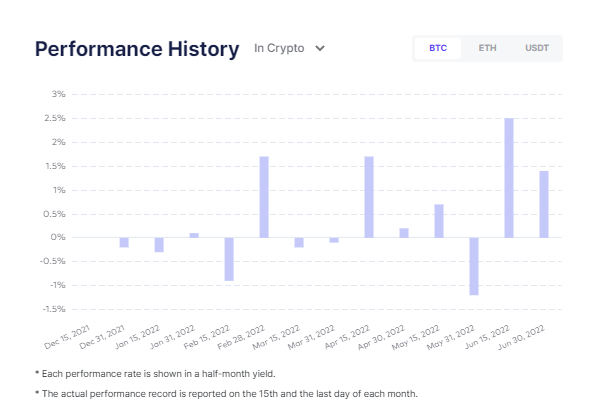
Switch — is from my understanding is Haru’s version of swapping, where users can profit off of liquidity pools. And like most LP’s, they are most likely subject to impermanent loss which explains why some months have a negative interest rate:
Other things to note about Haru
KYC — All investors are required to go through a KYC process. I myself, had some problems with my KYC, but after getting some things cleared up, I was able to get mine done in minutes.
Customer Service — They have an in-app live customer chat service (which is what helped me get through KYC). The chat does not work on the weekends unfortunately, but besides that I found them to be pretty helpful and responsive.
South Korea has had some threats with crypto-regulations — There’s been a great deal of controversy around crypto in South Korea lately, and I would imagine this is one of the reasons why they do 100% KYC. As more regulations get passed, I would imagine that as a result of Haru’s employees/operations in Korea, there might be some unintended consequences. That being said, South Korea’s newest president is said to be very crypto-friendly so I imagine that there won’t be any significant changes for at least the immediate future.
Affiliate Program — For all the rates I mentioned, if you sign-up through a referral link (here’s mine), you can actually get a boosted earning rate of 0.2%. From what I’ve gathered, this is still in testing so I don’t know how long or how good that boost will last. But this also leads me to my next item…
These rates won’t last forever — in the AMA with Hugo Lee, this possible reduction of rates was explicitly stated on more than one occasion, especially if Haru continues its rapid growth. Basically with the greater amount of funds they have to manage, it requires more resources to maintain standards of security and relative operations, resulting in profits that will not be as high as they are today.
User complaints — from what I could see, the only complaints had to do with user error (like the guy that sold off his USDT for cents on the dollar) and also with problems getting KYC’d. Additionally their TrustPilot record is probably one of the better ones I’ve seen, standing at 4.9 out of 5 with hundreds of reviews.
Conclusion, TLDR
Haru Invest has shown some meddle by being able to survive the 2020 bear market and also continuing to be able to survive the current one. Using an algorithmic trading strategy they advertise that they are resistant to bull or bear markets, which looking at their documented earnings record, seems to hold true.
Are their exact methods transparent? No, but it makes sense to me that with algorithmic trading, it would not only be hard to do, and I imagine that it also would put them at a disadvantage to their competitors — none of which are offering comparable rates.
Have you been involved with Haru Invest? If so, I’d love to hear about it and any issues/successes you might have encountered in the comments below. And if you aren’t signed up, please consider using my referral link: https://app.haruinvest.com/signup?r=CryptoWith so that you can get boosted earning rates while at the same time supporting my blog.
And as always, thanks again for reading, and if you haven’t already, be sure to follow me on twitter to get all my latest updates: https://twitter.com/CryptosWith
Disclaimer: None of the content within this article is meant to be financial advice. Please do your own research and/or contact a financial advisor to find what investments might be best for you.





