
Many projects have injected with life following the ICO year of 2017. That was when blockchain technology really started to take off in the public’s eye and people began seeing potential for all sorts of applications.
They also saw potential in improving on the contemporary design paradigm of blockchain networks, ushering in the age of “next-generation” blockchains. Yes, you could argue that many next-gen blockhains were built before 2017, but many of them undeniably came to the fore during that year.
These were projects that wanted to improve upon things like consensus mechanisms, scalability, governance, liquidity, interoperability, and, yes, the use cases themselves. By changing the fundamental way the blockchain operates, they thought, they could make the blockchain more suitable for different applications.
While it is still very early days for these projects, which have a lot to prove as they are attempting to operate alongside many networks that have been around for much longer, and are thus much stronger.
Just imagine these newer networks competing with Bitcoin and Ethereum. They’ve got to be something special, right?
One of these projects was Tezos (XTZ), a project with a large market cap (it’s in the top 10), that has experienced both hype and drama. I’m going to look at the project, what it does, whether it’s distinct purpose will sustain it through the future - i.e. I’m going to explain whether it’s a good investment or not.
What is Tezos (XTZ)?
So Tezos (XTZ) has quite a bold tagline that gives the impression that it is working on something really important - it’s “a self-amending crypto-ledger.” Right off the bat, it tells us something that is “better” and “new.”
What does a self-amending cryptoledger actually mean though? And why is it any better than a non-self amending crypto-ledger?
By self-amending, the Tezos team means that the network makes upgrades and governance decisions quickly and seamlessly. These amendments take place in stages, with changes being submitted to the blockchain and open to voting after. If a change is approved, it is automatically implemented in the network.
This modular element of the project makes incorporating new technologies and solutions easier, allowing network stakeholders implement code seamlessly into the future. The team has combined with this an invoice mechanism and high grade smart contracts that undergo rigorous audits and are secured by mathematical verifications. The team has summarized the agenda of Tezos as follows: “Smart contract safety, long-term upgradability, and open participation.”
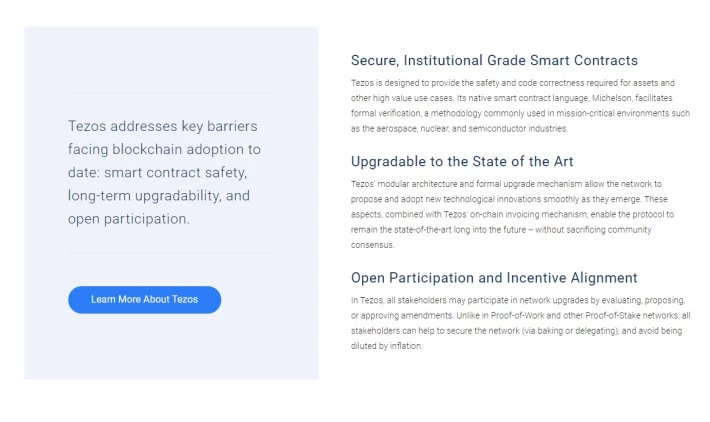
That’s all great, but you also need to know why it’s better than other ledgers? Well, there’s a clear use for enterprises and institutions here - having a self amending ledger that can be designed to implement changes without incurring a fork is useful for companies who are building something at scale and with the long run in mind. I’ll talk about the applications and potential later.
So it could be a big then and that’s why it has generated quite a bit of hype. The project conducted its Initial Coin Offering (ICO) in July 2017 and was at the time the most successful ICO, raising $232 million.
This was the beginning of a troubling period of legal trouble and delay for Tezos.
A Massive ICO, Followed by Internal Disputes

ICOs are a bit of a double-edged sword for issuers. Yeah, sure, it’s a great way to raise funds quickly - but easy come, easy go. Many projects have been subject to legal investigation and general scrutiny after their ICOs, largely having to do with projects not keeping their promises - and the most disingenuous of this bunch are just outright scams.
Tezos’ post-ICO incidents are a little different. The owner of Tezos’ intellectual property, Arthur and Kathleen Breitman, and Tezos founder and president Johann Gevers, were involved in a major dispute, which led to Tezos’ launch being delayed indefinitely.

The news made quite a few headlines and generated quite some controversy. A project that received a lot of general support and investment was suddenly on hold. This led to some of the project’s investors filing a lawsuit against Tezos, alleging that the XTZ tokens were securities and, being so, required registration. Which it didn’t have. The investors wanted a refund on their purchase, that’s all.
Some had even called this “the biggest scandal in the crypto world.” The Breitmans and Gevers seemed to be initially satisfied with the relationship, but things started to pile up. Multiple small disagreements and incident wore on the relationship, according to the Wired article. Generally speaking, it seemed as if the Breitmans were not happy with how Gevers was running the show. The disputes included hiring choices, besides the management of expenses.
Eventually, things came to a boil. One board member even quit because of the internal disputes. Gevers resigned from the board eventually, along with another board member, being replaced by community members Michal Mauny and Ryan Jesperson.
That led to the end of the saga, and now all attention has turned to Tezos’ ability to live up to its promises.
Is Self-amending Ledger Just a Fancy Term?
Tezos’ promises are basically three things:
- Governance through open participation that lets any vote on proposals,
- Smart contract security through formal verification
- Long term upgradability
The modular nature of Tezos means that developers can simply propose changes and users can stake tokens to vote on the change. The network uses a Proof-of-Stake (PoS) algorithm and the process by which users stake tokens is called ‘baking.’
Tezos’ consensus mechanism is similar to the Delegated Proof-of-Stake (DPoS) mechanism in that users can delegate voting rights to others, but this is optional.
The point of this system is to avoid all of the hassle that comes with forks, especially hard forks. The community can even test and evaluate the proposal, and make decisions accordingly.
I won’t go into the technical aspects of how smart contracts are more secure on Tezos, but basically the programming language that Tezos’ smart contracts are written in are secured by the formal checks imposed by the language (which is Michelson).
How Does it All Come Together?
That’s all very interesting right? But how can Tezos put all of that together and grow into a large, reliable network in which developers and companies actually make use of its benefits?
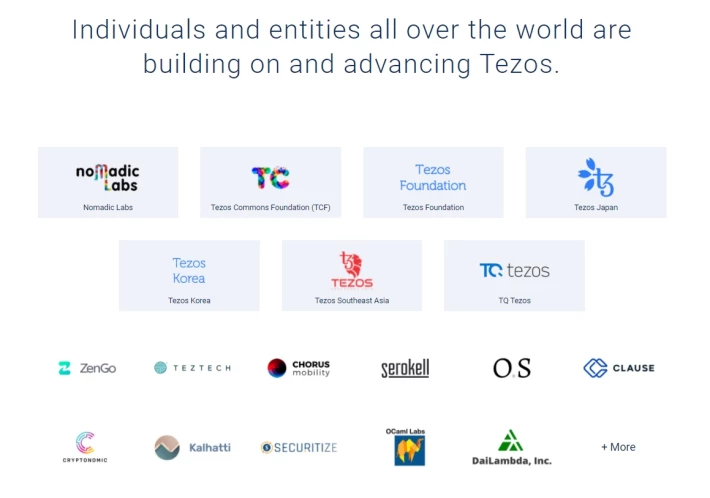
So far Tezos has already attracted some companies to work on the network and strengthen it. This includes Securitize, a major name in the digital asset securities space.
Tezos is also keen on working with governments and to that end has actually secured a partnership with a Singaporean platform called Tribe, which has been backed by its government. The collaboration will see a training program launched on the Tezos blockchain.
Security Token Offerings (STOs) seem to be another major application. Tezos and tZERO are working together to launch nearly $650 million worth of UK real estate on the Tezos blockchain. Similarly, Securitize is working with Tezos. Elevated Returns, a financial group that focuses on tokenization, has also migrated from Ethereum (ETH) to Tezos for the purposes of tokenizing $1 billion worth of real estate.
Tezos is definitely making a mark in the space and many projects and companies seem to think that it is a viable blockchain for their purposes. This will be heartening for investors to hear, as people do seem to think that Tezos’ properties of governance, self-amendment and security make it a good choice from a technical standpoint. Tezos wants to have a reliable infrastructure for Decentralized Applications (DApps)
I recommend reading the Tezos whitepaper for the nitty gritty on the technical aspects of the project.
Price History

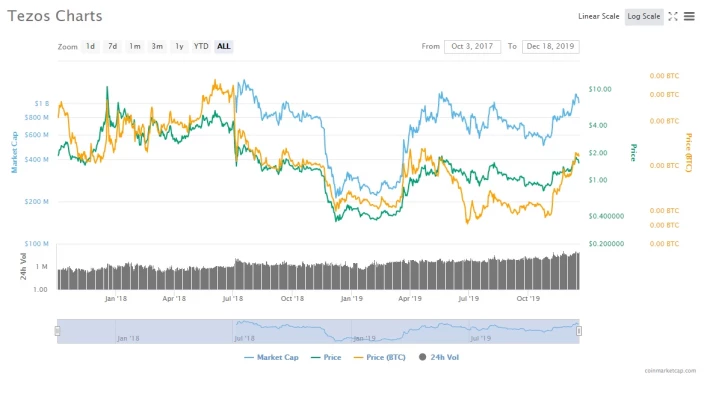
The XTZ token is currently priced at $1.56, though it was as high as just under $12. That last happened during the great spike of 2017 (those were the days!).
Since the drop-off in prices, the token has declined in prices, before settling in the $1 - $2 dollar range - and it has been this way for the past 6 months or so. The token did take a few noticeable price dips since 2018.
The token is traded on major exchanges, including Binance, OKEx, Coinbase Pro and Kraken.
Where Could Tezos (XTZ) Be in 5 Years?
This answer to this question will a lot assumptions supporting it. Will Tezos function reliably as a blockchain that enterprises can use? Will it come to be overtaken by other projects, which have been around longer and are also the recipient of improvements? Is there something really special in Tezos’ protocol, special enough that it will be a viable platform in the future?
It’s still in the top 10 by market cap, which is something, given the delays and the struggles that it has gone through. People still seem to believe in its goal and technology, at least to some extent.
Tezos is building a secure infrastructure for DApps to flourish, and because of that, a large part of its success will come from developers building on the network and the ecosystem flourishing. There are signs of this already, but not enough for investors to get giddy. Ethereum is the runaway leader when it comes to this, with many big names incumbents working on Ethereum-based solutions.
Sure, it’s easy enough to say that novel governance solutions and changes to the way a blockchain is designed will have a great impact on the market. But can you say which ones?
Tezos’ governance system, smart contract security and self-amendment features are strong, attractive features that are deserving of attention, but it will have to demonstrate itself going forward if it is going to remain one of the biggest cryptocurrencies, or else go bust.
Conclusion
Then should you invest in Tezos (XTZ)? Well, it depends on your risk appetite.
Bitcoin (BTC) and Ethereum are easy investment choices - they underpin so much of the cryptocurrency market that they are no-brainers as investment choices. Going forward from there, it’s generally good to choose projects that are doing well in solving very specific problems. Ripple (XRP) for cross-border payments, Zcash (ZEC) or Monero (XMR) for private transactions, MakerDAO’s MKR and DAI for Decentralized Finance (DeFi), and any of the decentralized cloud computing or supply chain projects.
Tezos is in a more speculative category. You’re betting on whether this could become a network that developers flock to and one rich with features that support DApps. There is potential here and pitch is good on paper, but you really want more evidence before you commit your cash.
If your willing to diversify your portfolio with such assets, and are willing to do due diligence with respect to monitoring development and growth, then perhaps Tezos (XTZ) could be a suitable investment. You have to make the call for this one.





