
Last weekend was an interesting moment in the cryptosphere: according to some tweets, a degen was "about to be liquidated for more than the on chain liquidity on $FTM", which could have resulted in "bad debt & slow/failed transactions on chain".
Due to this FUD, FTM dumped before boucing back a bit later. What was the risk that Fantom blockchain and its coin disappeared? Could it happen with other blockchains? Let's have a look at a few parameters:
1) TVL (Total Value Locked) of DeFi blockchains
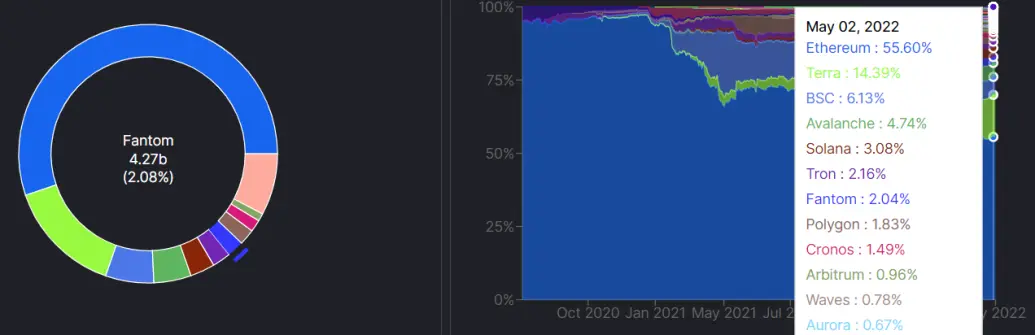
As you can see on these graphs from Defillama, Fantom TVL looks huge but it is only 2% if the total TVL, which is ultra-dominated by Ethereum:
- Terra is #2 due to Anchor protocol and high lending rewards on UST. However, as the rewards are progressively decreasing, TVL will decrease too
- BSC is still #3, despite all the competition around. So far, it is still the best option to trade and farm tokens from various blockchains and protocols
- Avalanche is #4 and represents twice the TVL of Fantom. It seems Avalanche attracts more investors due to enhanced security and decentralization
- Solana is #5 which is better than Fantom and is more decentralized. However, Solana has already suffered from several outages, with FUD around
- Polygon has a smaller TVL than Fantom, but benefits from the positive aura of Ethereum on top of which it is build as a sidechain, giving credibility
- Arbitrum is still very small in TVL but benefits from Ethereum security of which it is a real layer-2... And they might launch their token like Opitmism
Nothing can be concluded from these figures. However, it might be worthwhile to take into account the risk of investing into a blockchain with a small TVL which does not benefit from Ethereum security, i.e., all the layer-1 blockchains with small TVL - e.g., Solana, Tron, Fantom, Cronos, Waves, Aurora...
2) Consensus algorithm
The most popular consensus are proof-of-work and proof-of-stake. Altough Bitcoin and Ethereum use both proof-of-work, which gives them the highest level of security, most of the other blockchains use proof-of-stake, and Ethereum will soon use proof-of-stake too. It is theoritically less secure, but it is more scalable and environmental friendly. The risk is that a state or bad actor takes the control of the blockchain by staking more coins that all the other ones. To prevent that risk, more decentralization is required, and hence more validators for a given blockchain.
3) Number of validators
The number of validators is the key factor to estimate the level of decentralization of a blockchain. The more validators, the more secure the blockchain:
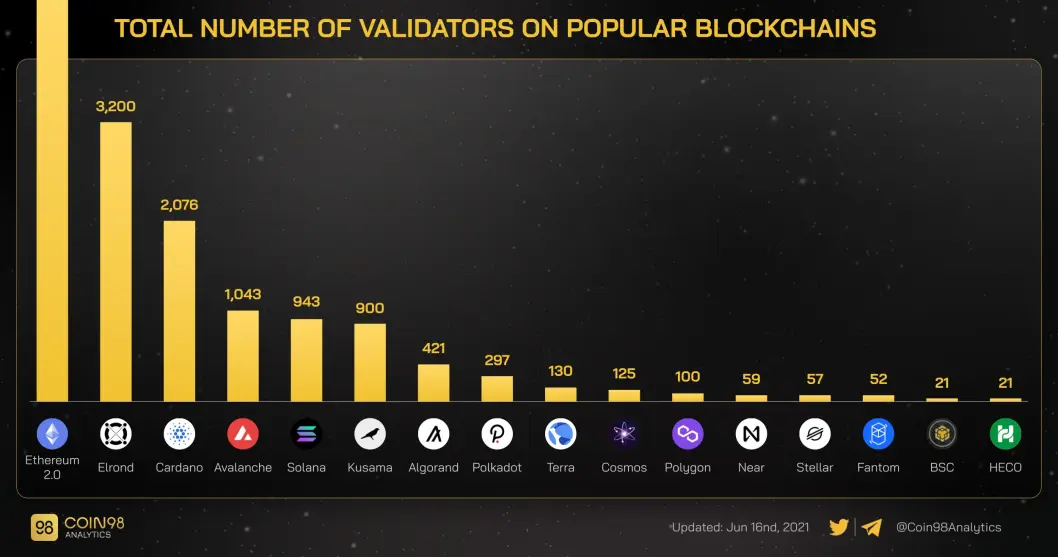
Although the situation has a bit evolved since this graph was done, the orders of magnitude are still the same:
- Ethereum is the most decentralized blockchain, except Bitcoin.
- Elrond appears surprisingly as the #2, due to sharding
- Cardano is the #3, but has almost no TVL (see above)
- Avalanche is the #4 and still growing
- Solana is the #5... when it works
- What is suprising is to see some of the highest TVL blockchains like Terra or BSC with only around 100 validators or less...
In summary:
By looking at the TVL and number of validators, the most reliable blockchain seems to be Avalanche apart from Ethereum.
Elrond could be a good option due to sharding technology helping decentralization but needs to get more developers to build dapps. The BSC has still to improve decentralization. Regarding Ethereum sidechains or layer-2 like Polygon or Arbitrum, they benefit partly or fully from Ethereum security.
The biggest issue is for the layer-1 blockchains like Fantom which are not decentralized enough and still have a small TVL. They have to grow in order to make sure that they cannot die from a big liquidation or from massive withdrawals due to the FUD.
Below a few referral links to earn more cryptos...
- Elrond: earn $10 EGLD
- Helium Staking: 10% referral discount
- Helium Rent: earn HNT by renting a shared hotspot





