
Some people prefer quest/points airdrops because they know what to do. However, in these cases, they are small airdrops, unless there are activities that are "prohibitive" for the average user involved (think for example LP/swap of a certain size). Let's start from the assumption that there are 3 large categories of airdrops:
1) Tiered distribution (these are the best airdrops: tokens are distributed in certain ranges. For example, volume from 1k to 10k: 30 tokens, from 10.01k to 50k: 200 tokens, etc. Number of transactions from 10 to 30: 25 tokens, from 31 to 50: 70 tokens, etc. Each criterion considered will have a quantity of tokens that are then added together). Some examples from the past: Uniswap, 1inch , Paraswap, Forth, Arbitrum, Optimism, Jito Network, Tia, Jupiter, Zksync, Starknet, Avail, etc
2) Linear distribution (what you receive is proportional to total points or fees spent. These are not real airdrops but the old Yield Farming of DeFi 1.0. Simply with the old Yield Farming, your LP generated fees + tokens with a certain APR and you could dump it, day after day. Today you do not receive day after day but everything together after 1 year and the APR is not known). Some examples: Mode, Blast, Aevo, EtherFi (however there was a minimum number of tokens for small holders), Eigenlayer (similar to EtherFi ), Lightlink, Zircuit, etc
3) Fairdrop (in this case, all addresses take the same amount of tokens. If you made 30 transactions or 200, if you made 1k or 1 million in volume, if you had $30 in stake or 50k there is no difference). A similar example was Stargaze ($Stars) on Cosmos (although there was a band system that allowed to increase the number of tokens received respecting more criteria but in each criterion, all eligible, received the same airdrop)
WHICH AIRDROP TO GIVE PRIORITY
What type of airdrop to give priority to? First of all, funding tells us the target (where there is funding there will be a token).
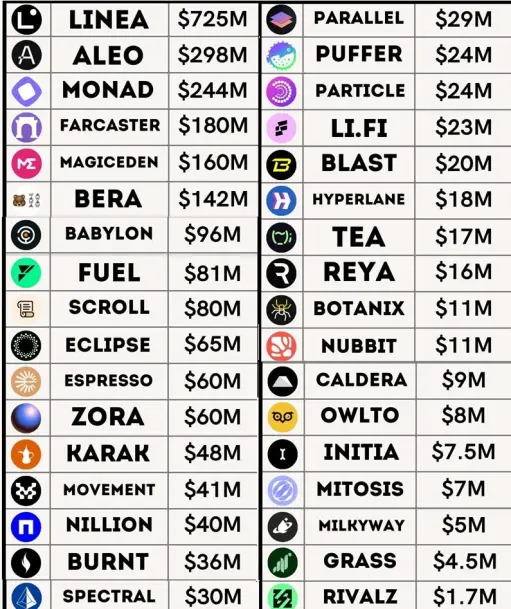
A clear example is Hyperliquid that gave away 10 billion dollars for 200k addresses, without VC and funding. I received 3500 $Hype (today each is worth 32$. Unfortunately I sold it, too early). The size of an airdrop does NOT depend on funding (which however influences listings on small/medium/large exchanges) but on:
1) Eligible addresses (the fewer addresses there are, the larger any airdrop will be)
2) Supply dedicated to the airdrop ( usually 10-20% of the total supply)
3) Circulating at TGE (if it is 100% community or if there are tokens at the team/VC immediately unlocked. 100% at TGE is the ideal situation!) You have to find the right compromise: generally where there are very few addresses it means that that protocol has little "hype" and will generate little volume/fee. Where there are many farmers/hunters, it will be very diluted (so it will be on average small)
Protocols to farm in order of importance and some examples (the first ones on the list are on average the most fruitful):
1) Chains (better those not based on points)
2) Dex (usually AMM have a market cap about 50-100 times smaller than the chain where they operate, however they give good satisfaction )
3) Dex Aggregator (they generate less fees than dex, however they have a simple infrastructure to build and earn fees through the various routes)
4) Bridge and Bridge Aggregator (if based on volumes/activities they do not use linear distribution; those that give points are less good because they will most likely use linear distribution based on the fees spent/number of bridges: this favors spammers/bots)
5) Perps/Future Exchange (now all give points, however the advantage is that there are few addresses using them. However with points + linear distribution you could receive dust with low volumes!)
6) LRT/LSD (I'm not talking about drugs but about restaking! The use of points makes these drops generally small if you are a small holder but it also applies to Whales: they receive large amounts but keep a lot of liquidity deposited for a long time)
7) Staking On Chain (some chains, due to how they are built, guarantee airdrops to stakers. The main example is Cosmos Hub so $Atom, $Tia, $Saga, etc. All distribution methods are used: tier airdrop, linear distribution or fairdrop. It depends on the project)
8) Liquid Staking (in this case it is very likely that a linear distribution proportional to what you have in stake will be used, however there can be noble and beautiful exceptions such as Jito Network that using tier distribution gave a minimum airdrop of 15k)
9) Lending/Yield Farming (they use linear distribution are not true airdrops and are proportional to deposit time and liquidity)
10) Stakedrop (these airdrops are those of validators for example. An APR is simply applied to your staked amount. An example? Staking on some $Atom/$Inj/$Tia node validators or launchpool on Binance)
11) Testnet (If you have no funds to use or fees to spend, you can try testnets which are free. Obviously in these cases it is very important not to have high expectations and evaluate whether it is worth wasting your time! If we exclude rare cases for example Aptos, these are airdrops where very little supply is dedicated (1-3%) because it is easy to create multi-accounts. Nowadays some projects require connecting Twitter/Discord to limit sybil attacks)
12) Giveaway (these are small gifts often with social quests. If a giveaway has a pool of 1 million dollars to divide by 300k users, you understand well that the average will be 3-4$ per address. They are NOT airdrops but small bonus)
Remember to use these dapps when they do not have points: usually "early" users are rewarded a lot!
Are you interested in ways to earn crypto bonus? Check it out here: Some Sites To Earn Crypto Bonus (Old & New)






