
TOKEN2049 took place in Singapore on October 7–8, 2026, at Marina Bay Sands. The event brought together approximately 25,000 attendees, over 250 speakers, and more than 600 side events. The general sentiment emerging from the conferences was that the crypto sector is shifting its priorities: there is less focus on purely speculative narratives and greater interest in integration with traditional finance, tokenization, AI agents and on-chain financial infrastructure. Below is a recap by topic, including a brief description of each and its implications for those following DeFi, trading e tokens.

RWA AND TOKENIZATION
Banks, financial firms, and crypto operators are increasingly engaging in concrete discussions about bringing stocks, bonds, real estate, and other assets on-chain. The true potential lies not merely in creating tokens, but in making them usable as collateral, tradable, and integrable into new financial products.
TRADFI
The presence of representatives from Nasdaq, Franklin Templeton, BlackRock, Morgan Stanley, and other firms highlighted a shift: institutions are viewing blockchain as an infrastructure to enhance their existing services.
AI AGENTS
AI agents could autonomously analyze markets, manage strategies, execute trades, and pay for services. Blockchain can provide programmable payments and transaction settlement. Key areas of discussion included DePIN, digital identity, and payments for AI services.
GLOBAL PAYMENTS
Stablecoins are increasingly viewed as tools for transferring funds, managing liquidity, and reducing the time and costs associated with international payments. There was also a debate regarding the use of USD-pegged stablecoins versus those pegged to local currencies, particularly for emerging markets.
DEFI
While the potential of DeFi is widely recognized, institutions demand greater security, reliable custody, transparency, and a robust operational track record. One potential evolution is "invisible" DeFi. DeFi that operates in the backend of traditional or regulated financial services, remaining unseen by the end user.
FINANCIAL "SUPER APPS"
Exchanges are aiming to become comprehensive platforms, offering spot trading, perpetuals, options, lending, savings, and payments. Competition is no longer just about fees and liquidity; it is about the ability to retain users within an entire ecosystem.
AI-DRIVEN HACKS AND ATTACKS
AI can assist both attackers and defenders. The importance of formal verification, audits, and more automated defense systems has been highlighted. A critical factor remains the human element: issues like phishing, scams, and user manipulation cannot be solved simply by improving smart contracts.
POST-QUANTUM CRYPTOGRAPHY
Discussions have focused on preparing blockchains for potential advancements in quantum computing—specifically regarding cryptographic schemes based on elliptic curves—including migration paths and concrete security upgrades.
ZK PROOFS AND PRIVACY
Privacy has also been addressed as a prerequisite for institutional adoption; businesses need to protect their data and transactions while retaining the ability to demonstrate compliance to auditors and regulatory authorities. Topics such as Zero-Knowledge (ZK) proofs, confidential payments, private DeFi, and verifiable identity have emerged.
REGULATION
The discussion highlighted differences between the United States, which is subject to greater political volatility and certain Asian economies, where the regulatory path may be more gradual but consistent.
CRYPTO NEOBANKS AND FINTECH
Banking services built on crypto infrastructure seek to integrate cards, payments, swaps, vaults, and yield-generating products. The potential advantage lies in a more efficient structure; the challenge, however, is identifying sustainable revenue models and focusing on markets where there is genuine, concrete demand.
INSTITUTIONAL FLOWS
Funds and institutional investors are adopting more structured approaches, including the use of ETF, derivatives, and longer-term positions. The report notes that buying on dips and employing certain options strategies could help reduce market volatility, though without eliminating the associated risks.
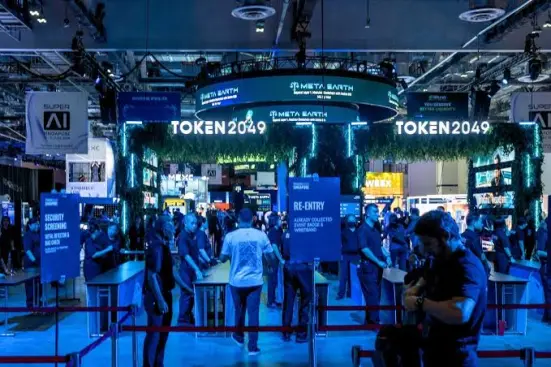
Key presentations and notable figures:
Jeff Yan (Hyperliquid): A fireside chat featuring the founder of the exchange, highlighting the role of decentralized perpetuals and on-chain trading platforms as a significant sector within the crypto ecosystem.
Shayne Coplan (Polymarket): A session focused on the prediction market sector, which combines event-based wagering, information markets, and economic incentives to aggregate user expectations.
Arthur Hayes (Flop Labs): Representing the macroeconomic and investment perspective, he discussed liquidity, financial conditions, and potential scenarios for the crypto market—including the role of AI agents.
Balaji Srinivasan (The Network State): Explored the concept of a "network state", online-organized communities that seek to develop their own institutions, economies, and forms of coordination, partly through the use of crypto tools.
Eric Trump (World Liberty Financial): His participation brought to the stage the intersection of crypto, new financial products, and key figures from the U.S. political and economic landscape.
Alex Svanevik (Nansen): The agenda included a talk on "agentic trading"—the prospect of AI systems analyzing data and markets to compete alongside human traders.
Personally, I find most of these topics interesting. Compared to a few years ago, there are fewer memecoins and fewer NFTs. As for NFTs, I actually see this as a negative, perhaps I’m just too nostalgic for 2021 and 2022, an era of total, unhinged "degen" activity centered around NFT. Beyond the purely speculative side of things, I believe NFTs could have interesting use cases for things like ticketing, gaming, and so on. Where I always take issue, however, is when the conversation turns to regulation; as you know, I don’t trust governments or any political party. Remember, everyone is looking out for their own personal interests: gaining control, getting rich, and collecting taxes.
Article always updated with all the possibilities of on-chain farming (airdrop): Some Sites To Earn Crypto Bonus (Old & New)






