
Thorchain is also referred to as Chaosnet. It is a cross chain dex that allows you to exchange native tokens. They are not synthetics or wrapped tokens. It was built with Cosmos SDK and Tendermint BFT as the consensus algorithm. Through this platform it is possible to exchange native tokens using the various blockchains supported on the protocol. Basically Thorchain is based on the AMM model introduced by Uniswap therefore with liquidity pools. These pools are composed of the token/Rune (Rune is the native token of Thorchain) 50 and 50%.
For example Btc / Rune, Bnb / Rune or Eth / Rune. All this serves to simplify the trades because it is possible to trade Btc with Usdt or Eth, passing through Rune. What is the difference with Uniswap or Pancakswap? On classic AMM there are more swaps to switch from one pool to another when the trade is executed. Obviously, to use these pools you have to expose yourself to Rune. The pools are located on two different chains: for example on the Ethereum blockchain and that of Rune. There is also a refund on the impermanent loss which increases linearly with the passing of the days (after 100 days I will have 100% protection against the impermanent loss, if I remove the liquidity after 60 days I will have a protection of 60%). Each vault on Thorchain contains liquidity of that blockchain:
- Bitcoin blockchain
- Ethereum blockchain
- Bnb blockchain
- Avalanche blockchain
- Fantom blockchain
- etc
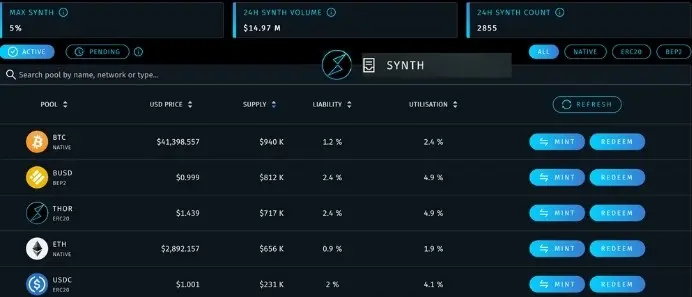
There are therefore interactions between one vault and another (inbound and outbound) when a swap is performed with an outbound transaction from the Bitcoin vault, validated by the Thorchain nodes and authorized to be transmitted to another vault (for example chain Ethereum). We will then have the passage of funds from Electrum (Bitcoin wallet) to Metamask (Ethereum). There will obviously be network fees. The nodes are called "Thornodes" and are secured by a bond in Rune by the validators. Validators must hedge liquidity in the various pools. Slashing leads to a loss of 1.5x of the malicious transaction value (if a $ 10,000 malicious transaction is validated, the validator will lose $ 15,000 in Rune).
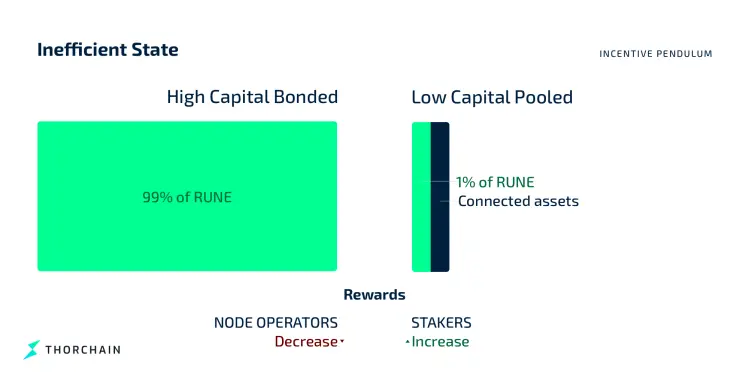
The hedging bond as mentioned is only in Rune tokens, they cover the various pools. If there was a lot of liquidity entering the Thorchain, these pools would be discovered by the nodes so in this case the staking reward on the validator nodes would be increased and the one for the liquidity providers decreased until it returns to equilibrium.
The "Churning" mechanism provides "reserve" validating nodes that take over from the active nodes, in case someone wants to close his node or is ejected from the network for malicious behavior.
The growth of the native Rune token depends on the "non-Rune" liquidity of the various pools: the more this liquidity grows, the more Rune are needed. I underline that Rune is used to complete the 50 and 50% pool and to cover the pools by means of the validator bonds. The bonds must cover 100% of the various pools: for 3 billion "non-Rune" liquidity you need triple Rune or 9 billion dollars (3 billion to form the pool and 6 billion to hedge it through bonds).
Are you interested in ways to earn crypto bonus? Check it out here: Some Sites To Earn Crypto Bonus (Old & New)






