
Mt.Gox was the first cryptocurrency exchange born in 2010 (founded by Jaled McCaleb and then passed to CEO Mark Karpeles) and which managed a large part of the volumes between 2011 and 2014. Then, as we know, in 2014, withdrawals were suddenly blocked, declaring bankruptcy after having announced that he had lost approximately 850,000 BTC, which was valued at $400 million at the time. Following the Mt.Gox bankruptcy investigation, data emerged that revealed an anomalous trading pattern. It emerged that a bot or entity called “Willy” had placed numerous orders to buy Bitcoin regardless of price, which made it appear that Mt.Gox was handling significant trading volumes. In reality, these orders were not backed by real funds and appeared to be an effort to simulate trading activity to attract additional investors. In fact, it seems that the exchange was already insolvent in 2011. The never-cleared theft of hundreds of thousands of BTC and the simulation of volumes were among the key factors that contributed to the collapse of Mt.Gox. It's important to note that the identity of whoever programmed Willy Bot remains unknown, and mystery continues to surround this episode. CEO Mark Karpeles was embroiled in a lengthy legal process in Japan following the collapse of Mt. Gox. During the trial, he was accused of embezzlement and fraud related to the disappearance of the Bitcoins. In March 2019, he was convicted of data manipulation and acquitted of embezzlement.
Investigator Kim Nilsson: “I went into the investigation basically imagining that Mark Karpeles was probably the bad guy, maybe he had fudged the numbers, maybe there never even was all the BTC that users had deposited. My initial theory was that, as some people also theorized at the time, maybe some of those BTC never existed. Maybe it was this bot that simulated volumes had messed up the accounting. Eventually, over time, as I worked more on the case, it became more obvious that, in reality there had been a Bitcoin theft. Apparently Mt.Gox had no money and over 650,000 and more likely 850,000 Bitcoins were missing. That was all that was known. In early 2014, a data leak occurred in where someone who apparently hacked Mt.Gox had gotten hold of some of their accounting documents and posted them online"
INSOLVENCY IN 2011 AND BTC THEFTS
The exchange was founded by Jaled McCaleb in 2010 but the handover to Mark Karpeles occurred shortly after. Prior to this, the exchange suffered a $50,000 exploit (Liberty Reserve) so Mark purchased the exchange minus this $50,000 that was stolen. Technically even then there were no funds to repay all customers, due to this hack. Shortly after, someone else broke into the cold wallets and stole another 80,000 BTC. Jed sent a message to Mark saying "Hey it seems that most of the BTC have disappeared", in reality Mark was not worried about it also because he received emails from Jed in which he provided some suggestions on how he could recover them by injecting further investments into the company or simply by transferring the debt into dollars, so that it does not increase if the price of Bitcoin rises, etc. So they were clearly both aware that the amount was missing and that there was a problem. So for some reason, they both thought it was a debt they could keep hidden and try to clear it later. At the time the theft occurred, the price of Bitcoin was close to a dollar or something like that. So, in rough numbers, 80,000 Bitcoin would have been around $80,000. Not an irrecoverable sum, far from it. But just a few months later, around June, the price suddenly rose to $30 per 1 Bitcoin. These 80,000 Bitcoins suddenly became a huge amount of money for which the exchange had absolutely no backing. So yes, that shortfall could have become a problem in the future but it became one much more quickly than feared. According to some investigators, the Willy bot was created for this reason, according to others its objective was not to eliminate the debt but simply simulate volumes to attract more liquidity.
Kim Nilsson: “Actually the Willy bot is a kind of collective term that encompasses all the manipulation, so to speak. There were two generations of the Willy bot that Mark was using. One was done manually and I think it started in 2011. Then at the end of 2013 he also created the automated version, which is the one that got noticed in public. I don't believe they were created to reduce debt. There were also additional accounts that were used to hold money seized from fraudulent customers and things like that"
Two months later, Mark had 300,000 BTC stolen from his computer (it was BTC from the exchange's customers). This would have decreed the end of the exchange already in 2011 but the hacker decides to return them in exchange for a bounty (a reward). Then in June the account of the former founder Jed was hacked and he still had administrator privileges (which allowed the balance of any account to be manipulated) so whoever did it entered his account, used these privileges and started to add tons of BTC to other people's accounts and sell them on the market, causing the price to collapse. In August, Mt.Gox decides to purchase the Bitomat exchange which was operating in Europe and was in difficulty, also absorbing the debt of 17000 BTC. In September, Mt.Gox suffers another theft of 77,500 BTC through the creation of temporary accounts that were then deleted. These BTC were then laundered on Trade Hill and BTC-E (which were the main money laundering exchanges at the time). The largest theft was that of 630,000 BTC from a hot wallet but it occurred gradually over the months/years of activity. Users deposited funds and these were gradually stolen from the server to which some hackers had gained access. These stolen BTC were then even recycled on Mt.Gox itself and on other exchanges including CryptoExchange. On the latter, some users had their accounts blocked because they came from the theft of another hacked exchange called Bitcoinica. Basically CryptoExchange interacted with Mt.Gox which was tracking all the stolen BTC on Bitcoinica (it received a kind of notification when these stolen BTC were deposited by them) freezing the accounts but ironically Mt.Gox did not notice which ones it was, little by little, losing. Alexander Vinnick (owner of BTC-E) was arrested for having laundered 630,000 BTC but there is no certainty that he was the author of the theft, more likely someone gave them to him so that he could recycle them on various exchanges (the BTC once deposited on exchange they are mixed with all those of other users and let's say that they lose track). The progressive disappearance of all those BTC from the exchange remains a mystery even today and the precise dynamics of the attack have never been clarified.
THE OPERATIONS OF WILLY BOT AND OTHER ANOMALOUS ENTITIES
Speaking more precisely about Mt.Gox bots, in December 2013, many traders began to notice suspicious behavior. Essentially, every 5-10 minutes, non-stop, for at least a month until the end of January 2014 the Willy bot was buying a random number of BTC between 10 and 20. Even though Willy was buying in a fairly recognizable pattern, he wasn't officially found in the Mt.Gox trading records which reached up to November 2013. With some data leaked in that period, it is clear that Willy did not have a single account but multiple user UID so the trading activities were spread across multiple accounts.
Kim Nilsson: “There appeared to be an internal trading bot on Mt.Gox that was exchanging money into Bitcoin. It was doing so in such volumes that it almost had to be simulated, perhaps using non-real money. It wasn't even the first time that people started to notice it. 'hey, there seems to be someone running trades at regular intervals' or something like that"
Basically it seems that, every time an account was created on the exchange, Willy spent an exact amount of USD to buy BTC on the market (the most common was $2,500,000), creating additional accounts. In total, a staggering approximately $112 million was spent to purchase nearly 270,000 BTC, most of which was purchased in November. It is no coincidence that in that period, BTC increased its value by about 10 times until it went to ATH at around $1100 in December 2013. Curiously, the first Willy account (created on September 27, 2013) unlike all the others had a UID anomalous user: 807884, as normal accounts at the time had a progressive number and only reached 650,000 or so. There was only one other account with a UID higher than 650000 and it was 698630 (active for 8 months and later called Markus by the investigators) and then deactivated 7 hours before the first Willy account became active!
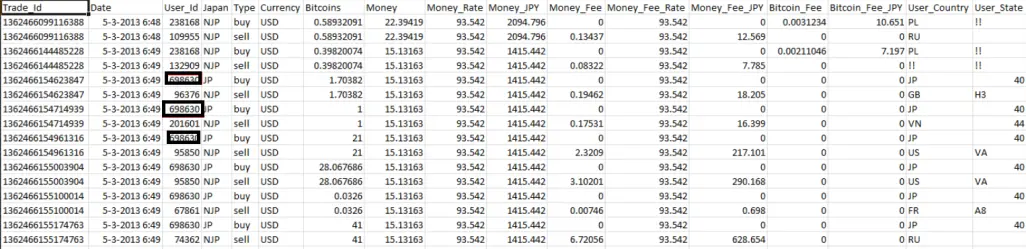
So it is reasonable to assume that these accounts were controlled by the same entity. UID 698630 actually had a registered country and state: "JP", "40" the FIPS code of Tokyo, Japan. According to various reports conducted by analysts, this account had somehow purchased tons of BTC without spending any money. Interestingly, this account sold every now and then and for some reason the price values in this case were correct. Its largest sale occurred on June 2. As can be seen from these operations: he sells a lot of BTC, receives $4 million, then buys back 15,000 BTC, spending very little.
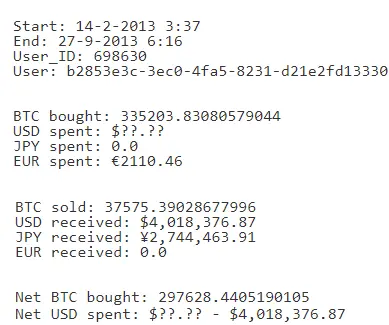
300,000 BTC are then purchased and combined with Willy's purchases, this is approximately 570,000 BTC. Although there are no trading records after November 2013, several traders observed that Willy was active for much of December 2013 until the end of January 2014. Although this occurred at a slower and more steady pace (around 2000 BTC per day ), should add up to approximately another 80,000 BTC purchased. So this is a total suspiciously close to the approximately 650,000 BTC supposedly lost. The simplest conclusion is that someone gained access to the system, was able to self-assign USD amounts at will to various accounts, and began purchasing and withdrawing remotely. After all, Willy's constant creation of new accounts appears to have been aimed at avoiding detection. However, there are things that don't add up to this theory; in fact there is a lot of evidence to suggest that all of these accounts were controlled by Mt.Gox itself.
For a few months in 2013, two versions of the exchange logs were present in the database leaked and then analyzed by the authorities: a complete log and an anonymous log with user hashes and country/state codes removed. As of April 2013, there was a ".zip" file that contained one of these anonymized logs - one use may have been to send it to auditors to show some internal data. Upon closer inspection, it turns out that the full, anonymized versions of all logs differ in two ways: user hashes and country/state codes have been stripped from the original file. The anomalous user UID (698630) is changed to a small number (634) and its strange fixed "Money" values (where no money appeared to be spent on purchases) are corrected to the expected values.
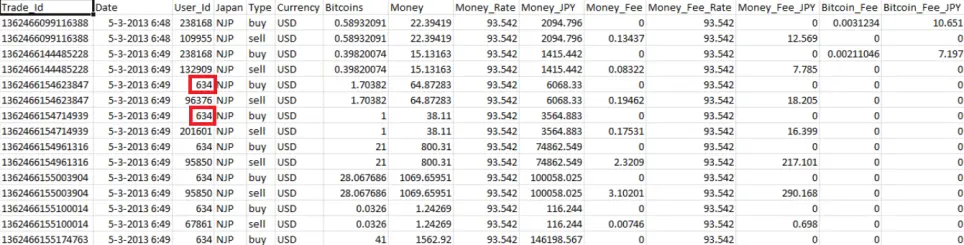
From the list of accounts leaked in 2011, the user with ID 634 appears with the username "MagicalTux". The "fixed" file has an earlier creation date than the full log, so it couldn't be a bug that was fixed later. Everything suggests that these values were changed manually, presumably to erase traces of suspicious activity. Although another possibility is that it is actually the opposite: the correct registry with the previous creation date was the original and all other registries were altered with a different UID not traceable to MagicalTux to cover fraud in a way rough (also someone forgot that there was still a zip file around with the data unaltered). Another interesting thing is that the bots apparently were immune to suspensions of operations (trading was suspended several times during the year due to regulatory problems in some countries, including the USA). In fact purchases of 10-20 BTC were found every 5-10 minutes at a time when no one else was able to trade, via API or otherwise, Willy was somehow able to continue buying as if nothing had happened. This makes it possible that the bot was running from a local Mt.Gox server. It's not impossible that a hacker managed to install some sort of rootkit on Mt.Gox's servers and run the bot from there, but it seems extremely unlikely. Furthermore, from the reports it seems that some users/bots with the initials "JP" did not pay commissions, even if it was reconstructed that these accounts had probably been compromised. By late 2013, customers were complaining about weeks, if not months, of delays in executing fiat money withdrawals (Mt.Gox also had regulatory issues in the US).
THE BEGINNING OF THE END (2014)
Willy probably continued to be active until the end of January 2014: buying 10-20 BTC every 5-10 minutes, for a total of 100 BTC per hour. It wasn't always active, but most of the time. January was when things fell apart for Mt.Gox; withdrawals were increasingly delayed, and faced with speculation that even JPY withdrawals (which had hitherto been instant) were experiencing unreasonable delays, panicked people began to withdraw en masse.
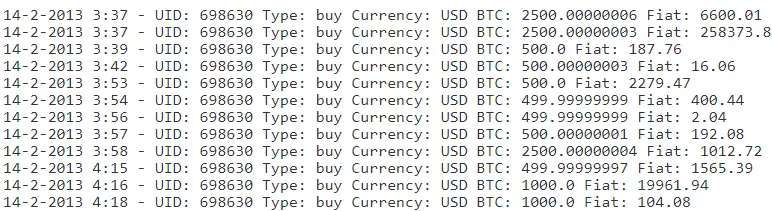
Combined with the fact that Willy was still active, this caused the spread between the price of Mt.Gox and the few other exchanges to get completely out of hand. At the peak, on January 26th, Willy suddenly became inactive, and with that, the price returned to a more reasonable spread with other exchanges. Shortly after, on February 3 to be precise, it seemed that Willy had started trading again but in reverse, or with a slightly altered pattern: he seemed to sell around 100 BTC every two hours. It didn't take long for Willy to pick up his pace. Most likely, the entire BTC dump at the time (Bear Market 2014) was caused by this bot dumping all the purchased BTC. That would be one of the explanations why none of Willy's accounts had a final balance despite all the purchases and there was no trace of BTC withdrawals: they were probably all put back on the market. The volumes seem to match more or less. Where did the fiat money go then? Perhaps they were used to buy the missing BTC and other assets (which however were stolen). JPY (Japanese Yen) withdrawals were stopped at the beginning of January, but all pending ones from previous months were also eliminated. This shows that the original reason for the delays (currency conversion issues) were nonsense; they just didn't have fiat anymore. Yet, somehow, they had enough fiat for withdrawals on the day they closed, i.e. after the dumps. But these are speculations. BTC withdrawals were suspended on February 7, 2014, the exchange complained about the presence of a bug that allowed the details of a transaction to be altered by deceiving the system (essentially a shipment seemed not to have occurred, even if it had been executed). On February 24, 2014, the site went offline and disappeared into thin air. According to reports, the exchange was insolvent after losing approximately 750,000 customer BTC and 100,000 of its own BTC (worth half a billion dollars). According to some rumours, there was talk of an exit scam.
CORRELATION BETWEEN BOT AND BTC PRICE IN 2013 AND 2014
As of February 18, 2013, it appeared that some bots had been programmed to sell at set price levels. If you check the bubble periods at the end of 2013 you can see a high intensity of purchases of Willy and the other bot 698930, the same thing when the dump then occurs in 2014 with the sales carried out by the bots. It must be recognized that, whether intentionally or not, Mt.Gox has injected hundreds of millions of dollars of false liquidity by manipulating the market with customer money. The price of Bitcoin subsequently deflated for about 5 months from its peak in December, as enough fiat money no longer arrived on the exchange to support these types of prices.
RECENT YEARS: 2014-2023
On March 9, 2014, the exchange files for bankruptcy with 850,000 BTC missing. CEO Karpeles was arrested in August 2015 by Japanese police and charged with fraud, embezzlement and manipulating Mt.Gox's computer system. After being questioned, Japanese prosecutors accused him of misappropriating $2.6 million in BTC deposited in trading accounts by Mt. Gox investors and transferring it to an account he controlled, about six months earlier that the exchange failed in early 2014.
In May 2016, Mt.Gox creditors said they lost $2.4 trillion when Mt.Gox went bankrupt, and demanded that they be repaid. The Japanese trustee overseeing the bankruptcy said only $91 million in assets had been traced to distribute to the claimants, despite Mt. Gox saying in the weeks before the bankruptcy that it had more than $500 million in assets.
In March 2018, trustee Kobayashi said that enough BTC had been sold to cover creditors' claims. On March 14, 2019, the Tokyo District Court found Karpeles guilty of falsifying volumes to inflate Mt. Gox's revenue by $33.5 million, for which he was sentenced to 30 months in prison. The Court later acquitted Karpeles of a number of other charges, including embezzlement and aggravated breach of trust, based on the belief that Karpeles had acted without bad intentions. At the creditors' meeting on October 20, 2021 it was announced that the civil rehabilitation plan was accepted by 99% of creditors (representing 83% of the total amount of voting rights) and that billions of dollars would be provided in Bitcoin as compensation. The plan was officially approved on November 16, 2021. On September 21, 2023, Mt.Gox announced that the deadline for finalizing payments had been postponed by one year and that the new promised end date is October 31, 2024.
Are you interested in ways to earn crypto bonus? Check it out here: Some Sites To Earn Crypto Bonus (Old & New)






