
Even if you've been active on exchanges (Crypto) and brokers (Forex/Stocks) for years, you should absolutely avoid copy trading strategies based on the profit-sharing model (the strategy creator earns a percentage of the profits generated by followers). First, because every trader has their own risk profile, and second, because if you want to trade, you should operate independently. The profit-share model is terrible (if you're copying) because the trader might not even use his own capital (or might use small amounts), "exploiting" only the profits from his network. Clearly, the strategist makes money if his strategy is profitable, but he might be encouraged to use riskier strategies since he earns a percentage of the profitable positions of his followers. If he doesn't use his own funds or uses small amounts, he's practically at zero risk: if the strategy is profitable, his followers earn, and he takes a percentage from everyone (be wary of any profit-share with commissions greater than 5%). If the strategy uses a stop loss or the account is liquidated, the losses are minimal or nonexistent.
FAIR MODEL?
Profit-sharing was born as a theoretically fair model: the strategist only earns if you earn.
However, the strategist could be incentivized to:
- He could earn even if his network is losing money (thanks to his small exposure and the percentages received from each trader under him).
- Take excessive risks to generate fast and aggressive performances (to expand his network).
- On the followers side, you don't know the bot and what strategy it is (whether it's a martingale, grid, hedging bot, brokerage, etc.).
These strategies attract followers with short, "inflated" performances and backtests that have little value. The big problem is that they take profit-sharing on every individual winning trade.
Many stop losses devastate followers, but the strategist has already cashed in if the strategy has worked for a few weeks. Technically, it's not a scam, but an unfair model, where only the person creating the strategy profits because stop losses, in similar markets and with similar strategies (small lots with increasing exposure), are inevitable. If the risk is medium or even high, the second stop loss practically wipes out their accounts.
Furthermore, as mentioned, many inflate returns by using short trades, small lots, and extremely aggressive positions.
TRADER EXCUSES IN COPY TRADING NETWORKS
The justifications some traders use to justify stop losses or account liquidations (unless there are macroeconomic events that could justify a counter-trend to their position):
- Broker error.
- Latency/server down.
- Market manipulation.
- Hacker attack.
These excuses are used to avoid losing the net (which brings the strategist the main profits) and, in any case, are much easier to implement than admitting that the strategy was overleveraged, involved a martingale, grid, or a losing hedge.
Parameters to monitor and red flags:
- Drawdown (should not exceed 20%).
- Excessively high leverage (small lots with huge, growing exposures over time).
- Flat curves ("slow grind up" strategy).
- Curves that are too regular and rise over time (up to the stop loss, which exposes the trader to large losses. They highlight microprofits, low drawdowns with latent risk that accumulates over time. Typical of martingale, anti-martingale, averaging down, and grids. While the curves rise steadily, the equity is usually "sawtoothed," a symptom of positions held until they turn profitable).
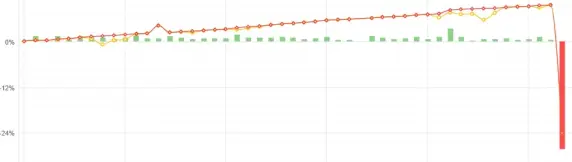
-Smooth equity curves (small but repeated drawdowns adjusted with averaging, small frequent profits. Averaging allows for profitability on most trades but exponentially increases risk, which materializes when volatility increases or the trend is strongly contrary; in these cases, stop losses are devastating. Mean reversion and "soft" grid strategies).
Sudden drops highlight accumulated risk resulting from grid trading, averaging down, masked martingales, and unhedged mean reversion strategies.
EQUITY AND BALANCE
When equity and balance diverge significantly, it means the strategy is holding many open positions, often at a latent loss. Balance only shows profits already closed, while equity shows the real value of the account, including open trades. These strategies are usually used to offset latent losses with small closed profits (typical of grid or martingale bots).
In practice, the system: locks in only micro-profits and leaves increasingly large losses open until the stop loss is reached. The larger and more persistent the equity-balance gap, the greater the risk of a long-term blow-up.
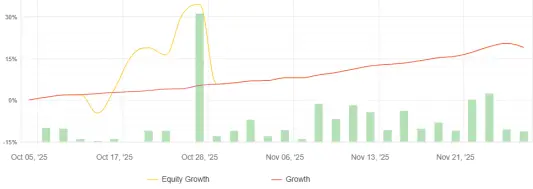
LADDER BALANCE: MARTINGALE OR GRID
Key signals: Small, frequent profits. Huge latent drawdown (much lower equity).
Lot size increases as the market moves against you. This is:
1) Martingale (if lots increase aggressively).
2) Grid (if lots are large but less aggressive).
The stop loss is usually absent or very wide.
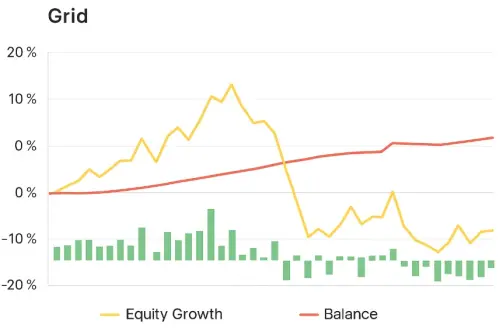
GROWING BALANCE WITH UNSTABLE EQUITY: HYBRID GRID OR HEDGING
Key signals: Open both long and short positions to "lock in" drawdowns. Equity moves up and down as the balance rises. The bot attempts to average in both directions. This is grid hedging: a more complex version, but with the same risk: ultimately, if the market goes into a strong trend, the account goes bust.
MULTIPLE STRATEGIES
When a trader has too many strategies, it's another huge red flag. Grid/martingale strategies are spread across variations, hoping that one or more strategies will turn a profit, for example, when the stop loss hits the third.
Are you interested in ways to earn crypto bonus? Check it out here: Some Sites To Earn Crypto Bonus (Old & New)





