
In this article we will see some Crypto trends and news for 2024. Not necessarily at a speculative and price level but technical news. Terms with which you will need to get used to knowing what you are talking about.
RealWorldAsset (RWA): I have already talked about RWA. This term refers to the process of representing real assets digitally. These can be physical assets (real estate, houses, buildings, beer, etc) or intangible assets (brands, copyrights, etc) represented digitally. This process is becoming widespread in Defi, especially on lending platforms, where entrepreneurs and companies can borrow crypto liquidity (to carry out their activities) and depositors receive interest (including on US Treasury government bonds). Another advantage is being able to buy a part of a property in which you want to invest but you don't have the liquidity to buy it completely. If you want to try Parcl (platform on Solana) you can trade "long" and "short" on real estate markets (mainly in the USA). Trades allow you to earn points (1 point/$1 for each open trade and 3 points/$1 for each USDC deposited into the LP pool). The points suggest that an airdrop will arrive for users. If you need an invitation code: rwabonuspoints (connect Phantom to the platform, create your account and add the code by going to settings at the top left, then referral and add the code. Your points will receive a 5% boost)
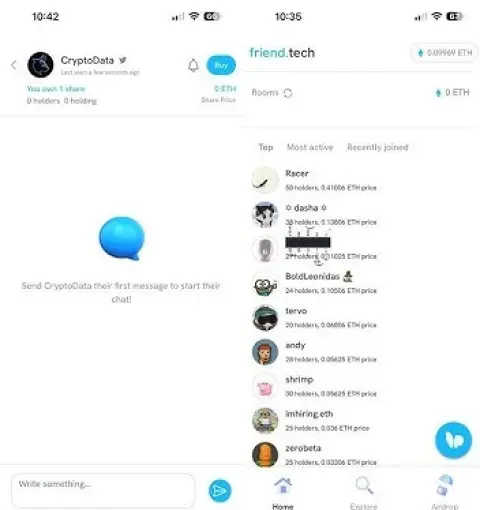
Account Abstraction: creating applications that support "invisible" wallets without the user realizing it. The structure is the same as that of a wallet but more user friendly, for those who have never had to deal with the world of cryptocurrencies. Examples of this type could be FriendTech (dapp on the Base chain that tokenizes profiles on.
Modular Blockchain: they are divided into separate modules that can be developed, updated or replaced independently of each other. These modules are designed to interact with each other consistently and allow for greater flexibility in managing the blockchain.
Since the various components are separated, it is easier to add resources or upgrade only the parts necessary to handle an increase in workload and therefore they are more scalable.
Modules can be upgraded or repaired without affecting other components, making it easier to improve the blockchain. They can be designed to be compatible with other systems and blockchains, improving interoperability between different blockchain networks. Separating modules can help isolate potential vulnerabilities and improve overall system security.
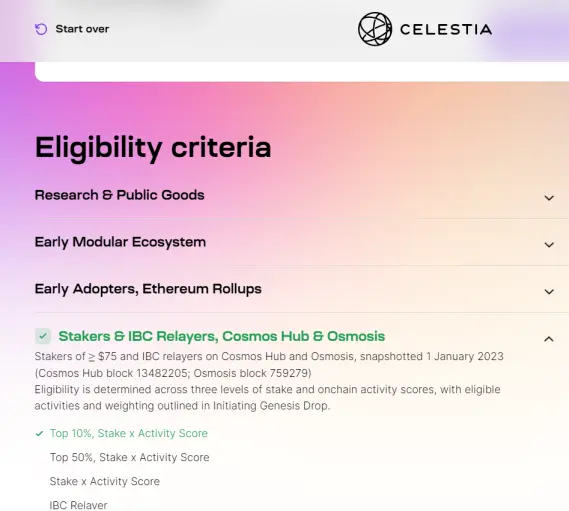
Ultimately, unlike non-modular (monolithic) blockchains which deal with a bit of everything (consensus management, validation and irreversibility of transactions, data archive and availability, etc.), modular ones have a basic blockchain (which manages consensus and irreversibility of transactions) and separate rollups (which take care of execution). The "external" data is verified with Zero Knowledge (mathematically) or Optimistic (i.e. always assumed true and verified when necessary in a 14-day time interval). This concept has also been implemented on Ethereum. In some ways Polkadot, Tezos and EOS also use this principle. In 2023 it was further evolved thanks to Celestia. It is essentially similar to what happens on Ethereum with the difference that the consensus is managed by Celestia (which represents the mainnet let's say) and on it it is possible to build rollups (the data and transactions are available on Celestia).
Proto-Danksharding: essentially this Ethereum update serves to make this blockchain even more scalable, up to 100,000 TPS (today there are around 15, Layer2 reaches over 100). The concept of fragmentation of the blockchain (into various parts) and therefore sharding is abandoned.
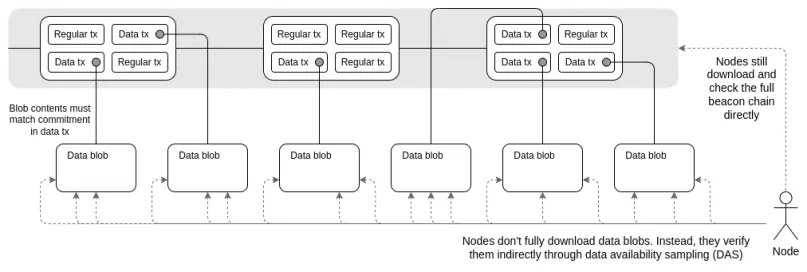
The update allows you to add cheaper data to blocks performed on rollups. Today Layer2 publish their transactions in Calldata which is an expensive method since it is processed by all Ethereum nodes and they reside forever on chain, even if the rollups only require the data for a short period. Proto-Danksharding introduces data blobs, which can be sent and linked to blocks. The data in such blobs is automatically deleted after a fixed period of time (1-3 months). This means that rollups can send their data much more lightly, which results in cheaper transactions. Rollups publish the transactions they perform into data blobs by attaching a polynomial function to the data (evaluable at several points). The data blob sent by a rollup must be checked to ensure that it is not malicious. This requires the re-execution of the transactions in the blob by a verifier who proves their validity (similar to the Merkle proofs on the Ethereum mainnet, i.e. hierarchical block data structure where if you want to analyze a transaction you don't have to download the whole block but only the desired data following the path of the considered element up to the root node of the Merkle tree). This proof is called KZG and fits a polynomial equation to the data evaluated at certain secret data points. A prover would fit the same polynomial to the data, evaluating it at the same values, and checking that the results match. This is a way to check that it is compatible with zero-knowledge techniques, used by some rollups. KZG also uses a method called "ceremony" to generate a secret random string of numbers, which can be used to verify data. It is very important that this string of numbers is not known and cannot be recreated by anyone. To ensure this, each participant receives a string from the previous participant. Then, they can create new random values (via entropy, for example by randomly moving the mouse) and mix them with the previous value. Then, they send the value to the next participant and delete it from their local machine. As long as this is done honestly, the final value will be unknown to a malicious user. For the ceremony to be compromised, 100% of these participants would have had to be malicious. From the participants' perspective, if they know that they are honest, there is no need to trust anyone else, as they assume that others are also honest (individually satisfying the "1 of N" honest participant requirement).
Are you interested in ways to earn crypto bonus? Check it out here: Some Sites To Earn Crypto Bonus (Old & New)






