
On April 15, 2026, KelpDAO became the largest DeFi exploit of the year. Attackers drained $292 million through a LayerZero-powered bridge configured with a single verifier. The exploit was attributed to North Korea's Lazarus Group, the same actor responsible for the Ronin Bridge hack four years earlier. Within 48 hours, $13 billion in DeFi TVL had been withdrawn as depositors panicked.
Three days later, Drift Protocol lost $295 million in a separate breach. Together, these two incidents accounted for more than half of all DeFi hack losses in 2026.
By mid-June, the numbers were staggering. DeFi total value locked had fallen from $114.49 billion in January to $71.77 billion. That is a 37.3% decline in six months. One hundred twenty-one hacks. $942 million in losses. Ethereum down 43%. Arbitrum down 55%. Plasma down 75%.
The headlines write themselves. DeFi is dead. Again.
But here is the interesting part. While the speculative layer of DeFi is bleeding out, the institutional layer is growing. Real-world assets reached $26 billion. TRON's DeFi ecosystem grew 5%. BlackRock's tokenized Treasury fund crossed $3 billion. And the protocols that survive this purge will look nothing like the ones that dominated the last cycle.
This article is not a defense of DeFi. It is a map of where the capital is actually going.
The Numbers That Should Terrify You
Let us start with the damage.
DeFi TVL stood at $114.49 billion on January 1, 2026. By June 18, it had fallen to $71.77 billion. The year-to-date low was $69.40 billion on June 7, a 45.7% drawdown from the January peak of $127.75 billion.
The decline is not just a price effect. Token prices have fallen, which reduces the dollar value of locked collateral. But actual withdrawals have been massive. The KelpDAO exploit alone triggered $13 billion in withdrawals within 48 hours. Aave, the largest lending protocol, saw TVL collapse from $26.4 billion to $14.3 billion after the exploit created up to $230 million in bad debt.
The hack numbers are equally brutal. One hundred twenty-one incidents in 2026. $942 million in losses. The second quarter produced 85 incidents and approximately $775 million in losses, making it the most active quarter for DeFi exploits on record.
The KelpDAO breach was particularly damaging because of its systemic nature. The vulnerability was not exotic. At the moment of the exploit, 47% of applications running on LayerZero were using the same minimal verifier setup. One point of failure. Hundreds of millions in assets. And a reminder that bridge risk did not decline after 2022. It simply moved into cross-chain messaging layers where it is harder to see.
The Chain Bloodbath (And the Two Exceptions)
The TVL collapse was not uniform. Some chains bled more than others. And two chains actually grew.
Ethereum, which holds 53.1% of all DeFi TVL, fell 43% to $38.24 billion. Arbitrum, the leading Ethereum layer-2, sank 55%. Plasma collapsed nearly 75%. The layer-1 and layer-2 ecosystems that built their value propositions on high throughput and low fees found that those features matter less when users are fleeing for safety.
The two exceptions are worth studying.
TRON grew approximately 5% in 2026. Its DeFi TVL now sits at a level that, while modest compared to Ethereum, is moving in the opposite direction of the market. The reason is simple. TRON's DeFi ecosystem is built around USDT settlement and stablecoin lending. When speculative yield farming collapses, stablecoin utility becomes more valuable. TRON processes a meaningful fraction of global USDT transfers. That is not a narrative. It is a payment rail.
Hyperliquid grew roughly 7% on perpetuals trading and its expanding HyperEVM ecosystem. It is one of only two major chains to grow TVL during the collapse. Hyperliquid's growth is different from TRON's. It is not about stablecoins. It is about derivatives. In a volatile market, traders want leverage. Hyperliquid provides it with a user experience that centralized exchanges struggle to match.
The lesson is not that TRON and Hyperliquid are inherently better chains. It is that DeFi capital is rotating from speculative deposits to functional utility. Yield farms are dying. Payment rails and derivatives platforms are surviving.
The Bridge Risk Evolved. Nobody Noticed.
In 2022, bridge exploits defined the DeFi security landscape. Ronin ($624 million), Wormhole ($326 million), Nomad ($190 million). The pattern was clear. Centralized validator sets with thin multisig thresholds. The industry responded by building better bridges.
The KelpDAO exploit revealed that the risk did not disappear. It migrated.
LayerZero is not a bridge in the traditional sense. It is a cross-chain messaging protocol. Applications use it to send messages and assets between chains. The KelpDAO bridge was powered by LayerZero but configured with a single verifier. One entity controlled the cross-chain validation. When that entity was compromised, the bridge collapsed.
The disturbing part is how common this setup was. Forty-seven percent of applications running on LayerZero were using the same minimal verifier configuration. The vulnerability was not unique to KelpDAO. It was systemic.
This is the new shape of bridge risk. It is no longer concentrated in dedicated bridge protocols that everyone knows are dangerous. It is distributed across cross-chain messaging layers that sit beneath much of how DeFi moves assets. The risk is harder to see, harder to audit, and harder to avoid.
For users, the implication is stark. Cross-chain deposits are not just risky. They are risky in ways that the last cycle's security frameworks did not anticipate.
The $26 Billion That Proves DeFi Is Not Dead
While speculative DeFi was collapsing, something else was growing.
Real-world assets, or RWA, reached $26.01 billion in aggregate TVL by March 2026. BlackRock's tokenized USD fund, BUIDL, crossed $3.03 billion. Circle's USYC reached $3.07 billion. These are not DeFi protocols in the traditional sense. They are tokenized versions of traditional financial instruments sitting on blockchain rails.
Andrew Forson, president of DeFi Technologies, put it directly. "DeFi is way more than those protocols that have been hacked. Those who don't know that are suffering from deep ignorance."
The institutional interest is real. BlackRock, JPMorgan, and Morgan Stanley are rushing into tokenization. The stablecoin layer, with $314 billion in circulating supply, is working. The RWA layer is attracting capital that never touched a yield farm.
This is the decoupling that matters. DeFi TVL is falling because speculative capital is leaving. But institutional capital is entering through a different door. The protocols that bridge these two worlds, the ones that can offer Treasury-backed yields with DeFi composability, are the ones that will define the next cycle.
The Yield Compression Nobody Wants to Talk About
The most uncomfortable truth for DeFi veterans is that the yield era is over.
In 2021, triple-digit APYs were common. Token emissions subsidized returns that had no economic basis. Users chased yields that were mathematically guaranteed to collapse. When they did, the entire sector was tarred with the same brush.
In 2026, sustainable DeFi yields look very different. Treasury-backed stablecoin lending pays 4-6%. Liquid staking on Ethereum pays 3-4%. Protocol fees from established platforms like Aave and Lido generate real revenue, not token inflation.
The protocols that relied on emissions to attract deposits are dying. The protocols that generate revenue from actual usage are surviving. The transition is painful for yield chasers. It is necessary for the sector's maturity.
Here is the yield framework that actually works in 2026. If a protocol offers more than 15% APY, ask what is subsidizing it. If the answer is token emissions, the yield is temporary. If the answer is protocol fees from real usage, the yield is sustainable. Most protocols cannot answer this question honestly.
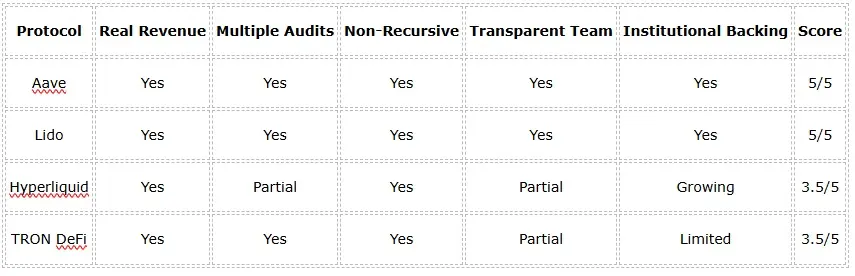
The Survivor Protocol Checklist
How do you evaluate a DeFi protocol in 2026? Use this framework.
Five criteria that matter:
- Real revenue, not token emissions. The protocol generates fees from actual usage. Lending interest, trading fees, or staking rewards. Not inflationary token rewards.
- Multiple audits plus active bug bounties. One audit is not enough. The protocol should have audits from multiple firms and an active bug bounty program that has paid out for found vulnerabilities.
- Non-recursive collateral. The protocol does not allow you to deposit its own token as collateral to borrow more of its own token. This was the mechanism that amplified Terra's collapse.
- Transparent team with verifiable history. The founders and developers have public identities, previous work history, and no history of abandoned projects.
- Institutional partnerships or backing. The protocol has relationships with regulated entities, insurance providers, or institutional investors. This is not a guarantee of safety, but it is a signal of legitimacy.
Five red flags that should make you run:
- Yields above 20% APY with no clear revenue source. If it sounds too good to be true, the yield is being subsidized by token inflation or new depositor funds.
- Unaudited code or anonymous team. No audit means no verification. Anonymous team means no accountability.
- Cross-chain bridges with minimal validator sets. The KelpDAO exploit proved this is still the most dangerous vector.
- Recursive collateral or leverage loops. Any protocol that lets you collateralize its own token is building a feedback loop that can collapse.
- Recent launch with massive TVL growth. Rapid growth from a standing start often indicates mercenary capital that will leave as quickly as it arrived.
Protocol scorecard:
Table
What This Means for Your Capital
If you are still in DeFi, the rotation is clear. Move from speculative yield farms to protocols with real revenue. Move from experimental cross-chain positions to established single-chain platforms. Move from unaudited protocols to those with institutional backing.
The opportunities are not gone. They are different. RWA yields from tokenized Treasuries offer 4-6% with minimal smart contract risk. Liquid staking on Ethereum offers 3-4% with the security of the largest proof-of-stake network. Perpetuals trading on Hyperliquid offers exposure to derivatives demand without the cross-chain risk.
The protocols to avoid are the ones that have not changed since 2021. High-emission yield farms, unaudited cross-chain bridges, and anonymous teams launching tokens with no revenue model. These were always risky. In 2026, they are radioactive.
DeFi insurance exists through platforms like Nexus Mutual and InsurAce. The coverage is expensive, the claims process is slow, and the coverage limits are often lower than the deposits you are protecting. In most cases, self-insurance through diversification and position sizing is more practical.
Key Takeaway
DeFi lost $942 million to hacks in 2026. TVL fell 37%. Ethereum bled 43% of its locked capital. The headlines say the sector is dead.
But TRON grew 5%. Hyperliquid grew 7%. Real-world assets reached $26 billion. BlackRock's tokenized Treasury fund crossed $3 billion. And the protocols that generate real revenue from actual usage are still standing.
DeFi is not dead. It is splitting into two sectors. The speculative layer, built on token emissions and unsustainable yields, is collapsing. The institutional layer, built on tokenized assets, stablecoin utility, and protocol revenue, is growing.
The capital rotation is not a bug. It is the market doing what markets do. Separating the sustainable from the speculative. The protocols that survive this purge will be smaller, more boring, and far more durable than the ones that dominated the last cycle.
The question is not whether DeFi will recover. It is whether your capital is in the part of DeFi that is growing, or the part that is dying.
FAQ’s
Q: How much has DeFi TVL fallen in 2026?
A: DeFi TVL has fallen from approximately $114.49 billion in January to $71.77 billion in mid-June 2026, a 37.3% decline. The year-to-date low was $69.40 billion on June 7.
Q: How much was lost to DeFi hacks in 2026?
A: As of mid-2026, 121 hacks have resulted in $942 million in losses. Q2 2026 was the most active quarter with 85 incidents and approximately $775 million in losses.
Q: What was the KelpDAO exploit?
A: In April 2026, attackers drained $292 million through a LayerZero-powered bridge configured with a single verifier. The exploit triggered $13 billion in DeFi TVL withdrawals within 48 hours and created up to $230 million in bad debt on Aave.
Q: Is DeFi dead in 2026?
A: No. While speculative DeFi is collapsing, real-world assets have grown to $26 billion, TRON's DeFi ecosystem grew 5%, and institutional interest in tokenization is accelerating. The sector is transforming, not dying.
Q: Why is TRON's DeFi TVL growing while others shrink?
A: TRON's DeFi ecosystem is built around USDT settlement and stablecoin lending. When speculative yield farming collapses, stablecoin utility becomes more valuable. TRON processes a significant portion of global USDT transfers.
Q: What are real-world assets (RWA) in DeFi?
A: RWA refers to tokenized traditional assets like Treasury bonds, real estate, and commodities traded on blockchain. BlackRock's BUIDL fund crossed $3.03 billion, and Circle's USYC reached $3.07 billion in March 2026.
Q: Which DeFi chains lost the most TVL in 2026?
A: Ethereum lost 43% of its DeFi TVL. Arbitrum sank 55%, and Plasma collapsed nearly 75%. Only TRON and Hyperliquid grew.
Q: What is the Survivor Protocol Checklist?
A: Five criteria for evaluating DeFi protocols: real revenue, multiple audits, non-recursive collateral, transparent team, and institutional backing. Five red flags: yields above 20% with no revenue source, unaudited code, cross-chain bridges with minimal validators, recursive collateral, and rapid TVL growth from standing start.
Q: Are DeFi yields still attractive in 2026?
A: DeFi yields have compressed significantly. Sustainable yields from RWA (4-6%) and liquid staking (3-4%) are replacing unsustainable token emissions. The 100% APY era is over.
Q: How can I protect my DeFi investments from hacks?
A: Use protocols with multiple audits and bug bounties, avoid experimental cross-chain bridges, diversify across protocols, consider DeFi insurance, and never deposit more than you can afford to lose.






