
These days, you will surely have heard about the depeg of two stablecoins: xUSD (Stream Finance) and deUSD (Elixir). In reality, the contagion led to the depeg of other yield bearing stables (for example USDx by StablesLabs). In this article I will explain how this perpetual machine worked, capable of "generating" money from nothing.
PROTOCOLS INVOLVED
Stream Finance: issues xUSD, an “institutional stablecoin” with “market-neutral” strategies.
Elixir Network: issues deUSD, theoretically “backed by real assets” (ETH staked, T-bills).
YieldFi, mHyper: “yield partners” used to give credibility and multiply loops.
Hyperithm: institutional fund manager; get in early, get out before collapse with $10M in profits.
PERPETUAL MACHINE FOR INFINITE MONEY
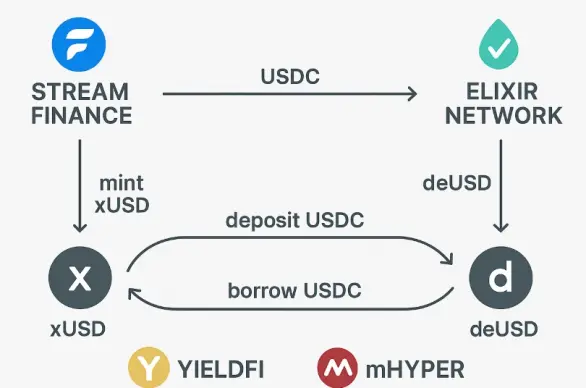
The basic idea is that each stablecoin (xUSD, deUSD) is "backed" with the other, creating a closed circle of fictitious liquidity. Neither of them had real collateral reserves behind them (other than a minimal part). Just 1.9 million real USDC generated over 14.5 million xUSD thanks to a chain of recursive loans and mint.
The operational “loop” (this is normal yield farming):
- Users deposit USDC into Stream Finance.
- Stream moves them to a secondary wallet and exchanges them for USDT.
- Use these USDT to mint deUSD on Elixir.
- Return the deUSD to the main wallet.
The Spiral (in leverage):
- deUSD is bridged to Avalanche or World Chain.
- Used as collateral to borrow other stablecoins.
- These are converted back into USDC and brought back to Ethereum.
- The cycle is repeated three times in a single day leading to the creation of $10M in deUSD.
The Recursive:
- With the latest USDC borrowed, Stream mint xUSD, its own stablecoin therefore deUSD is “backed” by xUSD. xUSD is “hedged” by deUSD. A circular cover, not a real one.
- Each xUSD token (theoretically $1.25) is actually worth $0.40 or less in actual assets.
The Circle Closes:
- Elixir receives USDT (≈10M$) and deposits them in “custom” lending markets (Morpho).
- Elixir lends those USDC to Stream, accepting xUSD as collateral.
- Stream uses those funds to mint new deUSD, closing the loop.
I know, you're lost but basically: USDC → deUSD → loan → xUSD → loan → deUSD and so on, generating stables covered by loan loops. Another 2 protocols, namely YieldFi and mHyper, were presented as "yield aggregators", but mainly served as a legitimate front to attract retail capital to enter the loop seen above. YieldFi's largest holdings are deposits in a vault on Morpho Vault called ABRC. Their largest position is in the yUSD/USDC market (yUSD is their stablecoin), where borrowers leveraged yUSD across multiple lending platforms. YieldFi represented over 10% of mHYPER's total value locked. On Arbitrum, mHYPER lent against yUSD. mHYPER's second largest allocation: Stream's xUSD. Stream mints xUSD, Elixir mints deUSD, both flow into the Morpho and Euler lending markets.
YieldFi's yUSD borrows from these markets and at the same time serves as collateral for mHYPER. mHYPER lends in the same ecosystem, creating a closed loop where the solvency of each protocol depends on the solvency of every other protocol. Hyperithm (institutional fund) invested in the system and withdrew all funds early (earning 10M), leaving retail users exposed when on-chain data started to leak.
RED FLAG
Proof of reserves never published (coming soon) and over 90% APY returns promoted as “market-neutral”. Stablecoins not truly collateralized (10%). Markets on Morpho created ad hoc, to simulate use but low volumes and liquidity controlled by the protocols themselves. Morpho and Euler are legitimate platforms, but it's possible to create vaults without permission.
THE EPILOGUE
Approximately $70M of USDC was moved in the loop. Over $14.5M in xUSD and $10M in deUSD were created with less than $1.9M real.
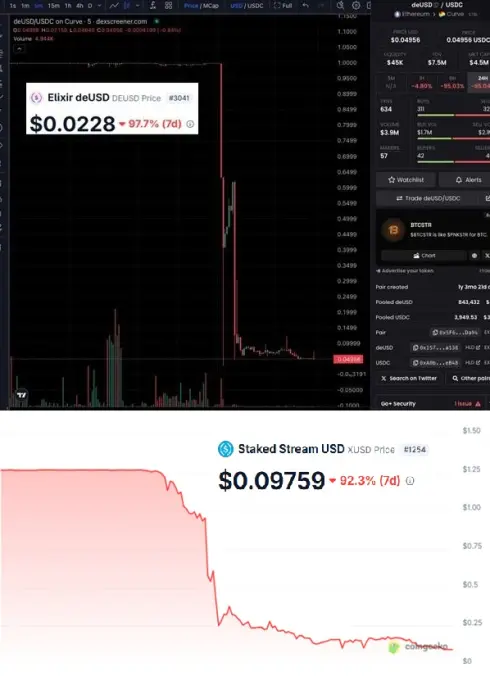
The inevitable outcome is that the system collapsed when investors tried to exit at the same time. xUSD (Stream Finance) and deUSD (Elixir) lost their peg (deUSD lost 98% in 20 minutes).
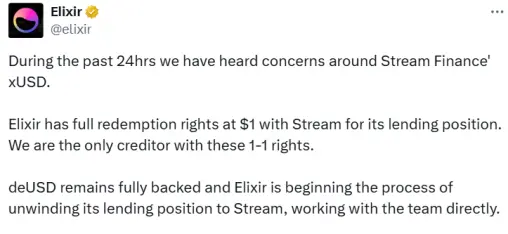
Elixir is still issuing refunds to deUSD holders and users who used LP, as it had 1:1 dollar-collateralized lending. That is, if Stream will repay its debts to Elixir, but the latter has opened a portal for the claim.
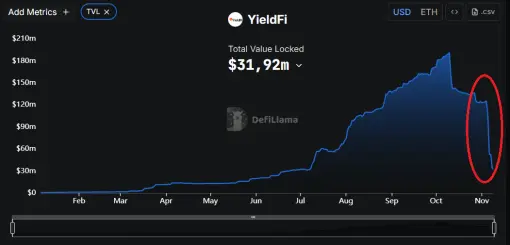
Stream collapsed after a fund manager lost $93M. The xUSD minting loop round made the platform the largest holder of its own stablecoin. xUSD was widely used as collateral on the Plasma chain (Euler). $107 million worth of xUSD was provided with a hard-coded oracle at $1.27. The collateral was used to borrow USDT0, plUSD and msUSD. Each of these lending markets is now facing a significant amount of bad debt. The actual liquidation and clearing of these bad debts led to the collapse of xUSD due to the hard-coded oracles. YieldFi's TVL lost over 75% but in truth yUSD had no problems (it executed over 140M redeems in a few days).
rUSD and iUSD (other protocols) also appear to have used loops and have a portion of the collateral in their assets.
The markets, though seemingly isolated, are always interconnected through lending and loops. Morpho's permissionless market structure meant exposure was hidden everywhere. Euler Finance remained exposed to multiple tokens in this network. The vaults had layered risk: loans against xUSD, which were collateralized by deUSD, which collateralized yUSD, which funded mHYPER, which lent in the same markets. Retail depositors were unaware they were exposed to a recurring minting that could collapse when interest rates changed or a protocol faced a wave of redemptions. Although much more complex in some ways, this story is reminiscent of FTX and its FTT token, which pumped up its balance sheets (secured to borrow valuable assets).
Are you interested in ways to earn crypto bonus? Check it out here: Some Sites To Earn Crypto Bonus (Old & New)






