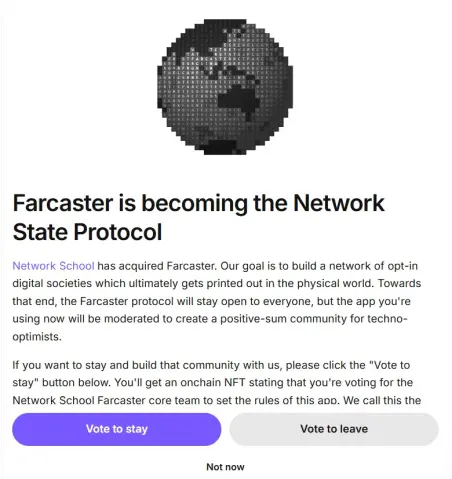
If you use the social network Farcaster, you have surely encountered a prompt asking you to "vote" on whether to stay or leave. It is a curious request, and, in my view, a rather controversial one. Setting aside the fact that it runs counter to any principle of decentralization, as Farcaster is, in effect, moving in the opposite direction, let’s examine what this actually entails.
NETWORK STATE
The acquisition of Farcaster by Balaji Srinivasan’s "Network School" could signal a significant shift in how (theoretically) decentralized social networks are designed and utilized. Rather than serving merely as a social platform, Farcaster is positioning itself as an infrastructure for digitally organized communities—communities that might, in the future, also develop a physical presence (through in-person meetups). This concept is rooted in the "Network State" thesis: the idea that online communities can coalesce around shared values, establish rules, organize economic activities, and progressively expand into the real world. The proposed model introduces a "social smart contract" through which users can agree to community rules and receive an NFT that functions as an on-chain access key. Those who choose not to opt in can retain read-only access via the main application, while their keys, funds, followers, and post history can be migrated to a different client (perhaps hinting at future forks?). The broader ambition is to integrate digital identity, social coordination, and community governance within a unified infrastructure.
PROBLEMS AND LIMITATIONS
That all sounds fine, but the description leaves much unsaid. What are the actual issues? The core concerns revolve around decentralization, the nature of governance, and the potential for increased censorship and control exerted by the primary application.
The following are slated to be prohibited:
- insults;
- inflammatory remarks ("flames") and provocations;
- threats;
- quarrels;
- racism;
- bots/spam.
- malware.
- NSFW content.
- undisclosed AI-generated content.
- any digital infraction.
They call it "decentralized democracy", it’s up to you whether to join by accepting the rules (this is standard practice on platforms like X or Facebook, too; it’s hardly a new concept).
On the surface, this seems fine (these are, after all, undesirable topics), but in terms of content, what actually distinguishes Farcaster (which originated in the Web3 space) from Facebook or Instagram? Today, these specific topics are being banned; tomorrow, it could be discussions about Bitcoin, a particular nation-state, or decentralized exchanges. Who gets to decide what is right or wrong? Essentially, they aim to follow a "Singapore-style" model, a middle ground that distances itself from both the Soviet-style approach (strict prohibition) and the "Somali" model (a free-for-all with no rules whatsoever).
If successful, Farcaster could evolve beyond a conventional social network, becoming a coordination layer for digitally native societies. The real test will be whether these communities can translate online participation into sustainable economic and social structures within the physical world.
PERSONAL THOUGHTS
Personally, I haven’t voted yet; as a Web3 user, I’m looking for something different from X or Facebook, not necessarily something that allows for illegal activity, but rather something that avoids excessive censorship. I’ve also read about the potential for gradual identity verification (KYC?), which, frankly, feels like too much for a social network. I’m not sure what Farcaster’s ultimate goal is, but the constant shifts in management make for a disjointed user experience, the platform has effectively reinvented itself several times over the last two years.
Article always updated with all the possibilities of on-chain farming (airdrop): Some Sites To Earn Crypto Bonus (Old & New)