
The other day I was reading "Bitcoin Under Stress: Measuring Infrastructure Resilience 2014–2025" (Wu & Neumueller, 2026), which objectively highlights Bitcoin's strengths and limitations. The paper analyzes how resilient Bitcoin really is, not in terms of decentralization, but in terms of the physical level of Internet infrastructure.
INFRASTRUCTURE
Bitcoin is designed to be decentralized and resilient, but it obviously also depends on undersea cables, ISP, data centers, and Internet routing, so it has dependencies on the global physical network.
The goal was to measure how well the Bitcoin network withstands real-world infrastructure failures. The study ran from 2014 to 2025, taking into account:
- Real Bitcoin P2P data.
- 658 undersea cables.
- 68 verified failures.
An interdependent network model (multiplex) was used:
- Physical layer (countries + cables)
- Routing layer (AS/Internet)
- Bitcoin layer (nodes)
- TOR layer (in the advanced model)
The underlying idea is that if a country loses physical connectivity, Bitcoin nodes there become isolated.
MODELS
1) 3-layer model: physical (cables + countries), Internet routing (AS), and Bitcoin nodes.
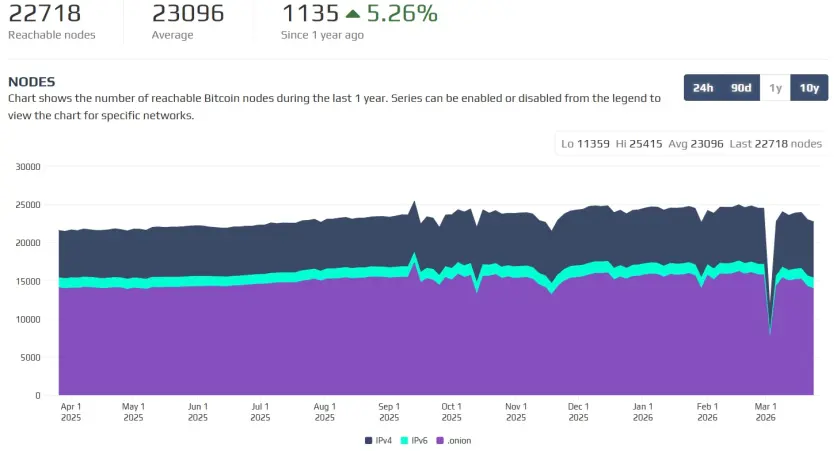
2) 4-layer model (with TOR): adds a TOR relay layer (63-64% of nodes use TOR).
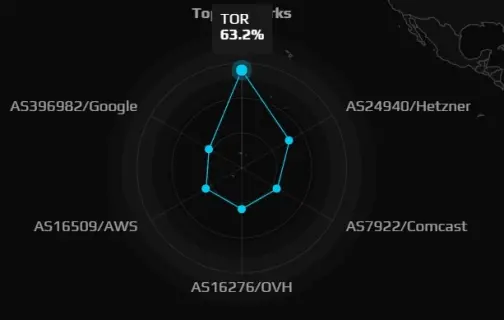
The key metric is the percolation threshold (p_c), which is the fraction of infrastructure that can fail before the network collapses.
MULTIPLEX NETWORKS: PERCOLATION THEORY ON INDEPENDENT NETWORKS
The basic idea is that there is no "single network"; in fact, Bitcoin is not a single network. It is a network on top of other networks:
- Physical layer: undersea cables, countries.
- Internet layer (AS): providers, routing.
- Bitcoin layer: P2P nodes, TOR (optional), anonymous relays.
These networks are interdependent: if the physical layer fails, the Internet fails, and so does Bitcoin. A network functions if there is a "giant" component: a group of nodes all connected to each other. If this fails, the network as a whole "no longer functions." The percolation threshold (p_c) measures how much infrastructure you can lose before the network fails. Essentially, it is the critical fraction of nodes/edges removed to destroy the giant component.
Two simulated scenarios are considered:
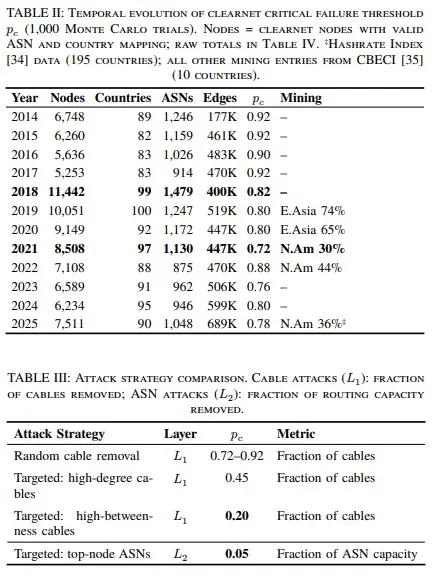
1) Random failures: removing cables at random from entire geographic areas. The result is a very robust network because redundancy leads to many alternative paths.
2) Targeted attacks: removing "central" (more important) nodes. The result is a more fragile network with low p_c (~0.05–0.2) because some connections are critical hubs.
The problem is interdependence with a domino effect: if a node fails in one layer, the others fail as well. Hypothetically, we can imagine a country losing its connection, Bitcoin nodes there disappear, there are fewer nodes, fewer connections, and other nodes become isolated. In this case, TOR helps (mathematically) because it introduces non-geographical alternative paths and less correlated connections (reducing the probability of nodes failing together). Bitcoin is like a network on top of a network on top of a network: resilience depends on the weakest point underneath.
RESULTS
Key findings:
- Random failures: Bitcoin survives up to 72%-92% of cable failures.
- Trend over time, worsening: from ~0.92 (2014-17) to ~0.72 (2021).
- Targeted attacks: drastic drop in p_c = 0.05–0.20.
Essentially, Bitcoin has proven to be almost impervious to random events but more vulnerable to "targeted" attacks.
Analyzing the 68 failures, 87% impact <5% of the nodes. In practice, the network degrades gradually and does not collapse suddenly.
TOR obviously does not weaken the network, but it increases resilience improves p_c by ~+0.02–0.10. This is because it distributes nodes better and circumvents geographic constraints. The paper shows that Bitcoin has Europe-North America corridors with large providers/clouds and a concentration in mining. Resilience decreases with mining centralization and improves with geographic spread and the use of TOR (it makes nodes difficult to pinpoint).
Technically, Bitcoin can survive even massive random cable failures thanks to global redundancy. It is more vulnerable to targeted attacks if strategic points are hit (high-centrality cables, large ISP/clouds). The decentralization inherent in the protocol logic (perfect) is different from the physical infrastructure (imperfect). TOR improves resilience by reducing geographic correlation. Real-world failures have limited impact because the network degrades slowly (no "global blackouts" in observed practice).
MINING
Regarding mining, distribution is less distributed than thousands of nodes. Hitting these entities doesn't mean stopping Bitcoin, but it could impact the rate of block production. As we know, hash rate is concentrated in pools like Foundry USA and Antpool, with a market share exceeding 50%. However, even this requires significant resources, coordination and attack capabilities. These scenarios are neither easy to implement nor sustainable. Some estimates, in fact, suggest costs in the hundreds of millions of dollars per hour of a concentrated attack (in the example of the 51% attack).
CONSIDERATIONS
The paper is interesting, but it makes enormous simplifications: it assumes that if a country loses connectivity, all the nodes there disappear.
In reality, VPN, satellites (Starlink) and alternative routing exist, so it overestimates fragility. The model also removes nodes and measures collapse, but in reality, Bitcoin adapts (new peers, rerouting, and other nodes reappear). It does not model the Bitcoin protocol because it is not just a network but has internal mechanisms: mempool, block propagation, and automatic retry. One critical issue is targeted attacks that assume perfect knowledge of the network, but in reality, it's difficult to know which cables to target and which nodes are truly critical (not everything is fully observable; many nodes are hidden behind firewalls and TOR), so the real network is different from the observed network.
It's certainly fair to say that a distributed protocol can have limitations if it has few cables, few providers and geographic concentration (there's a dependence on global infrastructures that aren't completely decentralized). If you're thinking of a catastrophic scenario involving a global blackout at the infrastructure (nodes), electricity, and internet levels, you should consider that Bitcoin would be the least of your problems (remember the Millennium Bug in 2000? The catastrophic scenario depicted didn't materialize, but if it had, there would have been serious problems in every sector—imagine what would happen today in a much more technologically advanced world).
Are you interested in ways to earn crypto bonus? Check it out here: Some Sites To Earn Crypto Bonus (Old & New)






