
Tron founder Justin Sun announced plans to buy $50-100M in Bitcoin for Tron DAO Reserve after BTC crashed to $74,674, following Binance's $1B allocation.
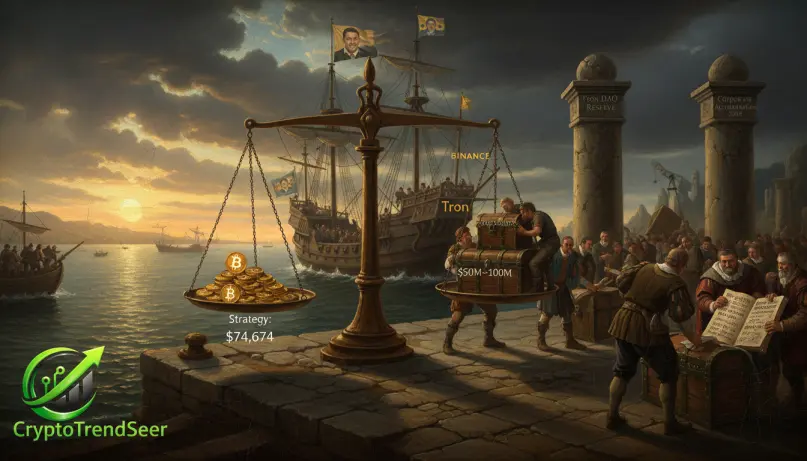
Tron founder Justin Sun told CoinDesk on February 2nd that he plans to add between $50 million and $100 million worth of Bitcoin to Tron DAO Reserve's holdings, marking a significant strategic shift toward diversifying the blockchain's treasury beyond stablecoins and native tokens. The announcement came as Bitcoin traded near $74,674—its lowest level since April 2025—following a brutal selloff that has seen BTC decline 21% since mid-January and roughly 40% from its October all-time high near $126,000.
Sun's planned purchase follows Binance's January 30th announcement that it would convert its $1 billion Secure Asset Fund for Users (SAFU) from stablecoins into Bitcoin over the coming months. The back-to-back statements from major crypto industry figures signal renewed institutional confidence in Bitcoin at depressed levels, contrasting sharply with the behavior of digital asset treasury companies that accumulated near record highs in 2024-2025 and are now sitting on unrealized losses exceeding 30%.
Strategy, formerly known as MicroStrategy, exemplifies the challenge facing early corporate accumulators. The company holds 712,647 BTC acquired at an average cost of $76,037—just above current market prices—meaning its treasury is now marginally underwater for the first time in years. Other corporate holders including MARA Holdings, Twenty One Capital, and Metaplanet face similar mark-to-market losses, having purchased significant portions of their holdings when Bitcoin traded between $90,000 and $126,000.
Sun's willingness to buy during capitulation rather than euphoria positions him differently from the wave of corporate treasury adoption that dominated 2024-2025. According to bitcointreasuries.net, approximately 150 public companies now collectively hold over 1.1 million BTC—representing more than 5.4% of Bitcoin's total 21 million supply. However, many of these companies accumulated at elevated prices, betting on continued appreciation that has not yet materialized.
Tron DAO Reserve currently manages billions of dollars in assets, primarily composed of TRX tokens and stablecoins including USDT (Tether) and USDD (Tron's algorithmic stablecoin). While these assets provide liquidity and transactional efficiency essential for day-to-day operations, they remain exposed to regulatory intervention, issuer risk, and dependence on traditional banking infrastructure. By allocating a larger share of reserves to Bitcoin, Sun aims to reduce reliance on fiat-pegged instruments and strengthen the balance sheet with an asset that operates independently of centralized monetary systems.
Analysts point to several reasons why Bitcoin is increasingly favored for corporate reserves despite recent price weakness. First, Bitcoin offers diversification benefits—its price movements have historically shown low correlation with traditional assets during certain periods, though this relationship has become more complex as institutional adoption increased. Second, Bitcoin provides potential long-term appreciation in a way stablecoins by definition cannot, as they are designed to maintain 1:1 parity with fiat currencies. Third, Bitcoin's fixed supply of 21 million coins creates scarcity dynamics that appeal to treasurers concerned about fiat currency devaluation.
Sun's announcement did not specify the exact timing or execution strategy for the purchases, leaving open questions about whether Tron will accumulate gradually or execute a single large transaction. Given Bitcoin's current volatility and thin weekend liquidity that has amplified recent price swings, a phased approach seems more likely to avoid moving the market against itself.
TRX has notably outperformed Bitcoin during recent market turmoil, falling just 0.9% on Friday while BTC dropped over 6%. The token currently trades around $0.284, holding above its December low of $0.27 and maintaining what analysts describe as a macro uptrend that began in late 2022. This relative strength may give Sun additional confidence to diversify into Bitcoin without destabilizing TRX's market dynamics.
Sun's close ties to President Donald Trump add another dimension to the announcement. Since late 2024, Sun has invested approximately $75 million into World Liberty Financial (WLFI), Trump's DeFi venture, and assumed an advisory role promoting the platform alongside Eric Trump at industry events. Sun also accumulated more than $100 million in the Official Trump memecoin, becoming one of its largest holders, and WLFI's USD1 stablecoin launched on the Tron blockchain in June 2025.
These connections became strained in September 2025 when WLFI froze Sun's holdings—worth over $100 million at the time—over transfer disputes, though the relationship appears to have since normalized. In January 2026, the SEC dropped a 2023 civil case against Sun related to alleged TRX market manipulation, a development Sun publicly credited to the Trump administration's more crypto-friendly regulatory approach.
Whether Sun's Bitcoin accumulation proves strategically sound depends on Bitcoin's trajectory over the coming months and years. If BTC recovers toward $100,000-$150,000 as some analysts forecast, the purchases will look prescient. If instead Bitcoin continues declining toward $68,000 or lower—as more bearish scenarios suggest—Tron DAO Reserve will join the ranks of corporate holders underwater on their Bitcoin allocations.
For now, Sun's announcement reinforces a narrative that despite brutal short-term price action, institutional and high-profile crypto figures remain committed to Bitcoin as a foundational treasury asset. Whether this confidence proves justified or becomes another example of "catching a falling knife" will depend on factors including Federal Reserve policy, institutional ETF flows, geopolitical stability, and whether Bitcoin's four-year halving cycle remains intact or has fundamentally broken down as some analysts now argue.




