
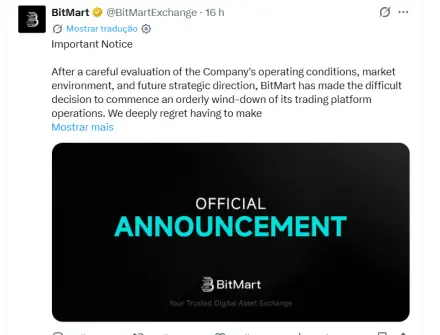
The cryptocurrency market was just hit by another bombshell announcement: BitMart, one of the most popular digital asset exchanges in the ecosystem, has officially announced that it will shut down all trading operations. The announcement triggered an immediate shockwave across the community, with the platform's native token (BMX) plunging over 50% in just a few hours. If you hold funds or have open positions on the platform, the time to act is now — the window for closing positions and withdrawing assets is open, with strict deadlines that every investor must follow to protect their capital.
📉 Shutdown Timeline: Deadlines and Restrictions You Need to Know
BitMart revealed a phased sunsetting strategy for its operations to ensure an orderly wind-down process. Effective immediately, new registrations and deposits (both fiat and crypto) have been completely suspended.
To avoid unnecessary losses or automated liquidation traps, pay strict attention to the official schedule released by the technical team:
-
July 26, 2026: Immediate suspension of registrations, deposits, and new position creation. Futures contracts enter Reduce-Only mode.
-
August 26, 2026 (01:00 UTC): Complete halt of all Spot, Futures, Copy Trading, Staking, Earn, and Launchpad trading. Any remaining Futures positions will be automatically liquidated.
-
January 31, 2027 (15:59 UTC): Final hard deadline when the platform permanently terminates website access and withdrawal services.
⚠️ Withdrawal Warning: The exchange stated that withdrawal services will remain active until the final deadline in January 2027. However, users should prepare for potential delays due to high withdrawal volumes and compliance checks (KYC/Travel Rule).
🔍 CEX Consolidation: What Is Happening to Mid-Tier Exchanges?
BitMart’s shutdown is not an isolated event. Within a short timeframe, other prominent trading platforms, such as the legendary BitMEX, have also announced plans to wind down their offshore trading activities. Industry analysts point to a structural crisis in the business model of mid-tier exchanges.
The global regulatory landscape — driven by strict compliance requirements across major jurisdictions — has made running offshore exchanges significantly expensive and complex. Lacking the massive volume and deep liquidity of industry giants like Binance, OKX, or Bybit, mid-sized platforms face shrinking profit margins, triggering an inevitable market "cleansing" and consolidation.
-
Liquidity Squeeze: Scarcity of new retail users and lower volumes make maintaining secure infrastructure financially unsustainable.
-
Regulatory Pressure: Aggressive compliance enforcement renders traditional offshore operating models unviable.
-
Capital Migration: Retail and institutional investors are shifting capital toward tier-1 exchanges or fully decentralized, non-custodial DeFi protocols.
🛡️ Survival Guide: How to Protect Your Assets and Avoid Scams
During exchange shutdowns, user anxiety runs high — and malicious actors often take advantage of the panic through targeted phishing campaigns. If you have assets on BitMart, take these immediate steps to secure your funds:
-
Close Active Positions: Do not wait for automatic liquidation on August 26. Manually close your open Spot and Futures orders to avoid extreme slippage.
-
Withdraw to Self-Custody Wallets: Transfer your balances immediately to a non-custodial wallet (such as MetaMask, Trust Wallet, or Ledger/Trezor).
-
Beware of Fake "Support" Accounts: BitMart staff will never ask for fees to "unfreeze" accounts, process priority withdrawals, or request your seed phrases/private keys.
-
Verify Official URLs: Access the site only by typing the address directly into your browser navigation bar — avoid clicking on sponsored search results or unverified email links.
💡 CONCLUSION & FINAL INSIGHTS
The closure of BitMart reinforces one of the oldest and most fundamental rules in crypto: "Not your keys, not your coins." The market is undergoing a necessary maturation phase, where only platforms built on hyper-solid financial foundations and complete regulatory transparency will survive.
For investors, this serves as a clear reminder not to store long-term capital on centralized platforms — especially mid-tier exchanges showing signs of declining traction. The smartest move right now is to pull your funds out of BitMart as soon as possible and re-evaluate your overall portfolio risk management.
💬 Were you using BitMart, or were you caught off guard by this announcement? Do you think more mid-sized CEXs will shut down soon? Let us know your thoughts in the comments below, leave a Like/Tip to support our work, and follow our profile on Publish0x for daily crypto insights!






