
At the moment, due to my mother in law staying to help with the childcare and her wanting to go to bed early we have juggled the sleeping arrangements around a bit. Mama_Rah is sleeping at the hospital with Younger_Rah (who should all being well be home on Monday). Mama_Rah's mum is sleeping in our bed, because she goes to bed a lot earlier than me and I am sleeping on the sofa in the living room - and by the way this was totally my suggestion. So last night as I was falling asleep, I noticed a phenomena, that I have noticed before, only this time I decided to ask about it.
So I asked Co-Pilot the following question, which will also qualify and explain exactly what I am talking about..
I have poor eyesight (+8 in my left eye and +7 in my right eye). Why is it at night when I look at for example a red standby button on a TV set, rather than looking like a single blurred light it looks like literally hundreds of tiny pinpoint red lights in a circle? What is the name of this phenomena and how does it work?
We are not allowed by P0x Rules to post AI content, but to summarise (and I would have got the same answer having done traditional research), this is what I learnt, but let's start with what I actually see.
What I actually see is the fourth image (top right) in a darkened room without my glasses.
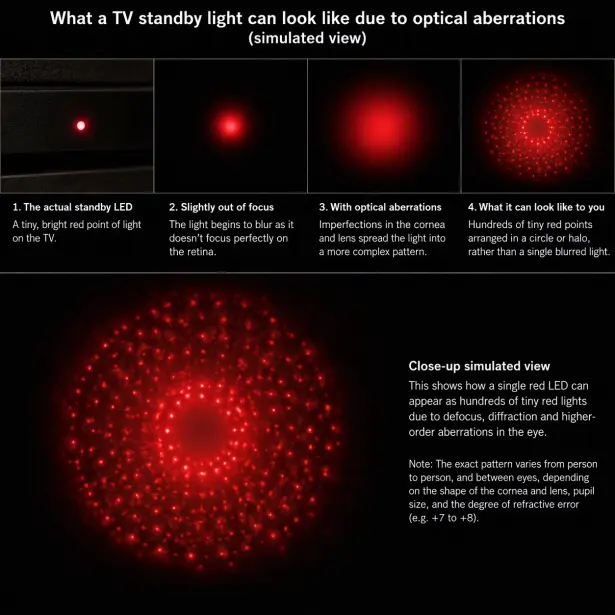
This is a very well-known optical effect, and with a prescription as high as +7 to +8 dioptres (significant hyperopia/long-sightedness) it's not surprising that you notice it strongly. The phenomenon is almost certainly a combination of diffraction, higher-order aberrations, and entoptic effects (visual effects generated by structures within your own eye).
Concerning the standby LED, which is essentially a very small, extremely bright point source in an otherwise dark environment there are several things that can be observed.
Without the correct correction (AI's phrase not mine) the image is out of focus and forms a larger "blur circle" rather than focusing on a point on the retina. The structure of the eye also contributes to the effect because the cornea and lens are not optically perfect. The truth is that every eye has tiny irregularities which distort the blur pattern into complex shapes and this is exaggerated because bright lights reveal these imperfections much more than ordinary objects do.
What makes this stand out more is that the pupil, as a result of dilation, is much larger at night this then allows light to pass through more peripheral parts of the cornea and lens, where optical imperfections are greater. The same physiological causes also explains why many people see halos, starbursts, streaks, or fragmented patterns around lights at night.
The resulting blur isn't actually a blur at all and I can personally attest that it contains fine structure even though that does not necessarily mean that it is uniform. The eye's optics break it into many tiny bright and dark regions and as a result the individual sees dozens or hundreds of miniature lights arranged in a circular pattern.
While there are other phenomena that ophthalmologists might describe it as haloes around lights, starbursts, higher-order aberrations, diffraction patterns, and other entoptic phenomena, the most apt description is encapsulated in the term Point Spread Function (PSF). Every optical system, including the human eye, spreads a mathematical "point" of light into a more complex pattern. In eyes with refractive error, the PSF can become quite elaborate.
And btw squinting makes absolutely no difference at all.
Red LEDs are especially good at producing this effect because they are very small and very bright relative to their surroundings and especially in a dark room where the individual pupil is large and the red light emits a narrow range of wavelengths. Collectively these conditions make optical artefacts much easier to see than, say, a white wall or a lamp shade.
And so there you have it.
Stay safe and well my friends as always.






