A lot of faucets love to play the "Roll" game. The rules are simple: you click the button, it "rolls", you get a number and depending on that number you get your reward. The more "rare" the number is, the more reward you get. Theoretically, there must be some fairness, probability and random number game behind all this, but in practice, I doubt the faucet owners pay much attention to these math theories.
On the other hand, many faucets today are built upon ready-made scripts, which their owners bought for twenty bucks somewhere on Bitcointalk. And these scripts might well have bugs. And even worse, they might have bugs in faucet's favor. In other words, the casino cheats, although unintentionally...
Look at these screenshots below:
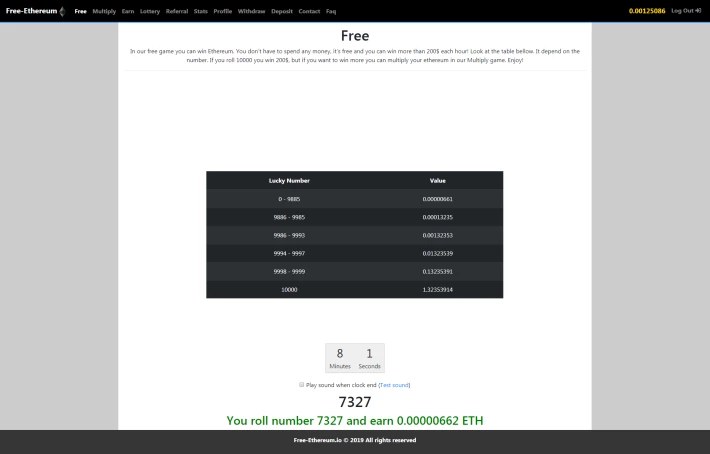

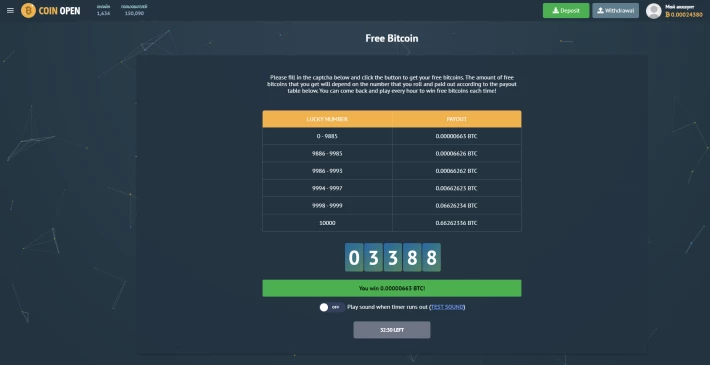
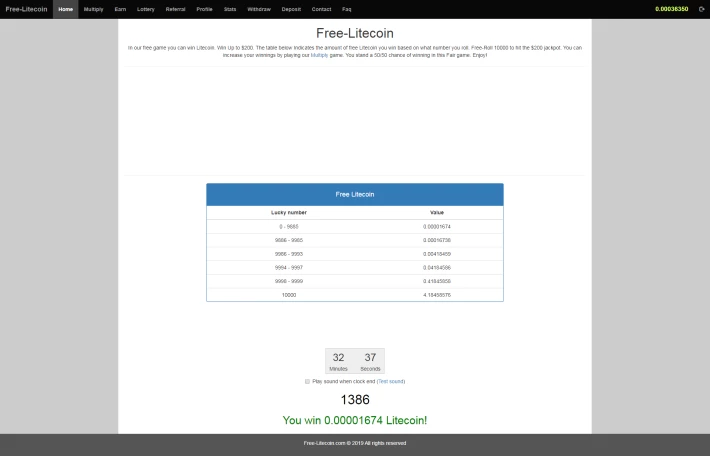
All of them look very similar, isn't it?
Maybe all of them have the same owner. And all of them definitely have the same script behind. The script that cheats?
No matter how many times you roll -- you always get a number between 0 and 9885, i.e. the lowest possible reward.
Those who know the math could tell that the probability to roll anything between 9885 and 10000 is about 115/10000x100=1.15%, i.e. about once every 100 rolls (with a decent random number generator, of course). Really, scientia potentia est.
Personally I'm simply too stupid for math and prefer to think that either the script has a bug or someone just cheats somewhere. In any case, when you see a roll like above and with 0-9885 magic number -- don't much expect to get from it anything except minimal rewards...
However, I don't tell that such faucets don't pay. At least, Free-Ethereum.io does pay, if you handjob it long enough to get 0.001 ETH min withdrawal plus 0.0004 ETH commission:
 (
(
Disclaimer: I'm neither an employee nor an owner of any crypto project including the above-mentioned ones. The article is informational and not an endorsement, guarantee or financial advice of any kind. The links are affiliate. I myself have assets at the mentioned projects.






