
What is Monero?
Monero (XRM) was created in 2014 with a very deep commitment to privacy, scalability and decentralization. The peculiarity of Monero is that it is based on the CryptoNote protocol. His code was also praised by Wladimir J. Van der Laan, one of the Bitcoin developers. In April 2017, it exceeded $ 600 million in market capitalization, finishing sixth. Within a few months, it reached a capitalization of over 2 billion dollars.
THE STORY OF MONERO
Monero was launched on April 18, 2014 as "BitMonero" (name consisting of "Bit" for Bitcoin, and "Monero" which means "coin"), the name was then changed to "Monero" just 5 days after its launch .
An interesting feature of the coin is that "Monero" means money if it is translated from Esperanto, Esperanto is an artificial language created with the aim of connecting different peoples through a language that belongs to no one in particular, that is therefore a universal heritage of all.
It was launched as a fork by Bytecoin, then released with two substantial differences:
- The time for the creation of the blocks has been halved, going from 120 seconds to 60 seconds
- The emission speed was halved, even afterwards the block time of Monero returned to 120 seconds; keeping emissions planning the same and doubling the blocking bonus.
A few weeks after its launch, a mineral GPU was developed that was optimized for the CryptoNight proof-of-work function. In January 2017, the Ring Confidential Transaction algorithm was adopted, which strengthened privacy for users.

HOW DOES MONERO WORK?
Monero is based on the Bitcoin proof-of-work system.
Compared to Bitcoin, however, Monero is programmed for a smaller number of coins issued (18.4 million) that will be exhausted within eight years.
Monero is preferred for the privacy it offers on transactions. Everything works through the ring signature algorithm, which has introduced an extra security layer, precisely because it does not allow to show the amount of a transaction to a third person compared to the two protagonists of the transaction.
Monero privacy works like this:
- The signatures of the rings encrypt the sending address
- RingCT hides the amount of the transaction (made mandatory by the end of 2017)
- Stealth addresses hide the transaction receipt address
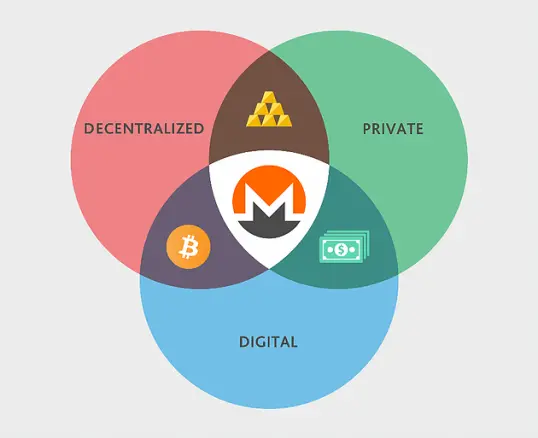
Monero is a completely decentralized cryptocurrency, while Bitcoin has lost this characteristic as monopolies have been created over the years. Furthermore, it is made secure through a "Proof of Work" scheme
Monero is also characterized by its high scalability. Monero does not provide a maximum size for the size of the blocks. Therefore, compared to Bitcoin it does not have the limit of 1 MB blocks, which prevent its scalability. At the same time, however, the system provides for a penalization mechanism, in order to prevent excessive blockage from occurring.
Finally, regarding the commissions, as its use increases over time, commissions per transaction will decrease; while on the other hand the commissions for total transactions will increase.






