
You are reading an excerpt from our free but shortened abridged report! While still packed with incredible research and data, for just $20/month you can upgrade to our FULL library of 50+ reports (including this one) and complete industry-leading analysis on the top crypto assets.

Becoming a Premium member means enjoying all the perks of a Basic membership PLUS:
- Full-length CORE Reports: More technical, in-depth research, actionable insights, and potential market alpha for serious crypto users
- Early access to future CORE ratings: Being early is sometimes just as important as being right!
- Premium Member CORE+ Reports: Coverage on the top issues pertaining to crypto users like bridge security, layer two solutions, DeFi plays, and more
- CORE report Audio playback: Don’t want to read? No problem! Listen on the go.
SEC vs Ripple Labs
In December 2020, the SEC filed a lawsuit against the executives of Ripple Labs & the company itself. Most entities generally settle with the SEC to ensure they can continue operations. Ripple did not, instead choosing to actively defend themselves in court against the SEC. The case is ongoing but the SEC's stance is clear below:
Ripple Labs raised at least $1.38 billion “over a years-long unregistered offering of securities. Ripple used this money to fund its operations without disclosing how it was doing so, or the full extent of its payments to others to assist in its efforts to develop a ‘use’ for XRP and maintain XRP secondary trading markets.”
It is expected that the SEC will make its case for XRP to be deemed a security based on the common definition and interpretation of the Howey Test, the most common legal test applied to securities. The four-component questions of the test are listed below:
1. Is there an investment of money?
2. Is there an expectation of future profits?
3. Is the investment of money in a common enterprise?
4. Do any profits come from the efforts of a promoter or third party?
The Ruling
"XRP, as a digital token, is not in and of itself a 'contract, transaction, or scheme' that embodies the Howey requirements of an investment contract." --Judge Torres
In a significant development for the digital assets industry, Judge Analisa Torres has issued a summary judgment in the case of the Securities and Exchange Commission (SEC) versus Ripple Labs. In a victory for the digital assets sector, the Court ruled that XRP, as a digital token, does not meet the criteria of the Howey test, and therefore, is not a security.
To ascertain whether a transaction qualifies as an investment contract, U.S. Courts adopt a nuanced approach, examining the specific circumstances of each transaction type. The SEC alleged that multiple forms of transactions constituted unregistered XRP offerings and sales. However, after careful examination, the Court found that only Ripple’s institutional sales met this criterion. In these sales, sophisticated buyers purchased XRP directly from Ripple Labs, reasonably expecting the firm to use the capital from sales to enhance the XRP ecosystem and increase the token's price. This arrangement satisfies all four prongs of the Howey Test.
Conversely, the Court ruled that purchases of XRP tokens sold by Ripple’s programmatic distributions did not constitute investment contracts. These transactions were "blind" bid/ask transactions, with purchasers having no way of knowing if Ripple received their funds. “Many Programmatic Buyers purchased XRP with an expectation of profit, but they did not derive that expectation from Ripple’s efforts,” the court ruling reads. Because the court identified that the third prong of the Howey Test was not met in these instances, they cannot be considered securities.
This part of the ruling is particularly noteworthy given its potential impact on other cryptocurrency protocols. While few protocols conduct programmatic sales in the manner of Ripple, many do have some form of programmatic emissions, such as rewards for miners or validators.
If the court's reasoning regarding programmatic sales is upheld, it could fundamentally alter the way tokens entering the market through programmatic issuance are viewed. For instance, tokens issued as staking rewards could be exempt from being classified as securities. This potential shift in classification could have far-reaching implications for the regulatory landscape of the cryptocurrency industry.
Furthermore, the Court determined that distributions of XRP tokens to pay employees and compensate third parties for the development of XRP and the XRP Ledger were not investment contracts, as there was no investor infusion of capital into Ripple under this scheme.
So, the TL;DR of the ruling is (apparently) XRP was unlawfully sold as an investment contract when sold to institutional buyers but was a lawful "something else" when sold anonymously via cryptocurrency exchanges or distributed to employees or insiders. This distinction made by the courts will almost certainly be appealed by the SEC. The ruling has created a situation where XRP is a security when sold to an institutional investor but not a security when sold on a cryptocurrency exchange or when sold in exchange for services to insiders. This inconsistency is seen as problematic, and critics expect the ruling to be challenged on appeal.
The case did not cover secondary market sales of XRP, leaving uncertainty about whether such offerings or sales would be considered investment contracts. This summary judgment, while a significant milestone, leaves a question mark over the legality of this segment of liquid crypto markets.
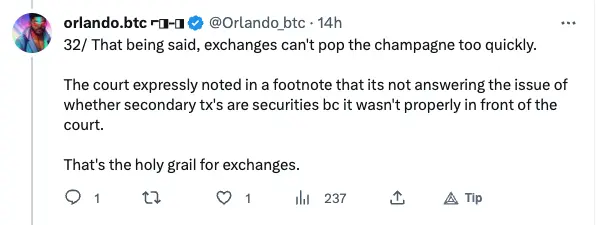
So, are secondary trades of cryptocurrencies, such as those occurring on exchanges, unregistered securities transactions? According to this decision, this question necessitates an individualized analysis for each case, leaving a considerable degree of uncertainty in its wake.
The court's decision that Ripple's institutional sales of XRP - the offerings, not the token itself - were indeed securities raises intriguing implications for other protocols and teams. Specifically, those who have sold tokens to early institutional investors who may have subsequently sold their tokens on secondary markets. This aspect of the ruling prompts a reevaluation of the legal status of such transactions and the potential regulatory implications for similar operations in the future.
The Implications
This landmark verdict underscores the complexity of the regulatory landscape for digital assets. It highlights the need for clear and comprehensive regulations that balance the need for investor protection with the potential for innovation in the rapidly evolving digital assets sector. As the industry continues to mature, such legal precedents will play a crucial role in shaping its future trajectory.
While the recent summary judgment in the SEC v. Ripple Labs case has provided some clarity, it has also opened new avenues for legal discourse in the digital assets industry. The SEC can still pursue Ripple for unregistered institutional sales, but many of Ripple's token distribution mechanisms have been deemed legal. Moreover, the verdict may have paved the way for the legalization of secondary market token sales.
However, the SEC is likely to appeal Judge Torres's ruling to prevent it from serving as a precedent for future legal arguments. This appeal process could potentially reshape the regulatory landscape for digital assets, setting new standards for what constitutes a security and an investment contract in this rapidly evolving sector.
For Ripple Labs and its key personnel, including CEO Brad Garlinghouse and founder Chris Larsen, the legal battle is far from over. They are now faced with the challenge of defending the sale of XRP tokens directly to investors. Unless they successfully appeal the decision that their institutional sales constituted an unregistered securities offering, they will have to confront the SEC in court.





