
You are reading an excerpt from our free but shortened abridged report! While still packed with incredible research and data, for just $20/month you can upgrade to our FULL library of 50+ reports (including this one) and complete industry-leading analysis on the top crypto assets.

Becoming a Premium member means enjoying all the perks of a Basic membership PLUS:
- Full-length CORE Reports: More technical, in-depth research, actionable insights, and potential market alpha for serious crypto users
- Early access to future CORE ratings: Being early is sometimes just as important as being right!
- Premium Member CORE+ Reports: Coverage on the top issues pertaining to crypto users like bridge security, layer two solutions, DeFi plays, and more
- CORE report Audio playback: Don’t want to read? No problem! Listen on the go.
SYS Token
The SYS token is the native cryptocurrency of the Syscoin platform. It is primarily used as a medium of exchange within the ecosystem, providing the underlying value for transactions and services. In the Syscoin 4.3 update, the role of the SYS token becomes pivotal for both transactions and consensus mechanisms. Masternodes, which require collateral of 100,000 SYS, validate transactions and secure the network. Additionally, the SYS token plays an essential role in Syscoin's new economic model, with block rewards and transaction fees contributing to the circulating supply and demand.
UTXOs vs. Accounts
SYS boasts a distinctive characteristic in that it embodies both UTXO and account-based token representations. Depending on the network it operates on, SYS can manifest as Syscoin Platform Tokens (SPTs) or ERC tokens.
The UTXO (Unspent Transaction Output) model is the foundational method of maintaining blockchain records and is utilized by cryptocurrencies such as Bitcoin, Zcash, and even new projects like Fuel. UTXO refers to the remaining amount of crypto unspent after executing a transaction. In the context of UTXO-modeled blockchain, individuals do not directly transact specific amounts of digital currency but instead transact in the denomination of UTXOs.
For a blockchain utilizing the UTXO model (like Bitcoin), there aren’t actually accounts or wallets at the protocol layer. Instead, bitcoin(s) simply exist as a list of unspent transaction outputs or UTXOs. Each UTXO has a quantity and a requirement for spending it. Transactions are generated by consuming current UTXOs and producing new UTXOs in their stead.
In the example below, Alice owns 1.2 BTC. She only needs to spend 0.2 BTC for her purchase. Therefore, because of the way the Bitcoin blockchain works, she will send all 1.2 BTC. 0.2 BTC will then go towards her purchase, and 1.0 BTC will be returned to her. It is very similar to only having a $20 bill and buying something for $5. You must hand over your $20 and get $15 returned to you.
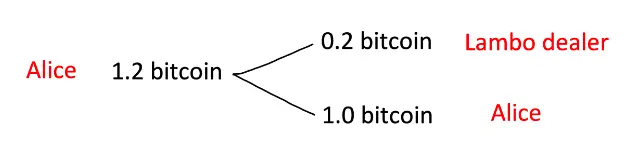
The UTXO (Unspent Transaction Output) model is similar to cash change in that it represents unspent funds but differs in that cash change has fixed denominations, while UTXOs can have fractional values. Additionally, cash change transactions are not recorded, while the record of UTXOs is permanently recorded on the blockchain ledger. The balance of an address can be determined at any point in time by tracing its recorded UTXOs.
The UTXO model has both advantages and disadvantages for Bitcoin-based wallets. On the one hand, it promotes privacy-preserving behavior as it is difficult to link digital assets to a specific wallet due to the creation of new addresses with each UTXO. On the other hand, it poses challenges in terms of user interface and experience as users are accustomed to the concept of accounts, whereas the UTXO model operates without the concept of an account, requiring users to rely on their wallet provider to manage a range of addresses and sum up the corresponding UTXO balances.
Accounts
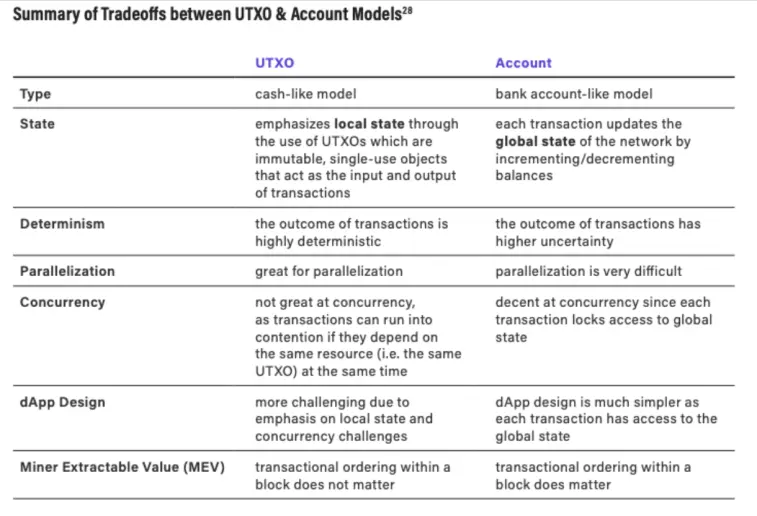
The Account-Balance model is an alternative method of maintaining blockchain records, primarily employed by smart contract platforms such as Ethereum and Binance Chain (BNB). It emerged as a solution to the challenges faced by Ethereum developers in adapting the privacy-focused, disconnected logic of the UTXO model to the accounts of decentralized applications (dApps).
Unlike the UTXO model, which resembles cash-based accounting, the Account-Balance model resembles bank-based accounting. On smart contract platforms, each wallet address has a single balance, which is increased or decreased with the receipt or transfer of funds respectively.
The Account-Balance model, as used in Ethereum, functions as follows:
- Jan has 10 ETH and wishes to transfer 5 ETH to Steve. The system first deducts 5 ETH from Jan’s account, resulting in Jan now having 5 ETH.
- The system then increases Steve’s account by 5 ETH. Since the system is aware that Steve already has 5 ETH, Steve’s final balance is 10 ETH.
While the Account-Balance model allows wallets to derive account balances in a much more straightforward and efficient manner compared to the UTXO model, it should be noted that it is more susceptible to double-spending attacks as compared to the UTXO model.
The method of record-keeping employed by a blockchain is crucial as it directly affects how a crypto wallet derives digital asset holdings. If a wallet cannot conform to the blockchain's mode of record-keeping, it is not functional. For instance, if a Bitcoin-based wallet provider is unable to handle the complexity of the UTXO model and track all the new addresses associated with UTXOs, it will result in a perceived loss of funds for the wallet user.
Source: Kraken
SYS Optionality
Owners of SYS have the option to incinerate their SYS to generate SYSX as SPTs, thereby benefiting from the high transaction speed provided by Z-DAG. Furthermore, they can employ the SYSX to create an ERC-20 variant of SYS through the SYSX Bridge. This ERC-20 SYS enables users to exploit all the features of NEVM, including the use of smart contracts.
Supply
SYS has a circulating supply of ~717 million SYS tokens and a market cap of $84.5 million. The token currently ranks within the top 300 projects by market capitalization on CoinGecko. At the time of writing, each SYS holds a value of ~$0.117. Syscoin's price history shows that its all-time high reached $1.30 on January 2, 2022, and the current price is approximately 90.98% lower than the all-time high.
Tokenomics Overview
SYS is uniquely structured to provide a sustainable and utility-oriented economic model. SYS tokenomics are built around the Ethereum Improvement Proposal 1559 (EIP-1559) concept, which removes a hard cap on the maximum supply of tokens. Instead, the supply of SYS tokens is dynamically managed via a combination of protocol emissions and the deflationary burning of transaction fees on the NEVM (Network-enhanced Virtual Machine).
Prior to the launch of NEVM mainnet and the integration of the EIP-1559 model, SYS had a capped maximum supply. Syscoin’s blockchain originated as a fork off of Bitcoin in 2014. At the time of the fork, the SYS token had a capped supply of 888 million compared to Bitcoin’s 21 million. There is no known genesis event as tokens had to be mined via proof-of-work in the early days of the Syscoin blockchain. However, with the new model in place, the supply of SYS can increase or decrease programmatically, providing an economic model that can operate indefinitely.
Syscoin's blockchain technology employs a SHA256 proof-of-work consensus, enabling it to be mined either exclusively or via merge-mining of any SHA256 PoW coin. The block time target is set at 150 seconds with a halving interval of approximately one year (or 210,240 blocks). Block rewards begin at 96.25 SYS, and they deflate by 5% per year to incentivize ongoing mining activity while controlling inflation.
Fees and Inflation/Deflation Mechanisms
Syscoin's unique approach to fees and inflation/deflation mechanisms strikes a balance between incentivizing network participants and maintaining the currency's economic health. It achieves this balance by carefully structuring block rewards and transaction fees.
Syscoin employs a block reward system that incentivizes miners, masternodes, and governance initiatives. This structure not only motivates participants to maintain and secure the network but also promotes community-led development through governance proposals. To counteract the inflationary effect of block rewards, Syscoin has a deflation rate of 5% per year. This rate effectively reduces the rewards over time, ensuring the coin supply doesn't grow indefinitely.
Once Syscoin transitions to the NEVM, its fee structure will change significantly. Taking cues from Ethereum's EIP-1559, Syscoin will incorporate fee burning into its structure. This mechanism further aids in combating inflation by burning a portion of the transaction fees. As such, the fee structure of Syscoin carefully incorporates both inflationary and deflationary mechanisms to maintain a healthy and sustainable token economy.
Syscoin 4.3 employs a dual system of fees and block rewards to manage inflation and deflation within the ecosystem. Transaction fees are split evenly between miners and masternodes, contributing to a self-sustaining ecosystem and incentivizing network security. Furthermore, the Syscoin platform uses a deflationary mechanism, reducing block rewards by 5% every 210,240 blocks, approximately once a year. This built-in deflation mechanism, combined with potential increases in transactional demand, can exert upward pressure on the token's value over time.
Block Rewards
Block rewards within the Syscoin ecosystem serve as the central stimulus for network participation and the securing of the blockchain. The entire reward system is delicately balanced to incentivize miners and masternodes and foster an environment of continued growth and stability.
At the heart of the reward system is the base block reward, set at 96.25 SYS per block. This reward is issued to miners and masternodes for validating and confirming transactions within the network, creating a monetary incentive for their vital services. However, this reward isn't constant. Instead, it is subjected to a programmed deflation rate of 5% every 210,240 blocks, which roughly translates to one year. This deflationary mechanism serves as an economic tool to control the supply of SYS tokens over time, potentially increasing the token's value as the emission rate decreases.
In addition to the base block reward, there is also an NEVM reward. This reward, set at 10.55 SYS per block, is derived from the integration of the Ethereum protocol into the Syscoin network via the Notary Ethereum Virtual Machine (NEVM). These rewards do not follow the deflationary scheme and remain constant. It follows the EIP1559 model, a proposal to reform the Ethereum fee market to make it more efficient and easier to understand.






