
You are reading an excerpt from our free but shortened abridged report! While still packed with incredible research and data, for just $20/month you can upgrade to our FULL library of 50+ reports (including this one) and complete industry-leading analysis on the top crypto assets.

Becoming a Premium member means enjoying all the perks of a Basic membership PLUS:
- Full-length CORE Reports: More technical, in-depth research, actionable insights, and potential market alpha for serious crypto users
- Early access to future CORE ratings: Being early is sometimes just as important as being right!
- Premium Member CORE+ Reports: Coverage on the top issues pertaining to crypto users like bridge security, layer two solutions, DeFi plays, and more
- CORE report Audio playback: Don’t want to read? No problem! Listen on the go.
Fees and Transaction Costs
Avalanche borrows from Ethereum's EIP-1559 fee structure with some important differences. Users pay two fees for transactions: 1) a base fee set by the network based on block space demand and 2) a tip to determine how their transaction is ordered in a block.
Transaction fees for all three Avalanche chains, as well as future subnet subscription fees, are paid in AVAX and ultimately burned. This eliminates AVAX from the circulating supply, helping to somewhat offset the current high inflation rate. Gas fees are dynamic and based on demand. In early 2022, the amount of gas used compared to the C-Chain’s capacity (a proxy for usage and demand) was near all-time highs. However, since May 2022, the combination of the crypto bear market and Avalanche’s top dapp Crabada moving to their own subnet has caused a dramatic decline in C-Chain gas usage (chart below).
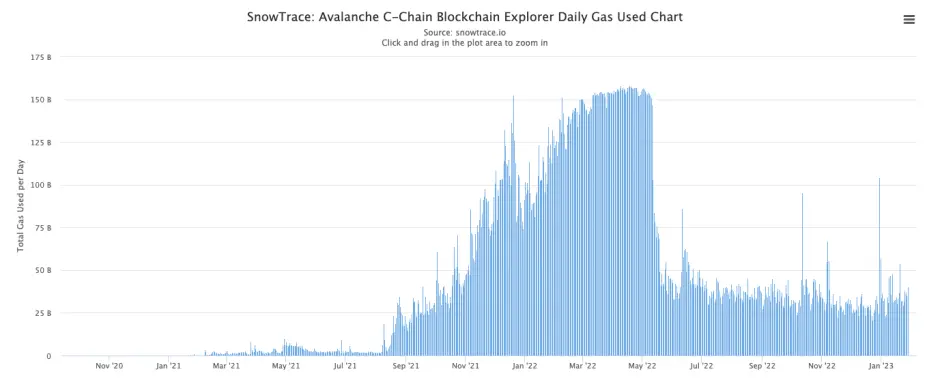
Total gas used per day, AVAX C-Chain. Source: SnowTrace
For most of the 2021 bull market, nearly every Avalanche metric was on the rise, including protocol revenue (fees). This is the sign of a healthy network that has real demand for block space. In fact, in April 2021, Avalanche generated the third-most fees behind Ethereum and Binance Smart Chain. However, since Cradaba moved to its own subnet (fewer fees for the L1) plus the market downturn, Avalanche, as of Q1 2023, is now only producing ~$20,000/per week, good for ~20th place among L1s and dapps.
 An example of Avalanche fees. Source: CryptoFees
For an L1 protocol, the burned coins minus token issuance can be seen as a form of profit. This is because, should more coins be burned than issued, the remaining coins' value (theoretically) increases. However, most protocols, Avalanche included, are nowhere near being “profitable,” as can be seen in the image below. Avalanche issuance far outpaces the number of tokens burned from transactional demand.
 Estimated pseudo-profit margin. Source: Coinshares
AVAX supply is ultimately capped at 720 million tokens, meaning that even if adoption grows, more fees get burned. However, if subnets do proliferate, the amount of AVAX that gets burnt could be slowed as protocol fees stay muted. This has, thus far into 2023, proven to be accurate. The image below illustrates the dampening effect subnets have had on average daily transaction fees (red). Total daily transactions have 4-5x from Q2 2022, but fees (revenue) generated have cratered. The average AVAX transaction costs in USD decreased by ~85% over the course of 2022. This decline contributed to the ~94% year-over-year decrease in AVAX income. Due to the fact that Avalanche burns all transaction fees, a decrease in transaction fees also decreases the burn rate of AVAX.
Unless more subnets can gain traction to counterbalance the reduction in fees, the protocol may have long-term sustainability issues. However, those are not immediate concerns and are a fairly ubiquitous issue for all chains (except, arguably, Ethereum).
 Source: Messari
This is good for users (lower fees) but, at least, a temporary net negative for investors/HODLers as there is less AVAX burning to offset net token issuance. It is temporary because, remember, AVAX has a capped supply. As of Q1 2023, nearly 2.1 million AVAX have been burned, mostly due to C-Chain activity.
 Total AVAX burned fees. Source: Avascan
The minting process offsets the transaction fee burning. Therefore, there’s no danger of the system grinding to a long-term halt due to the gradual destruction of coins. Plus, note the minting function and fees burned can be adjusted by governance.
Transaction fees differ depending on the type of transaction. Simple payments of AVAX carry little cost, while creating new subnetworks carries the heaviest fees. Fees carry a sliding-cost function where the fee is set by a globally-verifiable fee function and not by the transaction’s issuer. As the network congestion increases, fees increase. After specified time periods, the function is recalculated to accommodate natural increases in transaction volume over the network.
Unlike Ethereum’s model, where every transaction pays some gas, Avalanche uses a transaction tier model for two types of transaction-processing mechanisms. All keys with positive account balances can immediately interact with the platform where the fees are based on an allotment mechanism, functionally similar to a tiered payments model commonly found in cloud computing platforms. Every transaction names a sender address (invoker) which is checked for current invocation allotment.
If this address still has free invocations left, the transaction requires no fees to be attached by the sender. Past a certain amount of calls, the sender needs to attach fees based on the resources used to compute the transaction. Fees may also be paid via computation. Future developments will support free frequency-limited transactions, which don’t require fees in coins but require pre-computation.






