
You are reading an excerpt from our free but shortened abridged report! While still packed with incredible research and data, for just $20/month you can upgrade to our FULL library of 50+ reports (including this one) and complete industry-leading analysis on the top crypto assets.

Becoming a Premium member means enjoying all the perks of a Basic membership PLUS:
- Full-length CORE Reports: More technical, in-depth research, actionable insights, and potential market alpha for serious crypto users
- Early access to future CORE ratings: Being early is sometimes just as important as being right!
- Premium Member CORE+ Reports: Coverage on the top issues pertaining to crypto users like bridge security, layer two solutions, DeFi plays, and more
- CORE report Audio playback: Don’t want to read? No problem! Listen on the go.
Cardano's Ouroboros protocol is a revolutionary step in the world of blockchain technology. Learn about its unique features, such as epochs, VRF, and stake pools, that make it more secure and efficient than other protocols.
Cardano is unlike most other smart contract protocols in that it was not designed to resemble or be compatible with Ethereum and its Ethereum Virtual Machine (EVM). Cardano more closely resembles a POS smart contract-enabled version of Bitcoin, as opposed to being based on Ethereum. The key differentiators in Cardano, apart from other projects, include the Ouroboros base protocol, its unique multi-layer solutions, the Extended Unspent Transaction Output (EUTxO) accounting model, and the use of Haskell as the base programming language.
Consensus Mechanism
In order for a decentralized network of nodes/computers to function properly, the independent participants in the network need to reach an agreement over a shared state (e.g., who owns what on a blockchain). And while doing this, the network should remain fault tolerant with valid consensus despite imperfect information or malicious actors (Byzantine Fault Tolerance). Different blockchains implement different methods of doing so, but all are attempting to create a “consensus algorithm” that best fits their chain.
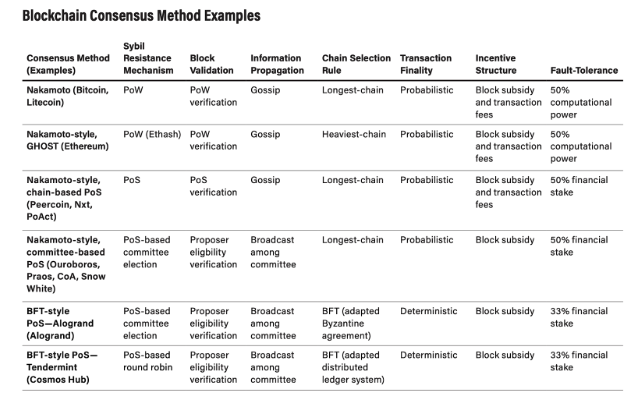
Consensus algorithms are used in public blockchain/distributed computer design in order to convince nodes in a decentralized system to agree on the next valid state. Within the context of public blockchains like Bitcoin and Ethereum, this signals that at least 51 percent of network nodes agree on the network's global state. In addition, a consensus algorithm often gives a guarantee (probabilistic or deterministic) that network nodes can reach consensus on the next valid state even if a minimum number of nodes in the system are adversarial. In Bitcoin's case, the consensus algorithm is Nakamoto Consensus. For Ethereum, it is known as Ethhash.
Nakamoto’s consensus requires waiting for the creation of several additional blocks to ensure transactions cannot be reverted. As a result, Nakamoto chains have high uptime (they do not go down or stall), but low transaction speed due to their probabilistic finalization guarantee. This is because Nakamoto Consensus requires waiting for “enough” blocks to be mined on top of the block that includes the user’s transaction that reorganizing or reverting the blockchain becomes economically impractical, ensuring some “economic certainty” but never theoretic/deterministic certainty.
One issue with allowing anyone to participate in the consensus of an open network is that one malicious actor can create endless nodes, thereby creating multiple identities, as seen by the blockchain. If one person could create enough nodes, they could theoretically control the network, known as a Sybil attack. For this reason, blockchains also need a Sybil Resistance mechanism in addition to its Consensus algorithm.
A Sybil resistance mechanism, on the other hand, is the process through which a decentralized system deters Sybil attacks. A Sybil assault occurs when a single node can flood the network with several identities and utilize them to obtain an outsized amount of power.
Ideally, each node in a decentralized system would represent one vote. If a node can impersonate multiple other nodes and get 100, 1,000, or more than 10,000 votes instead of one, then the system is vulnerable to assault. Sybil attacks are often deterred by requiring nodes to show proof of a difficult-to-fake resource (unlike online identities, which are easy to forge).
Proof of Work - Hash power (e.g., Bitcoin)
Proof of Stake - Tokens (e.g., Cosmos, Polkadot, Tezos)
Proof of Space-Time - disk space (e.g., Chia, Filecoin, etc.)
Proof-of-Authority - (e.g., Algorand)
Cardano is a multi-layered protocol that utilizes Proof-of-Stake consensus throughout the system: the CSL, where value is transferred, and the CCL, where computation takes place. The separation into the settlement layer (CSL) and computation layer (CCL) was created to increase efficiency and scalability and to increase the network’s capacity for protocol changes and soft fork implementations. By separating the layers, the network can theoretically optimize each without compromise, as argued in other current blockchains. However, both layers still use the PoS consensus protocol, Ouroboros. It follows the “longest chain” rule (Nakamoto-style consensus) in which nodes accept whichever blockchain is the longest as the "true" state of the transaction ledger. In PoS chains like Cardano, the chain with the most validator votes is considered "longest."
Ourobouros
The Cardano 1.5.0 Mainnet was released in March 2019, allowing for the support of Ourobouros, which uses Byzantine Fault Tolerant-Proof-of-Stake (BFT-PoS). The Ouroboros protocol organizes the passage of time into distinct epochs, each spanning a period of five days. Within each epoch, a total of 21,600 slots are defined, each with an approximate duration of 20 seconds.
Ouroboros consists of “Slot Leaders," entities chosen by fellow token holders. Slot Leaders confirm transactions and create new blocks, similar to miners in Bitcoin but do so at an average of every 20 seconds vs. 10 minutes.
Utilizing a verifiable random function (VRF), each node generates a random number. When the generated number falls below a certain threshold, the corresponding node is designated as the slot leader and is responsible for proposing a new block. “Input endorsers” are another set of stakeholders in the Cardano network which attest to blocks and transactions produced by the Slot leaders.
In the event that multiple nodes achieve this threshold, all will produce blocks, with the next selected slot leader building upon the lowest VRF number among them. The specific threshold value is contingent upon the amount of ADA held by the node, with larger staking pools having a higher likelihood of becoming a slot leader. In its current implementation, Ouroboros allows stake pool operators to be aware of the slots they will lead in advance, while other validators and users are not privy to this information. This added layer of uncertainty serves to enhance the security of the protocol by effectively thwarting potential distributed denial-of-service (DDOS) attacks targeting slot leaders.
 Source: Kraken
Ouroboros is a robust and safe PoS protocol that is protected against a wide range of attacks and security issues, including stake grinding. In addition to security, the design of Ouroboros improved throughput compared to the base layer Ethereum (~25 TPS), with initial testing reaching up to 257 TPS at the base layer. This amount is substantially lower than L1 peers. However, one transaction on Cardano is capable of more than a single transaction on other smart contract EVM chains (i.e., due to features like token bundling).





