
Investors, at first glance this looks like a technical operation.
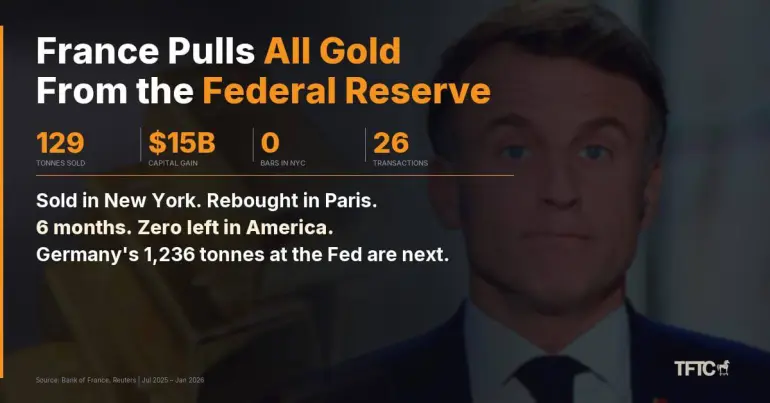
France retrieved 129 tonnes of gold from the Federal Reserve Bank of New York vault — worth approximately $15 billion.
But that’s not the key takeaway.
They didn't just move the gold.
They sold it in New York and bought new gold in Paris.
26 transactions over 6 months.
The official version from the Banque de France:
"Updating bullion standards."
Sounds logical.
But the structure of the operation suggests otherwise.
If you own physical gold in a vault —
you simply take it back.
You don't sell and repurchase it if access to the asset is free and unrestricted.
This is atypical behavior for a sovereign reserve.
Now, the bigger picture:
France has completely withdrawn its 2,437 tonnes of gold from the U.S.
All of it is now stored in Paris.
Zero dependence on American vaults.
And this is no longer an isolated case.
Germany — 1,236 tonnes still remain in the U.S.,
but domestic pressure is mounting: "Bring it home."
What does this mean?
This isn't about "gold being better than Bitcoin" or vice versa.
This is about trust between nations.
Gold is the ultimate settlement layer.
An asset with no counterparty risk.
And when countries start to:
— withdraw it from foreign jurisdictions
— change their storage structures
— reduce external dependency
that is a signal.
The system is becoming more fragmented.
The world is moving away from a single center toward multiple poles.
Where:
— gold is a reserve of trust
— Bitcoin is an alternative to the system
— fiat is a tool of policy
And the further we go, the stronger this stratification will become.





