
Future #1. The year is 2032. Your suburban home and SUV have been confiscated by the world government under the emergencies fairness act of 2024, and you have been designated to an energy-efficient 300 square foot apartment in the nearest metropolis. Sitting on your rented sofa, you begin to reminisce about the family BBQs you used to have as a child. Suddenly you have a craving for a beef hamburger, only to realize the social credits on your smart phone will only allow you to purchase government-approved lentils and powdered cricket meat from Uber Eats.
Peering out at the North Korean style cityscape, you feel that the cold weather is starting to get you down. You recall the family vacations you used to take to Mexico as a child, and you begin to browse through flights from your Apple-approved vacation app. Unfortunately they are all grayed out because the app knows that you've already Uber'd 300 miles twice to visit your parents this year. You will have to wait until next year for your carbon credit score to reset.
Future #2. The year is 2032 and the world is fractured. The United States is no longer "united" by any means, with some wealthy states having made Bitcoin and other cryptos legal tender, while poorer ones have waited for the failing world government to save them. The fiat dollars you hid under your mattress during the banking panic of 2023 are no longer accepted by local merchants.
A few businesses accept gold and silver for their goods, but most simply display the cryptocurrencies they are willing to accept. The price of a beef burger at the local shop has skyrocketed, and the owner only accepts Bitcoin. You realize that you don't have any, but thankfully the wallet on your smartphone is integrated with a cross-chain decentralized exchange that will convert the cryptos you own immediately into the currencies the merchant is willing to accept.
... These are two possible futures, and the direction we go will depend mainly on the decisions every individual makes as this worldwide financial crisis continues to unfold.
Inflation, Stagflation, or Hyperstagflation?
Now we are in the summer of 2022. Thanks to trillions of dollars of money printing over the past two years (this time going directly to individuals in the form of helicopter money) gas and food prices continue to rise with no end in sight. People are beginning to realize that this inflation is no longer "transitory" as the government officials once told them.
To make matters worse, central banks have started raising interest rates (ever so slightly) in a vain attempt to combat said inflation. As a result, indebted companies which took advantage of decades of low interest rates are starting to layoff employees in order to service their debt, in turn crashing the stock market as investors prepare for worsening economic conditions. Moreover, the housing market is falling off a cliff as nobody can afford the higher interest rates on their mortgages.
As a result of these higher interest rates, major banks are predicting that we are about to enter a recession. But let's be honest here. We've been in a global recession since late 2019 when the yield curve inverted, and Japanese and German GDP were already in contraction. The already poor economic climate was only exacerbated by the extreme lockdowns and travel restrictions of 2020 and 2021.
The idea that the economy was actually growing throughout lockdown after lockdown in China and the West is laughable. The only thing that gave the illusion of a growing economy was the trillions of dollars of central bank money printing, which propped up the stock market and bailed out millions of failing businesses and laid off individuals. But I digress...
At this point, the central banks are indeed stuck. Continuing to raise interest rates will cause the stock markets to crash further, put over-indebted companies into bankruptcy, and force them to layoff ever more of their employees. On the other hand, lowering interest rates and resuming money printing may save the stock market one last time, but will add fuel to the fire of hyperinflation, lead to a currency crisis, and cause people to finally lose faith in the dollar.
The Fed recently stated that they plan to gradually raise interest rates to 3-4% by the end of the year, in order to fight inflation that's officially at 8.9%, when we all know that, in reality, it's more like 20-30%. The question is, how high can the Fed actually raise rates this time around before the economy implodes?
A quick glance at historical interest rates over the past few decades illustrates an obvious trend:
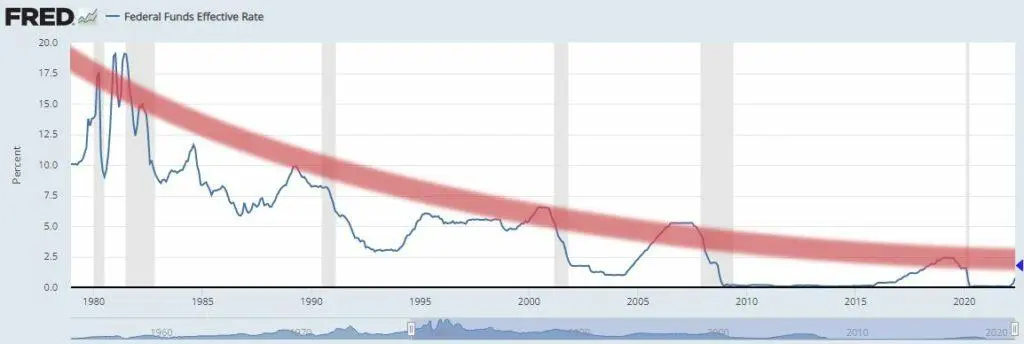
The Fed has never been able to raise interest rates back higher than their previous peak without causing some kind of economic calamity, such as bursting a housing bubble or crashing the stock market. The last time the Fed increased rates, they only managed to raise them slightly above 2% before the stock market collapsed, and they were forced to reduce them back to zero.
As per the above chart, we have indeed "kicked the can" as far as it can go in our debt-based fiat financial system. We are finally at a crossroads, where the old financial system needs to be replaced with something new.
The Elite's Solution (The Great Reset)
A lot of mainstream pundits, and well-known Fed critics in the Twittersphere will claim that the Fed and other central banks have been foolish to keep rates so low, for so long, implying that they are buffoons who don't know what they're doing.
Foolish people don't get into a position where they control the money supply of nations. Rather, the clever and powerful people behind the central banks know exactly what they're doing, and have prepared a solution to this inevitable dilemma, namely The Great Reset.
Since the financial crisis of 2008, quantitative easing and low interest rates have consolidated power into the hands of fewer and fewer people, who have used free money to take control of the vast majority of banks and corporations.
All they need is one final financial crisis to increase centralization to the point where the elite class have complete control over the population, to the extent they can even dictate how often a person travels and what foods they are allowed to eat. By using out-of-control inflation as an excuse to continue raising interest rates, that financial crisis could come off as though it were an accident.
CBDCs
One major component of The Great Reset is this concept of a Central Bank Digital Currency (CBDC) that major nations have been quietly engineering for years. The idea of a CBDC has been creeping into the mainstream consciousness since around 2020, when mainstream news agencies started to casually report on them.
A programmable CBDC would give the government complete control over how citizen's use their money. For example, allowing credits to only be used to purchase certain goods and services that are eco-friendly or in line with "woke" culture. These credits could also have an expiration date, such that they must be used up within the month, for example.
How the elite plan to transition citizens from the old digital fiat system into CBDCs isn't clear, because simply moving the population from dollars, euros and yen to CBDCs would not eliminate the debt problem, which has been building up over decades. If the central banks decide to continue raising interest rates as planned, there will be massive national, corporate and individual bankruptcies, and the need for some sort of coordinated "debt reset" in which there will be winners and losers, and likely a lot of social unrest.
Good or Evil?
For all we know, the powerful people who are directing this grande transformation may have the best intentions for humanity at heart, and are simply trying to steer a population on autopilot away from ecological disaster.
After all, one could argue that the world is indeed vastly overpopulated and, as a species, we have been destroying the natural environment with reckless abandon for several decades. A reduction in the population, a transition to green energy, and more sustainable practices (such as paper straws that disintegrate in your mouth within a few minutes) is perhaps what we need to once again live in balance and harmony with the natural world.
However we must remember the old adage that absolute power corrupts absolutely, and the concentration of power has reached unprecedented levels in recent years. Whether or not The Great Reset is good or evil is a philosophical question that every individual will have to ponder on their own, and come to their own conclusions. However, we should at least be aware that this bold plan exists and is being rolled out as we speak.
The people should also be aware of an alternative financial system that continues to gain traction. And if adopted on a mass scale, would completely change humanity's concept of money, and be precisely what we need to transition peacefully into a more sustainable future that also respects individual liberty.
The Grassroots Solution (Cryptocurrencies)
In 2008, an pseudonymous individual by the name of Satoshi Nakamoto was appalled by the bailout of irresponsible banks by innocent tax payers, and came up with an idea for a new form of money called Bitcoin. The idea was ridiculed by many at first, and took quite a few years to take off, but has since spread like wildfire in a decentralized, grassroots fashion.
Bitcoin, and crypto in general, came out of left field for the elite. The rise of cryptocurrencies has been chipping away power from traditional institutions, and providing regular people with an escape hatch out of the failing financial system. Essentially the elite underestimated crypto's potential and rate of adoption. It is truly a thorn in the side of those who are trying to orchestrate the Great Reset and consolidate more power.
We already see some smaller countries like El Salvador and Central African Republic refusing to go along with the implementation of CBDCs. Instead, they are adopting public cryptocurrencies like Bitcoin, taking a calculated risk that they will benefit by being ahead of a longer-term adoption curve, and the revolt of several other nation states.
This trend is going to continue, with more smaller countries opting out of IMF slavery and choosing to adopt crypto instead. We won't see the larger countries adopting crypto, but small states and towns within these countries will, leading to the division of what were once unified nations. In the end, crypto will transform governance and dissolve nation states as we know them today.
As more small countries, states, cities, businesses and individuals choose crypto over a financial system that no longer serves them, fiat currencies will be in less demand, they will continue to lose value, and cause more entities to adopt crypto. This cycle will repeat until cryptocurrencies have become ubiquitous throughout the world.
But What About The Recent Market Carnage?
The Fed's interest rate hikes have thrown financial markets into a panic. Despite cryptocurrency's solid fundamentals in terms of technology and adoption, it has been caught up in the mayhem.
The problem is that most traditional investors still see cryptocurrencies as "risk-on" assets, and sell them along with their tech stocks. What these investors don't realize is that properly engineered cryptocurrencies are not corporations, but rather decentralized, censorship-resistant, global currencies, which have a transparent supply. Therefore, they are a better form of money - a replacement to the dollar, the yen, the euro, etc. The trend of adoption and higher demand for crypto over the past decade is a clear indication that this is our inevitable future.
Consider that only seven years ago the entire crypto market was valued at merely $5 billion. Despite the recent crash from $3 trillion, the entire market is still valued at close to $1 trillion, which is 200x from where it was only seven years ago. It's absolutely ridiculous to think that this marks the end of crypto, especially given the prior crashes of over 50% in previous years. The long-term trend towards greater valuations is still intact, as illustrated in Bitcoin Magazine's recent tweet:
After you have been in the space for more than a few years, you become desensitized to these wild market swings because you know that nothing will stop people with purpose in their hearts. Dedicated and talented teams continue to work away on their crypto projects despite the steep market decline.
In fact, what these crashes do is cleanse the market of projects and participants who were only involved for a quick buck. It filters out those who didn't have the long-term vision of a sustainable financial system for future generations, and who feared the necessary changes that would have to be made in order to implement it.
The Glorious Decoupling
So how will cryptocurrencies eventually decouple from traditional assets, such that their prices are no longer correlated?
First of all, investors need to wake up to the fact that central banks have no chance at stopping inflation. Secondly, ordinary people need to drop the belief that the US dollar will remain a valuable world reserve currency despite the hyperbolic printing that has happened over the last two years.
It seems that non-transitory hyperinflation may be the only way to shake this denial, and when enough people finally make this realization a mass transition to cryptocurrencies will occur along with a fundamental transformation of our economy.
Conclusion
So how can you prepare yourself, friends, and loved ones for the tumultuous times ahead? Sharing of knowledge is key. Sometimes it requires taking a leap of faith while everyone surrounding you continues stuck in their old beliefs and recency biases.
Accepting reality and maintaining a well-diversified portfolio of cryptocurrencies may be your best bet. And if you're not located in a crypto-friendly jurisdiction, at least be prepared psychologically, emotionally, and physically for the changes that lie ahead.
All data points to the collapse of the traditional financial system and fiat currencies. I suspect we will see a battle between CBDCs and decentralized finance for years to come. It's not going to be a smooth transition, but the journey will make us a stronger and wiser species.
Do you think we are headed into a world of strict government control and CBDCs, or a global free market where decentralized cryptocurrencies are the means of transacting?
Follow Me
Be sure to follow me here on Publish0x so you don't miss any of my future articles.
As well as on Twitter @brennanhm






