
Since the financial crisis of 2008, major central banks around the world have engaged in an unprecedented monetary experiment. To pull the world out of the great recession and maintain the longest economic expansion in history, they have kept interest rates suppressed at historically low levels and expanded their balance sheets into the trillions of dollars.
Bitcoin was another experiment that was born out of the same financial crisis, created with the goal of bringing integrity and accountability back to finance. Engineered to be limited in supply and transferable peer-to-peer, Bitcoin leaves out the need for a bank to facilitate transactions.
This post covers how the current financial system is failing us, and how Bitcoin and other cryptocurrency platforms have set the stage for a paradigm shift in finance.
Unconventional Measures - ZIRP, NIRP, and Quantitative Easing
Since the financial crisis, the world's central banks have enacted unprecedented monetary policy in the form of Zero Interest Rate Policy (ZIRP), Quantitative Easing (QE), and Negative Interest Rate Policy (NIRP). All of which were meant to be temporary measures to get the economy out of recession.
Zero Interest Rate Policy (ZIRP)
ZIRP artificially suppressed interest rates to 0%, allowing governments and corporations to borrow money from banks at virtually no cost. While this has stimulated the economy to a degree, the negative implications have counteracted the original intention.
- Misallocation of capital - Unprofitable, poorly-managed companies have been able to stay in business thanks to free money. These inefficient companies have been propped up, preventing more efficient companies from taking their place. This should not happen in a healthy capitalist economy.
- Artificial stock market gains - Low interest rates have allowed corporations to borrow money to buyback their own stocks, increasing their Price to Earnings ratios (the same amount of earnings divided among a smaller amount of shares). Therefore stock prices rise, even though real revenue growth is weak.
- Debt accumulation - Governments, corporations and individuals have gone on a debt-based spending spree because borrowing has been so cheap. Governments have increased their deficit spending, corporations have borrowed money to buy back their own stocks, and individuals have taken out loans to purchase homes and pay for college.
As of 2020, world debt has grown to $250 trillion dollars. The exponential debt build-up can be represented by the US national debt, which has increased from $10 trillion in 2008 to more than $23 trillion in 2020:
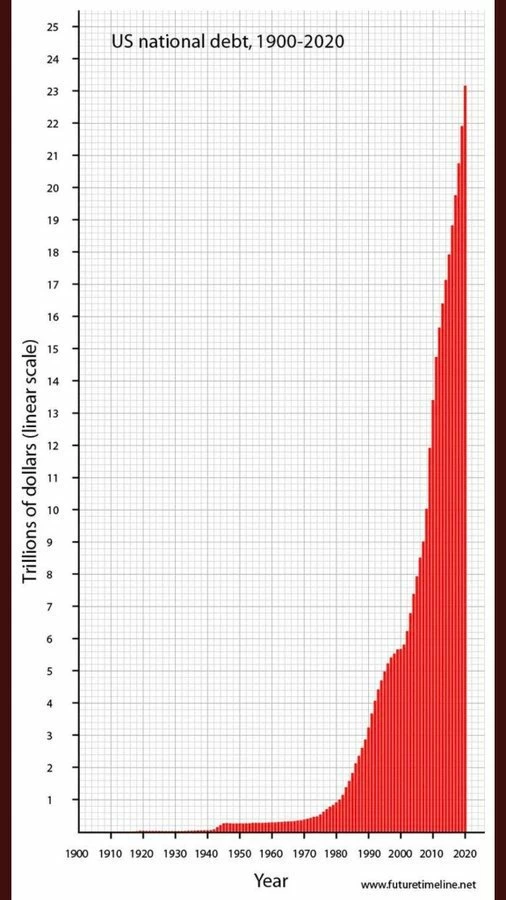
It doesn't look sustainable to me.
From 2015-2018 the US Federal Reserve attempted to normalize interest rates by increasing them from 0% to slightly above 2%. By the winter of 2018 the stock market couldn't handle it anymore and crashed, causing the fed to reverse course. Throughout 2019 they reduced interest rates three times, back towards 0%.
Quantitative Easing (QE)
Quantitative Easing (QE) is a process whereby central banks create money out of thin air, and give it to other banks in exchange for assets such as government bonds or mortgage-backed securities. It has been used to bail-out banks, create a "wealth effect" to increase spending, and keep financial markets on life support.
When a central bank does a round of QE, their balance sheet increases and the money supply goes up. Before the financial crisis of 2008, the combined balance of all central banks' assets was approximately 7 trillion dollars. After multiple rounds of QE, it has increased to about 22 trillion;
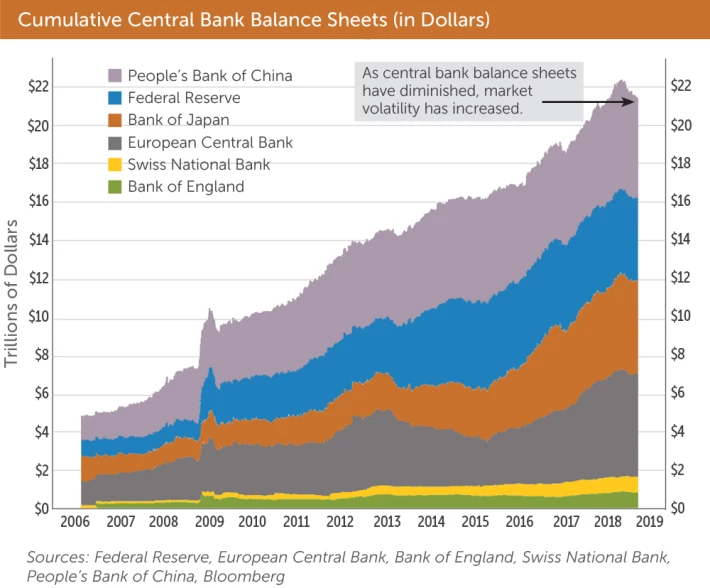
Some negative implications of QE are:
- Moral hazard - Banks don't have to be responsible with people's money because they know the central bank is always there to bail them out.
- Increased gap between the rich and poor - All this new money has pumped up the price of stocks, bonds and real estate, increasing the wealth of individuals who owned those assets before QE, and impoverishing those who did not.
The correlation between QE and stock prices is clear:
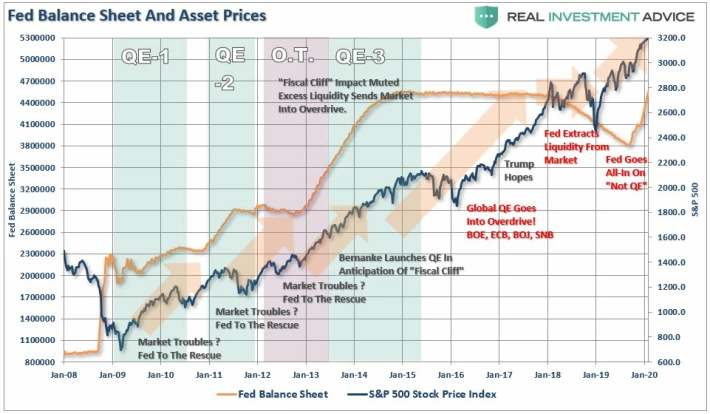
In 2018 the US Federal Reserve attempted Quantitative Tightening (QT) - a reversal of the debt they had accumulated over past rounds of QE. However, due to a lending crisis in the repo market last September, QT was halted and they have started to increase their balance sheet again.
Negative Interest Rate Policy (NIRP)
Europe and Japan have gone past ZIRP and entered the land of NIRP, where borrowers are actually paid to take out loans.
This means that investors lend their money to governments in exchange for bonds that payout less at maturity. Why would anyone do that? Likely because they are expecting more rounds of QE from the central banks to push up the price of their bonds, at which point they can sell them at a higher price to another investor (maybe your pension fund?).
In 2019, the amount of negative yielding bonds worldwide reached a record 17 trillion dollars:
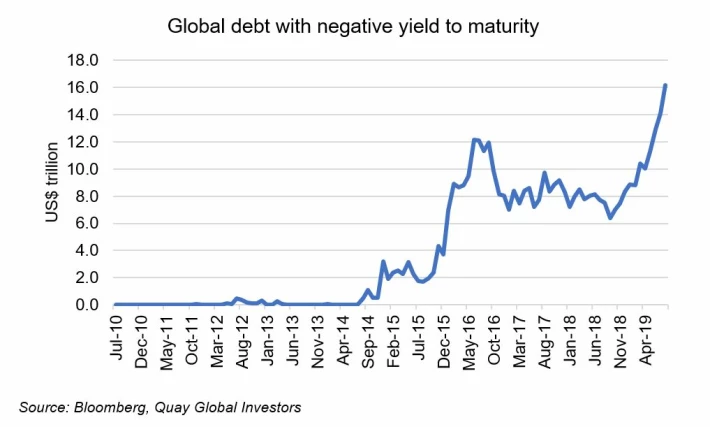
Some implications of NIRP:
- Elimination of cash - In a negative interest rate environment, savers prefer to keep their money as cash, rather than have it slowly eaten away in a bank account. This is why many countries are pushing for the elimination of cash.
- Artificial stock gains - It forces savers, who cannot take their cash out of the bank, to put their money into riskier assets like stocks, artificially increasing the value of the stock market.
The Temporary Solution Has Become Permanent
The central banks promised that ZIRP, NIRP and QE would only be temporary measures to boost economic growth, and that once things improved, they would normalize interest rates and reduce their balance sheets. However, despite the "economic recovery", these measures remain in place, and continue to keep financial markets on life support. They have attempted to reverse both ZIRP and QE and failed, proving that this financial experiment is not sustainable.
It has been made clear that neither the stock market, nor the banking system, can survive without central bank assistance in the form of ZIRP, NIRP, and QE. Thanks to these policies, the wealth gap has widened and debt continues to grow at an exponential rate. This debt monstrosity can only be managed if the economy grows along with it. Unfortunately (well, fortunately if you care about environmental preservation and global warming) the economy is decelerating and heading towards a recession.
Looming Recession
A recession occurs when economic growth contracts for more than two quarters. It's been over a decade since the last recession, and many believe that we are long overdue for one.
There are many signs of an impending global recession. Japanese and German GDP growth are already in contraction or non-existent. Manufacturing PMI levels have been decreasing throughout the Eurozone. International trade is slowing. ISM manufacturing indexes are in decline. U.S. jobless claims are starting to spike.
Last August, the yield curve between the three-month treasury and the ten-year bond inverted. Historically, this has always been a precursor to a recession:
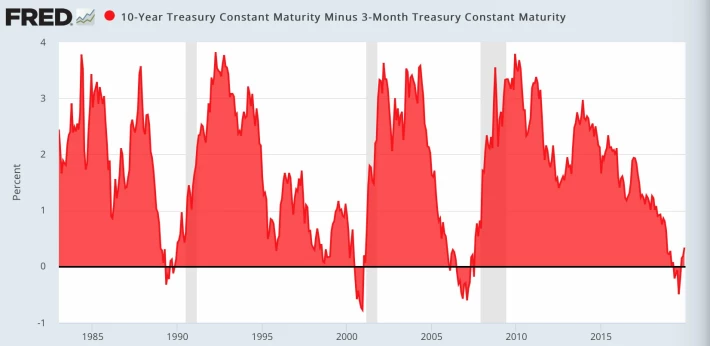
The grey areas in the above graphic represent recessions, which have all occurred shortly after a yield curve inversion.
We have been conditioned to believe the central banks can save us from recessions. To get out of the recessions of 1990, 2000, and 2008, central banks lowered interest rates and/or printed money to stimulate economic growth. Now, with current interest rates near zero (or negative) and central bank balance sheets sitting at record highs, economists are worried that the central banks have run out of ammo to fight the next recession.
Of course, there is no limit to the amount of money central banks can create. They could buy stocks directly (Which Japan and Switzerland have already done) and bailout failing corporations and pension funds if they wanted to. However, if they continue to create money to prop everything up, eventually there will be a currency crisis, in which people lose faith in the value of their government's money.
The End Of US Dollar Hegemony
It's not only gold bugs, permabears and crypto enthusiasts that are predicting an end to fiat currencies. Prominent people in the financial sector have already announced their weening confidence in the US dollar.
Mark Carney, governor of the Bank of England, has said the dollar is too dominant and could be replaced by a digital currency. Robert Kaplan, the Federal Reserve Bank of Dallas President, has stated "don't rely on the dollar remaining the world's reserve currency". Christine Lagarde, former head of the International Monetary Fund has said that cryptocurrencies might give existing currencies a "run for their money". And Deutsche Bank, the largest bank in Germany, recently published a paper predicting that digital currencies will replace fiat currencies by 2030.
The Big Picture
We live in a system where everything has been designed for infinite growth, despite the fact that we have limited resources. Central banks have been propping up a failing economy over the past decade by creating trillions of dollars to pump stocks, bonds and real estate into the stratosphere. This has done more to increase the wealth gap than boost the economy.
Banks and Too Big To Fail corporations continue to be bailed out at the expense of future generations, who are saddled with all this debt. Governments obviously cannot pay down their debts and are just kicking the can down the road, hoping their children and grandchildren will solve the problem. Unfortunately, we are seeing falling birth rates in developed countries, as young couples can no longer afford to have children.
The definition of insanity is doing the same thing over and over again and expecting a different result. We continue to throw money at this problem, in complete denial that we have reached the limits on growth. Instead of this new money fueling real economic growth, it's blowing an enormous bubble into stocks, bonds and real estate.
Eventually, this situation will reach a boiling point. When enough people realize there is no real production backing these overvalued asset prices, the bubble will burst, and we will see massive inflation as all the money created over the past decade goes into real goods and services, precious metals, and cryptocurrencies. At that point, I believe there will be a paradigm shift in the way we think about money.
Bitcoin, Cryptocurrency and the New Sustainable Economy
What perfect timing for the birth of a new financial system.
Bitcoin was born out of the financial crisis, perhaps an idea implanted into Satoshi Nakamoto's brain by god to save humanity from this failing financial system. Like a virus, it has spread like wildfire around the globe.
Bitcoin is a very secure form of money for the following reasons:
- Open-source, meaning anyone can look at Bitcoin's code to see how it works
- Backed by sound math, which has been proven scientifically
- Stored redundantly in computers spread around the world
- Open, transparent ledger, that can be audited by anyone, meaning we know exactly how much Bitcoin exists.
Bitcoin is not debt-based money that can be printed to infinity. But rather an asset limited in supply, just like the Earth's resources.
Some people argue that while Bitcoin is limited in supply, the number of cryptocurrencies that can be created is infinite. While this is true, only the cryptocurrencies that innovate and build communities will retain any value. Who knows how many cryptocurrencies will exist five, ten, or a hundred years from now, but competition is a good thing and only the best projects will succeed.
One way to gauge Bitcoin's growth is by measuring its value relative to the US dollar. While its price has been volatile, it is obviously trending upwards as you can see from these historical Bitcoin price corrections:
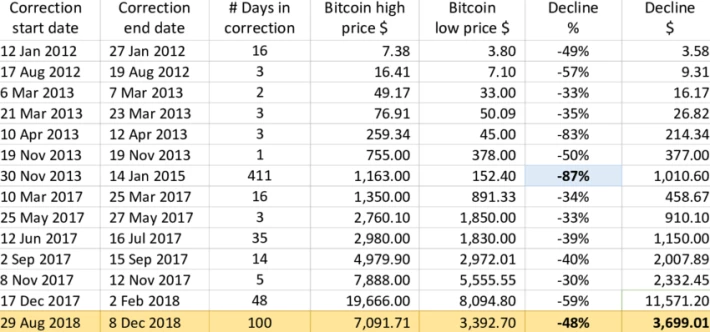
However, owning Bitcoin is not about getting rich in the traditional sense. It's about having the capital to push towards a more democratic and sustainable future. Early investors in Bitcoin have been able to redirect capital from the old system, into projects that are building a better system for future generations.
Bitcoin is just the tip of the iceberg. We now have cryptocurrencies that support smart contracts, privacy, instant transactions, and more. We are entering into a world where you no longer need a bank to send money, transfer ownership, raise capital, or take out a loan. The possible applications of cryptocurrencies are vast and not yet fully known.
Cryptocurrencies are going to challenge the way we think about economics, politics, ownership, and wealth. The technology is here, and more people are embracing it everyday.
While there may still be an abundance of skeptics, the trend is clear. Bitcoin and other cryptocurrencies are rapidly gaining traction, even with corporations and governments that once opposed them.
Facebook's Libra and China's National Digital Currency
The fact that major corporations and governments are developing their own blockchain-based digital currencies says to me that they are also losing confidence in traditional finance and agree that cryptocurrencies are the future of money.
In 2019, a decade after Bitcoin's release, Facebook announced plans to launch Libra, a stablecoin that will be backed by a basket of government currencies. Slated to launch in 2020, it has caused discomfort among major world governments, who believe it threatens their monetary sovereignty. The industry has mixed feelings about Facebook entering the space, but they do have the ability to introduce cryptocurrency to 2.4 billion active users.
China is also close to releasing their own digital currency, which the government has stated will not be backed by fiat reserves. Some are speculating that it will be backed by gold, which the Chinese have been stockpiling for years. China is not the only country planning to launch a digital currency. Venezuela, Iran, France, are all in the midst of developing their own.
Unfortunately, most corporate and government backed digital currencies are not decentralized like Bitcoin, and that means transactions could easily be censored and tracked. People need to know this. My hope is that the billions of people who are introduced to cryptocurrency through Facebook or China will eventually transition to public blockchains.
Preparation
How do we prepare ourselves for this new world? Besides being prepared mentally and emotionally for major changes, take some time to learn, invest and share.
Education
Keep an open mind. Start digging into all the cryptocurrencies on coinmarketcap, even the ones you were told are scams. Follow them on Twitter, SteemIt and YouTube (Or LBRY!). Take some time to go down the rabbit hole, then participate in the best way you can, whether that be mining, node operation, staking, blogging, programming, graphic design, marketing, etc. The number of ways you can earn cryptocurrency will only increase from now.
Investing
Once you have your head wrapped around how cryptocurrencies work, consider investing in them. I believe that Bitcoin and Ethereum are the two safest coins you can purchase at the moment, but several other projects have incredible potential.
Sharing
Rather than trying to explain how Bitcoin works to your friends and family, just demonstrate it by sending them a small amount. This is psychology 101, as their attitude will change when the value of the crypto you sent them creeps up.
Conclusion
Some may argue that the traditional financial system has served us well in decades past, but it's obviously not working for us anymore. The last decade's experiments have left us loaded with excessive debt, and on an unsustainable trajectory. We live on a planet with finite resources, therefore our economies cannot grow forever. Will we continue to ravage the planet, pile up ever more debt, and pass on the problem to our children and grandchildren, or will we finally transition to financial system that respects the planet and serves the people?
The Bitcoin experiment has thus far proven to be wildly successful, and has been the foundation for a "Cambrian Explosion" of other cryptocurrencies that are under rapid development to underpin the future financial system. This new technology has given us the opportunity to transition to a more democratic and sustainable world. I believe the number of people who truly want this change is growing every day.
Follow me on Twitter @brennanhm
Follow me on Steemit @brennanhm
Thank you!





