
Volatility on crypto exchanges is both one of the biggest attractions for investors, as well as one of the major reasons why newcomers to the crypto trading scene can be hesitant to start trading on them. The media tends to misrepresent or only present a lobsided view of volatility, specifically with regard to crypto investing. This article examines crypto asset volatility in detail and aims to provide a balanced view of volatility on crypto exchanges in addition to highlighting the advantages that volatility can offer for traders as well as market makers.
Volatility in crypto trading presents both advantages as well as risks for traders and market makers. The volatility associated with crypto assets provides greater opportunities for earning profits since the prices of cryptocurrencies tend to move longer distances within shorter timeframes.
If you would like to learn more about the reasons why crypto exchanges provide greater volatility than traditional exchanges, as well as the opportunities that volatility offers for traders as well as market makers, read on.
Why Are Cryptos So Volatile?
There are a number of reasons why crypto assets are more volatile than traditional financial instruments, such as stocks, forex, and commodities. Here are the main reasons why cryptos are more volatile than other types of instruments.
1. Cryptos have lower liquidity
Liquidity is the availability of a financial instrument in the market and the fact that the number of market makers in the crypto scene is currently still relatively limited is the main reason why cryptocurrencies are more volatile than traditional financial instruments.
Market makers make crypto assets more easily available to traders and investors, which means that they contribute to increasing liquidity in addition to lowering spreads and improving stability across exchanges. Nevertheless, market making in the crypto space is a new and still largely unexplored industry, meaning that the benefits of taking advantage of the crypto market’s volatility are potentially even more numerous for market makers than they are for traders.
2. Cryptos are used as a way to protect wealth
News events and international unrest lead to anxiety and reduced confidence in the future of traditional assets, particularly fiat currencies and other government-regulated instruments. As more and more people discover the convenience and relative control they have over cryptocurrencies, especially when it comes to issues such as true ownership and privacy, cryptos are increasingly used as a means to safeguard wealth since the value of cryptos cannot directly be endangered by government policies, nation-specific political turmoil, inflation, or wars. Cryptocurrencies, especially mainstream ones, such as Bitcoin and Ethereum, are increasingly being used as an alternative to gold, whilst they are also more fungible and convenient than the latter. Bitcoin and other crypto assets are indeed already being referred to as “digital gold” since they offer a practical way to preserve wealth and protect the value of liquid assets.
3. Less regulation
Regulation reduces volatility. However, volatility is generally regarded as a positive thing by traders –and market makers –especially when it comes to short-term trading. Several governments around the world have attempted to regulate cryptocurrencies by targeting centralized exchanges with KYC (Know Your Customer) requirements and transaction records. However, this has been largely ineffective as far as curbing the growing popularity of cryptocurrencies is concerned, and has resulted in a wave of new and better crypto exchanges, many of which are now decentralized (DEXs) and therefore cannot be regulated or shut down by third parties, including governments. This presents an unprecedented opportunity for market makers as there is now even greater interest in cryptocurrencies and thus also huge demand for market makers.
Crypto wealth distribution
Crypto assets are currently not as evenly distributed as traditional assets. This means that when individuals holding large amounts of cryptocurrencies sell them, or wealthy investors buy a large number of tokens at once, violent price fluctuations can occur and the market experiences volatility. Although, in theory, this means that markets can be manipulated by very big players, the volatility that this brings about is also highly attractive to traders, investors and,of course, market makers.
Basic Technical Concepts: Understanding CUV and DEUV as Underlying Factors of Crypto Volatility
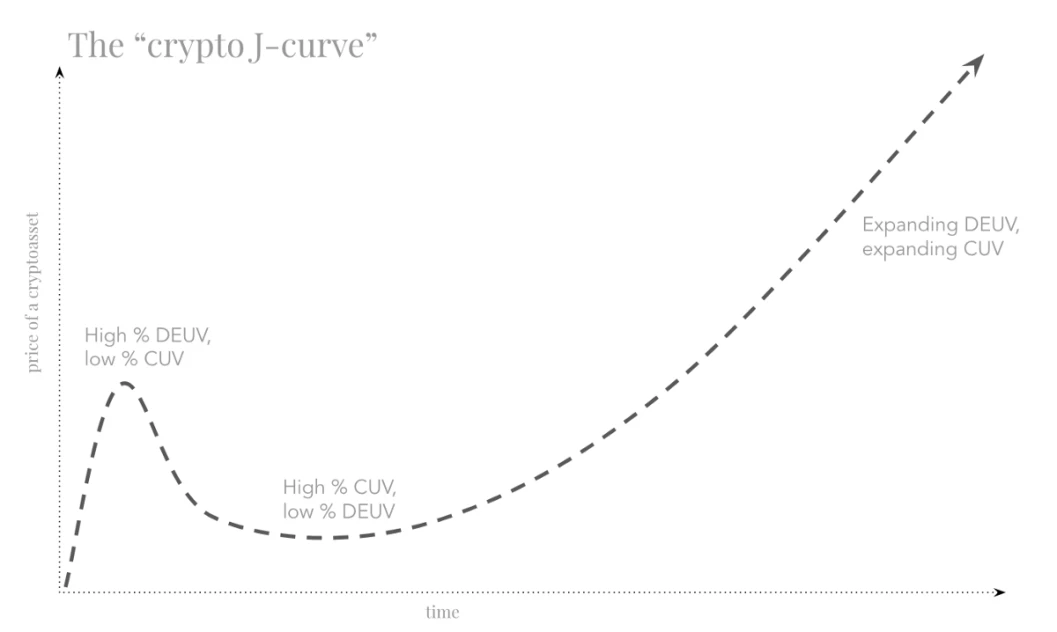
The two basic concepts to understand when examining the fluctuating price action of new assets, such as new crypto tokens and altcoins, are the CUV and the DEUV, the interplay of which result in the common J-curve formation, which is often perceived as volatility. Let us examine these two concepts in more detail.
CUV
CUV stands for “Current Utility Value” and is the actual practical value that an asset has. For example, being able to conveniently use (spend and receive) a crypto asset increases its CUV. CUV can also be dependent on reward mechanisms that are built in to some crypto instruments. For example, PoS (Proof of Stake)tokens pay out rewards to owners who stake their assets to help account for transactions on their respective blockchains.
DEUV
DEUV stands for “Discounted Expected Utility Value” and is the value that speculators expect an asset will reach in the future. For example, if a new altcoin or token enters the market, and buyers believe that its future value will be greater than its current value, they are likely to buy it in anticipation of this. This perceived value depends on both the likelihood of the asset’s future adoption rate, as well as the effectiveness of the project’s marketing campaigns.Many new crypto assets start out with a high DEUV, i.e. speculators in the market have confidence in the future value of an asset to the extent that their buying thereof actually pushes its price higher. At this point, it is almost always the case that the CUV is low, since the nature of new crypto assets is such that their initial market adoption is naturally limited and therefore does not allow for widespread use.Soon after, however, prices of new crypto assets tend to fall and this is when the DEUV (perceived future value) becomes lower than the CUV (actual practical utility value).The third phase is when the CUV, over time, results in an increasing number of investors once again gaining confidence in its DEUV and the result is the classic J-curve formation.
Taking Advantage of Volatility as a Market Maker
The number of millionaires that have been made in the crypto space since 2017, when mainstream cryptocurrency adoption rates saw their peak, is truly remarkable. The huge wave of crypto investment resulted in even more interest in crypto currencies and trading, in addition to hundreds of new market makers entering the scene, thereby increasing the liquidity as well as relative stability of existing crypto assets. The second wave of crypto applications, including Dexs (Decentralized Exchanges) and other DeFi (Decentralized Finance) applications has also further contributed to stability, reliability, user friendliness and convenience when exchanging and trading cryptocurrencies. These days it is fairly easy to invest in cryptos by means of the growing number of exchanges, many of which have a good reputation for security, ease of use, and the variety of the assets they offer, especially since the increasing market share of DEXs (Decentralized Exchanges) do not even require you to create an account or provide PII (Personally Identifiable Information).Despite this increase, the demand for market makers is still huge and it is definitely still possible to take advantage of the volatility that can be found on crypto exchanges thanks to the factors listed above. The relative lack of regulation, uneven asset distribution and quick price action make it much easier to profit off short-term trades than would be the case with traditional financial instruments, especially at low leverage. As a market maker, there are therefore many advantages to crypto trading, especially as more and more people start to turn to crypto investment amid international political unrest and concern about the continued long-term existence of traditional, heavily-regulated fiat economies that are subject to infinite quantitative easing (a fancy way of saying money printing), increasing social opposition to centralized financial systems, unfair taxation practices and currency manipulation. I hope that this article has provided a useful insight into the underlying factors of crypto market volatility as well as the benefits it can bring to traders and market makers. If you would like to learn more about becoming a market maker, you can talk to one of our consultants at GSR by clicking here.
Don Hartig
Crypto, Blockchain, DeFi, Finance Writer | World-renowned Linguist (EN, 中, DE, FR, ES, 日, NL, AFR) - (ranked no. 3 worldwide for Mandarin -> English native tranaslation) | Content & Marketing Manager | Consistent Trader (avg. 1% ~ 3% per day)
I am a crypto, blockchain and DeFi industry veteran, blockchain engineer, master copywriter, marketing guru and world-renowned linguist (fluent in 7 languages).
If you would like to hire me as a private trader, writer, translator or analyst, feel free to contact me here or via email at [email protected] or [email protected].






