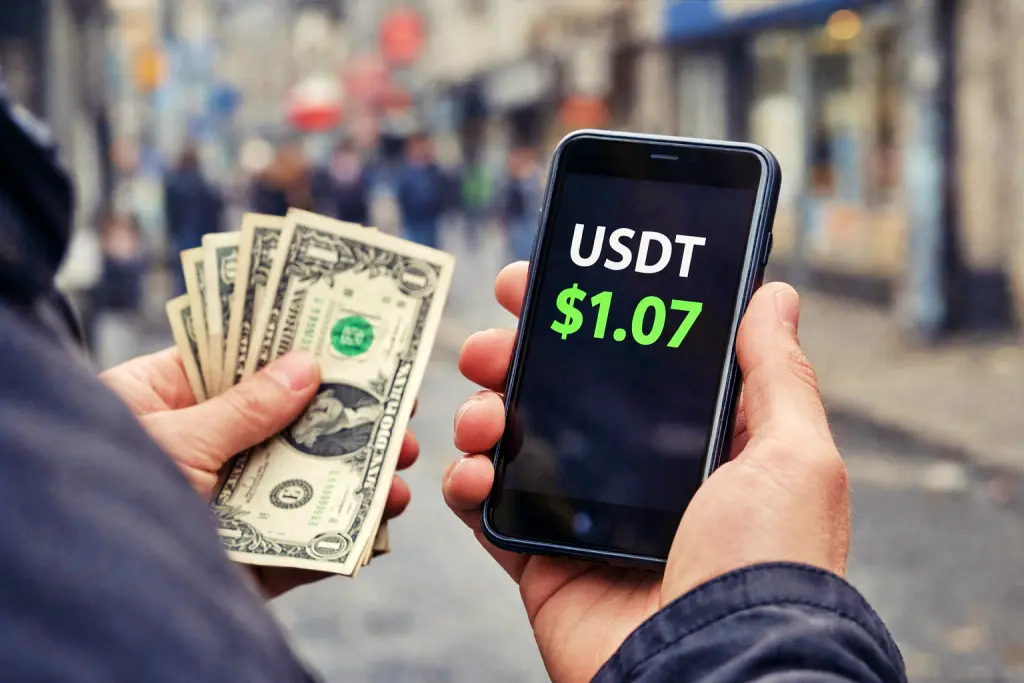
When reports started circulating that USDT was trading above a dollar on some Indian exchanges, my first reaction was that something had gone wrong with the peg.
It hadn't.
People were willingly paying more than a dollar for a digital asset designed to be worth exactly one dollar.
At first, that makes no sense.
If one USDT is supposed to track one US dollar, why would anyone agree to pay $1.07 for it?
The answer turns out to have very little to do with speculation and a lot more to do with access.
For many traders, freelancers, importers and businesses, access to dollars matters almost as much as the dollar itself.
Moving money through traditional banking channels can be slow, expensive or wrapped in restrictions that make simple transactions surprisingly complicated.
Stablecoins solve part of that problem.
They move around the clock, settle quickly and don't care whether banks are open or whether it's a public holiday somewhere.
Most of the time, nobody notices how valuable that convenience is because supply is everywhere and the price stays pinned close to one dollar.
You only notice it when supply tightens.
Recent pressure on crypto payment networks and reduced liquidity on some local platforms appear to have created exactly that situation. Suddenly there were more people looking for digital dollars than there were digital dollars available locally.
Prices reacted the way prices usually do when demand arrives faster than supply.
The premium itself isn't really the story.
Commodity markets have premiums.
Foreign currencies trade above official exchange rates in some countries.
None of that is unusual.
For years they were treated as a waiting room between trades.
A place to sit while deciding whether to buy Bitcoin, Ethereum or something riskier.
That description feels less accurate every year.
In places where moving dollars isn't simple, stablecoins end up filling gaps that banks leave behind.
People are not paying extra because they think USDT will make them rich.
They're paying extra because, in that moment, access to a digital dollar was worth more than the dollar's face value!