
Introduction
It is not new news that Decentralized Finance (DeFi) lending and Borrowing is thriving on the Ethereum Blockchain which is currently the DeFi platform of choice. Following the lending and borrowing immersion on blockchain is yield farming which offers hope of sustainable long-term passive income. Yield farming or liquidity mining is a way of generating rewards by locking up cryptocurrencies in a similar way that staking does. However, it is very different. Staking provides a guaranteed annual percentage return and involves low risk; whilst, yield farming generally offers much higher rewards (sometimes in the hundreds or thousands of percent). Nevertheless, the risk is often, but not always, much higher and the interested novice should take care when selecting pools to farm. Two pieces of good advice are; firstly, make sure that the pool has been audited and secondly, do research on the project to make sure it is not a scam. Matic Network provides an opportunity for 2nd Generation DeFi on Layer 2
Yield farming involves liquidity providers (LPs) depositing funds into a liquidity pool. The pool enables crypto community borrowing, lending and exchange of tokens and in return LP's earn rewards. Currently, yield farming uses ERC - 20 tokens; However, cross-chain bridges in the future will allow DeFi applications to be blockchain agnostic or interoperable. Matic is currently interoperable with the EOS and TRON networks through its Kardiachain partnership. “KardiaChain will utilize Matic’s highly scalable technology to meet throughput demands for KardiaChain’s large-scale enterprise solutions that incur high TPS. KardiaChain’s new mobile payment gateway in collaboration with Vietnam’s largest telco to serve Vietnam’s 100 million population will use Matic (Perry 1, 2020)." Matic Network provides an innovative opportunity for 2nd Generation DeFi on Layer 2. To understand why it does, it is necessary to understand the current major problem associated with yield farming and why this is preventing a sustainable money market for investors.
The Problem - 1 - Fees are a Fundamental Encumbrance
For those who have ventured into yield farming, it is clear that fees are a fundamental encumbrance. Why are fees such an issue when rewards are supposedly so high. The reason is that providing liquidity to a pool requires several transactions. These include a couple of transactions when acquiring pool tokens, usually through Uniswap or Balancer. A web3 wallet such as MetaMask will need to be used and once the transactions are completed to acquire the pools tokens for the selected liquidity pool, then the process of adding the liquidity to the yield farm must be completed which will demand a few more transactions. It is well established that gas fees on the Ethereum Network are very high much of the time. Transactions that several months ago would cost $cents now cost $dollars. The cost to invest in a yield farm costs anything from $50 to several hundred dollars depending on the amount invested. The same fees apply for reversing the process - stop farming and exit, then exchange the pool token for the original ERC-20 coins and tokens (e.g. Uniswap or Balancer). Additionally, it is important to remember that fees associated with farming and liquidity pools are much high than normal transactions. This is another reason why Matic Network solves this dilemma, the fees are 1000X less expensive than on the Ethereum mainchain. There numerous examples, but a twitter user Gbhoy recently tweeted that to transfer 29 DAI on the Matic Network costs $0.000002 (see below). This fee could be described as free because for $1 a user could perform thousands of transactions (Do the math).
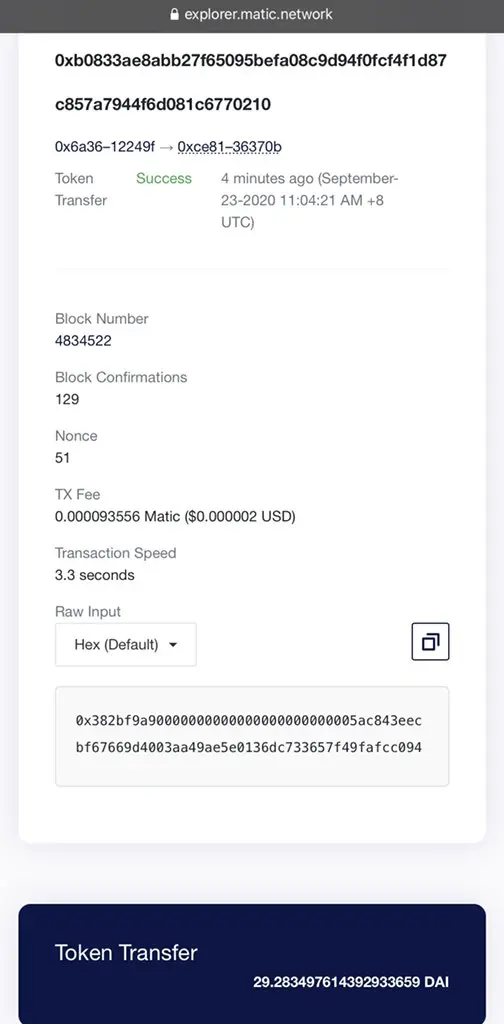
It is generally accepted that for the most, success in yield farming necessitates that the liquidity provider (investor) change pools regularly to ensure the best interest rates. Clearly changing pools regularly is not possible with the fees as they now stand. An alternative solution is needed; one in which fees are negligible and allow the yield farming enthusiasts to farm multiple pools at the same time, while changing pools strategically to ensure the highest possible yields. It is clear that Matic offers the solution to yield farming protocols. Imagine Yield Farming Multiple Farming Pools with NO Fees, or minimal fees
The Problem - 2 - Sustainability and the Ability to Earn Profits
The other problem currently associated with liquidity farming is sustainability and the ability to earn profits. Many farming pools initially offer huge interest rates - annual percentage yields (APY). These differ from annual percentage rates of (API) or return on investments (ROI).
- Although the interest is still very high it takes into account the effect of compounding.
- APY requires the direct reinvesting of profits which is not possible with the current high fees.
- In fact, most investors who do not have several thousand to invest will likely lose money due to fees.
It should be clear to the critical reader that yield farming on Matic Network will make possible for the investor to complete numerous transactions in multiple pools, as well as transactions that involve changing pools. This will result in power to the liquidity provider to prosper in the DeFi yield farming market.
The living legend, Vitalik stated recently:
I personally am steering clear of the yield farming space completely until it settles down into something more sustainable. But I'm not particularly a "smart mind in defi" so....
Other issues of sustainability relate to the high-interest rates which initially yield high returns in the native token of the farming protocol. Rewards are sold quickly while the token price is high because in most instances the token price falls rapidly due to the sell-offs. Although definitely not a pyramid scheme the current model does require continuous investment to sustain the price and with yield farming, the concern in the sector is to secure profit, thus selling predominates. A more economically sustainable model is needed in order to regain confidence and ensure the continuance of yield farming. A couple of projects currently building on Matic are offering innovation on the layer-2 platform. Matic is experiencing rapid adoption due to its high throughput and low fees, and with the decentralization of the network nearing completion, anticipation is growing.
Two Innovative DeFi Projects Launching on Matic Network
In order to solve the sustainability problem of DeFi protocols, EasyFi will be introducing new products to their DeFi protocol. EasyFi will be the first DeFi protocol built on Matic Network. A more comprehensive understanding of the protocol can be understood by reading the following article. In order to introduce a more sustainable model EasyFi, in addition to solving the existing problems by using Matic Network, will introduce a number of high-interest products that will put into action a high demand for the token. For example, micro-lending will for the first time be introduced to DeFi with the purpose of providing capital to millions who are unable to get it at the moment. The article link above will provide greater clarification. Easy Fi is due to launch within a few days. The number of new and exciting products in addition to yield farming will provide sustainability. In an article dated the 24th September 2020 EasyFi made the following statement:
EasyFi as a universal Layer 2 lending protocol is built as a blockchain agnostic money market protocol, starting with the MATIC network, which has helped us to address the most pressing concerns of skyrocketing gas fees and completion time of transactions. EasyFi envisions an open and inclusive financial infrastructure built upon the ethos of permissionless networks & automation of smart contracts. To create an open, reliable,
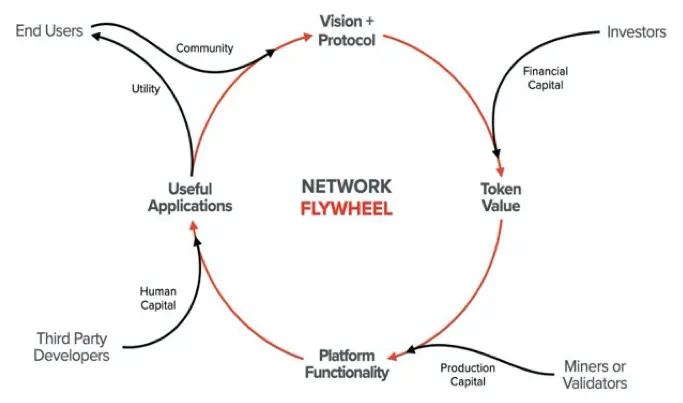
sustainable financial system, we believe, requires a higher level of thoughtfulness and dedication. Team Easyfi has committed to the deliverables and the ultimate goal of handing over the control of protocol to the community, with a conscious approach albeit. We see ‘decentralization’ as a spectrum rather than an overnight switchable program. We believe it is the utmost duty of the team and community together to attain a certain point of cognizance and set the flywheel in motion, making the system absolutely workable so as to mitigate any risk of failure.
The other project of interest to the DEFi community is also offering innovation on Matic Network. The projects name is StakeHound and it brings staking and DeFi together. Due to Matic Networks high scalability and low fees as mentioned above, StakeHound determined it to be the platform of choice currently in order to succeed in the DeFi space.
- The platform will allow users to stake tokens and get rewards - multiple different tokens can be staked.
- In addition, investors receive stake-backed ERC20 tokens from StakeHound - 100% value of the staked tokens
What this means is that the investor will earn rewards for staking continually. At the same time, stake-backed tokens to the equivalent value of the staked tokens will be issued. There is no time limit for these tokens to be returned. The stake-backed tokens can then be used to participate in other DeFi protocols. The concept is genius and doubles the working capital of the investor with no fear of liquidation. In the event that the user foolishly loses the stake-backed tokens in an investment, he/she will continue to earn staking rewards from the original staked tokens.
“StakeHound brings a completely new set of assets to the DeFi market.” — says Sandeep Nailwal, co-founder and COO of Matic — “We foresee a rapid adoption of the stakedTokens. And this is a great opportunity for us to provide a flawless stream of newly available liquidity for highly scalable Matic DeFi applications.”
Conclusion
A new generation of DeFi projects is emerging on Matic Network. The current dilemmas on the Ethereum Blockchain require layer-2 innovation which Matic offers in the form of scalability and low fees. The high fees on Ethereum mainchain which will surely grow even more problematic may make many DeFi products unsustainable. Due to existing problems, many DeFi protocols will likely begin innovating and building on Matic. Yield Farming Migration to Matic is Prudent.






