
Decentralized finance offers innovative ways to manage finances in a decentralized way, independent of banks or financial institutions. Decentralized applications (DApps) run on top on existing blockchains, for example, Ethereum, Bitcoin, EOS, and Elrond. Users have complete control over their finances through the use of smart contract technology. In many instances, 3rd party DApps that ensure the decentralization of authority are used, For example, Portis is a web-based wallet that connects Dapps to Matic simply and easily. Examples of Ethereum Dapps currently offering Lending and borrowing services are Aave and Compound. Another example is the Mainframe Defi Protocol which is due to be launched in approximately three months and which offers new Defi features and enhancements. Furthermore, Passive income can also be earned by those who lend their tokens for the purpose of providing liquidity. Defi offers much promise when compared to traditional financial institutions which no longer offer lucrative and stable financial options for long term investments like retirement. However, there are some obstacles to which are currently hindering the long term success of DeFi Dapps: Scalability, fees and asset interoperability. Matic offers the best solution for these hindrances.
1. Interoperability
“Interoperability is defined as the ability to share information across different blockchain networks, without restrictions” (O’Neil, 2019). In other words, according to O’Neil, “Blockchain interoperability, in turn, is the ability to exchange data between different blockchains seamlessly, as if there were no boundaries.” Interoperability is important and currently, blockchains are unable to share information – this is important for mass adoption. O’Neil clarifies that no corporation would want to do transactions using a blockchain if it was not interoperable. Usability across the world is dependent on interoperability. For example, Visa is interoperable across all merchants and ATM machines worldwide. In the same way, the internet is interoperable because it “allows for access and modification numerous datasets through application-specific interfaces (APIs).” If the internet was not interoperable it would not have been able to grow into what it is today and the same applies to blockchains.
The Matic website states that “assets on different sidechains across various blockchains will be made inter-operable by the Matic Network in the near future." There are certain blockchains working on interoperability but it is not yet there; for example, Polkadot, Cosmos, Chainlink, Wanchain and Quant, but the networks still remain isolated from each other. Matic is working on this process and current assets on EOS and TRON networks are interoperable with Matic through the Kardiachain partnership. “KardiaChain will utilize Matic’s highly scalable technology to meet throughput demands for KardiaChain’s large-scale enterprise solutions that incur high TPS. KardiaChain’s new mobile payment gateway in collaboration with Vietnam’s largest telco to serve Vietnam’s 100 million population will use Matic. Matic Network on ETH blockchain will be interoperable with other blockchains that are already in Kardiachain networks such as TRX or NEO.”
As stated previously, scalability is not sufficient for mass adoption, interoperability is also a criterion. Matic’s development is ensuring that the requirements for institutional level acceptance are being met at a high level. Furthermore, Cosmos will also be interoperable with Matic once “the Cosmos Inter-blockchain Technology (IBT) protocol goes live, will enable blockchains built on Cosmos to interact with the Matic Network and take advantage of the POS plasma-sidechains (Perry1, 2019). Currently, according to ConsenSys, the crypto industry is a series of unconnected systems. Matic is making good progress with interoperability, starting with the biggest and most used blockchain, while at the same time using and integrating the leading technology developed by other blockchains to ensure the realization of the goal of interoperability with the most used blockchains and Dapps.
2. Scalability & Fees
It is widely known that fees on the Ethereum blockchain are becoming increasingly high as greater adoption usage takes place. One of the reasons for this is that Defi and Dapps that use erc20 tokens now account for nearly half the assets on the blockchain (Jenkinson, 2020). Over 300 million has been raised by 13 smart contract projects in 2020. The smart contract platform now accounts for 51% of the value of the Ethereum Blockchain. The popularity of DeFi and USDT platforms has resulted in extremely high fees. The increasing volumes and users on the Eth platform have furthermore resulted in scalability issues. Currently, Eth can do 15 TPS. The Eth 2.0 outline can be viewed in this article (Ethereum 2.0 Status). Vitalik has stated that 100 000 TPS could be achieved by phase 1 of Eth 2.0 but this is at least two years away (Buterin). There have also been statements made that there will be delays which means it will likely take longer than two years (Eth 2.0 Roadmap). This is critical as in another two years the network will be even more congested as crypto is growing rapidly and high fees may make Defi products unusable. For this reason, layer 2 solutions are critical at this stage. In a recent test Matic is running at 7.200 TPS.
Matic was built to scale Ethereum and recent testnet results show that Matic can currently power Ethereum to 7,200 TPS (Cointelegraph- Wright, 2020)
In a Cointelegraph article by Madeira (2020) he stated that “scaling solutions are even more important to deliver the required user experience for DeFi customers while the Ethereum 2.0 is still under development.”
According to Madeira, the current congestion and scalability issues of Ethereum may soon hinder the use of DeFi. Fees can be extremely high and transactions can take a long time to process if there is congestion on the network. Although there are layer-two solutions available now, Ethereum 2.0 will still take years to fully develop and implement. Moreover, the lack of scalability can lead to future issues, and it poses a looming danger for DeFi projects and users alike. Dmitry Baimuratov, technical content lead of the OMG Network — a layer-two scalability project for Ethereum — told Cointelegraph:
“DeFi has become the major ecosystem player over the last year. The volume and interest are only growing, especially from traditional financial institutions and funds. Thus scaling solutions are even more important to deliver the required user experience for DeFi customers while the Ethereum 2.0 is still under development.”
In conclusion, Scalability, fees and asset interoperability are major obstacles to blockchain Defi & Dapps. Matic is currently the best solution because of its high scalability (7,200 TPS with potential for 65 000 TPS on a single chain), low fees (100 X less than Eth) and its interoperability functionality as well as future potential.
Matic’s 2 second block times can be viewed here https://explorer.matic.network/
3.Matic Network Mainnet Status
Matic Mainnet is currently up and running but is still decentralized due to the fact that the majority of the nodes are centralized (run by the Matic Network Development Team). However, with a few weeks, the Network will be fully decentralized.
The chart below is an estimate; it cannot be determined exactly. To move from the centralized network to a decentralized one entails ensuring 100% integrity of the network as well as the removal of any bugs or weaknesses - and the security must be flawless. Thorough testing takes time and cannot be timed exactly due to unknowns that may arise during the process.
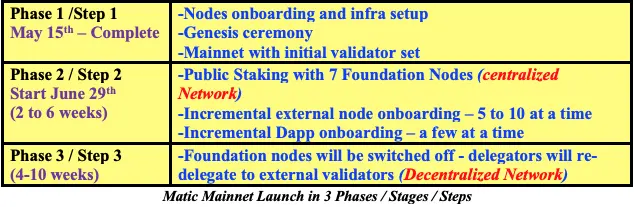
Additional information regarding the launch sequence can be found here: https://www.publish0x.com/blockchain-innovation/matic-network-clarifying-launch-sequence-transaction-fees-el-xgdvkrw
Contact a Core Team Member
For those interested in building / integrating with the Ethereum / Matic network you can contact a member of the team at https://matic.network/about/ where individual team members contact information can be found, or at [email protected]
https://twitter.com/maticnetwork
https://github.com/maticnetwork
https://medium.com/matic-network
https://open.kakao.com/o/gUpfOhmb
https://www.binance.com/en/trade/MATIC_USDT
https://coinmarketcap.com/currencies/matic-network/
Links
Buterin Eth 2.0
https://www.crypto-news-flash.com/buterin-ethereum-2-0-will-scale-to-100000-tps-in-phase-1/
ConsenSys
https://cointelegraph.com/tags/consensys
Ethereum 2.0 Status
Eth 2.0 Roadmap
https://consensys.net/knowledge-base/ethereum-2/faq/
Jenkinson - Ethereum Blockchain Congested
Madeira – Cointelegraph – Scalability
Matic Network Explorer
https://explorer.matic.network/
Matic – Clarifying Launch Sequence
Matic / Cosmos Interoperability
Matic Testnet 7200 – Wright - Cointelegraph
https://cointelegraph.com/news/testnet-results-suggest-matic-could-power-ethereum-to-7-200-tps
Interoperability - O’Neil
https://cointelegraph.com/explained/blockchain-interoperability-explained
Kardiachain Partners with Matic
https://medium.com/kardiachain/kardiachain-partners-with-matic-network-91dba3a84d0a
Ethereum 2.0 will take years
https://cointelegraph.com/news/waiting-for-ethereum-20-but-layer-two-solutions-are-needed-now
Mainframe
Portis and Matic
https://www.reddit.com/r/maticnetwork/comments/fx6idp/matic_to_become_interoperable_with_leading/





