
In the midst of a planned push to gain a majority stake in the Monero network's mining power, the Qubic mining pool managed to mine 20% of the network's blocks in a 24-hour period on August 3, according to Qubic founder and leader Sergey Ivancheglo.
This mining pool seeks to dominate Monero's hashrate and reach 51% of the processing power on that chain by August. Qubic's stated intention is to demonstrate the computational capacity of its network and combat the botnets that, according to its founder, currently dominate Monero mining.
Ivancheglo detailed on X that “Qubic has completed the current 24-hour Monero mining marathon. We managed to mine 20% of the blocks despite intense DDoS attacks orchestrated by an XMRig developer (on the Qubic network). Starting next Wednesday, we will have 3 marathons like this every week.”
The term " mining marathon" refers to a series of intensive tests with which Qubic attempts to increase its Monero mining share. Starting next Wednesday, Qubic plans to hold three such marathons per week, which could sustain or increase its network share.
At the same time, Qubic's leader reiterated on August 4 what he had said in his post the day before: the Qubic network is also under attack from actors in the Monero ecosystem, who are reportedly attempting a DDoS attack. This term refers to distributed denial-of-service attacks, where multiple systems attempt to overwhelm a server to disrupt its operation.
Ivancheglo suggests that a developer of XMRig, a Monero mining software, "orchestrated" these DDoS attacks against the Qubic network. He, in turn, interprets these actions as a coordinated attempt by actors in the Monero ecosystem to halt its advance and possibly execute a 51% attack against his own project.
It's worth remembering that Qubic involves both a Monero mining pool and its own blockchain. Currently, Qubic directs part of its computing power to the Monero network , leveraging its CPU-based architecture to generate returns that it then reinvests in its own token, QUBIC.
Ivancheglo also shared a graph indicating that 20% of the hashrate comes from an “unknown” source, which could include Qubic.
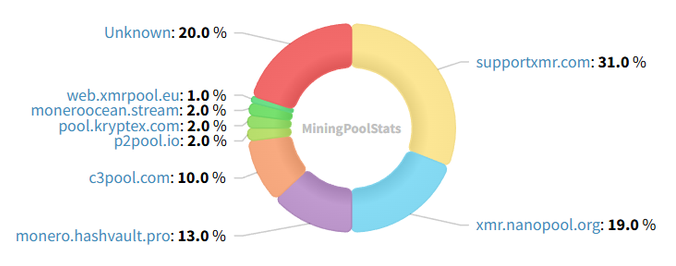 Qubic will be mining marathons on the Monero network. Source: X.
While Qubic claims to not hide the computing power it has contributed to Monero, at the time of this publication its website does not offer such information and it cannot be found in analysis tools such as Mining Pool Stats.
A campaign to displace botnets from the Monero ecosystem
Qubic uses its processing power to mine monero (XMR) and then sell it for USDT. With these funds, it buys back and burns its QUBIC token, generating a deflationary cycle that potentially increases the profitability of miners connected to the Qubic pool.
This mechanism incentivized more users to participate in mining through Qubic, increasing its share of the total Monero hashrate from less than 2% in May to nearly 40% in July. The next step, announced by Ivancheglo, is to reach 51% of Monero's mining power.
The Qubic leader's stated goal is to "bankrupt the botnet owners who have been stealing the revenue from honest Monero miners for years." This was reaffirmed in an August 4 statement by the Qubic team.
Faced with this scenario, some community members have proposed measures such as adjustments to the RandomX algorithm, consensus changes , or even a hard fork. Reaching 51% of Monero's hashrate would, in theory, allow an attacker to reject other people's blocks, reverse transactions, or censor payments, compromising the network's decentralization. However, for now, no concrete actions have been defined by the Monero protocol maintenance team.






