
Monero, the private cryptocurrency network, is experiencing a period of collective anguish. According to the team behind Qubic (a mining pool that promised to monopolize Monero blocks) and its CEO, the project finally reached a peak hashrate of 2.77 GH/s, representing 50% of the network's computing power. That said, data on Monero's hashrate distribution is inconsistent across various platforms, some of which demonstrate that such an attack is statistically impossible for now.
According to the epoch 172 report, titled "The Monero Experiment," Qubic has already mined a total of 4,285 blocks on the network, controlling more than half of the network's power. An updated source shows that the pool has already mined nearly 7,000 blocks. On July 12, the mining pool's CEO confirmed that a 51% attack would be a reality.
It appears Qubic has overtaken Monero by 51%. We're awaiting independent confirmation. In the meantime, the Monero team is fine-tuning the details of its 51% attack protection. Many accused us of being sponsored by three-letter agencies to attack this anonymous coin. What do you think now, after helping Monero prepare for its future battles with those agencies?
Sergey Ivancheglo, leader of Qubic and co-founder of IOTA.
According to an image whose source could not be determined, Qubic would specifically own 52% of the network's hashrate.
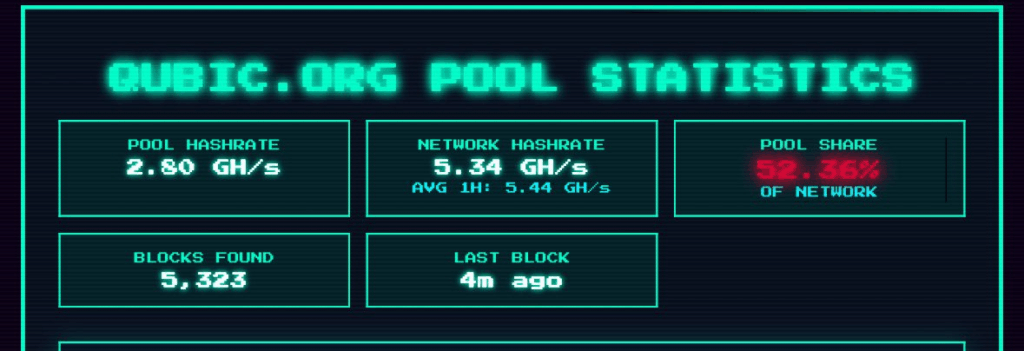
Qubic is a Monero (XMR) mining pool. Source: X social network, @CaffeinatedUser
Sergey Ivancheglo insists that the intention of the attack against Monero is benevolent, and is part of a proof of concept, an experiment on the proof of work of XMR.
However, some in the community are concerned that this concentration of power could lead to the introduction of orphaned blocks or double-spending on the private cryptocurrency network. The community's concerns appear to be coming true. According to Peter Todd, the Monero blockchain is already seeing reorganizations in the order of transactions.
One source that describes Monero's hashrate distribution is Miningpoolstats. However, this platform's data is inconsistent, varying arbitrarily from day to day. At the time of writing, this database shows an error in compiling Qubic's hashrate, stating that three pools other than the one mentioned account for nearly 80% of Monero's hashpower. Other platforms such as hashrate.no and miningpoollist show an incomplete list of mining pools.
This inconsistency could be a deliberate attempt by pool site contributors to hide Qubic's total hashrate, as none of them display updated data for this pool. This is likely to prevent panic from spreading within the community.
At the time of writing, figures such as Charles Guillemet and Peter Todd believe the attack on Monero is successful and in full swing. This "experiment" uses dual economic incentives to expand the pool's user base.
From the pool led by Sergey Ivancheglo, it's possible to mine XMR, but receive payments for your contribution in Qubic tokens. Thus, the company that runs the pool keeps the mined XMR coins in its possession to sell them.
It then proceeds to purchase more Qubic tokens and burn them, causing the price of Qubic to rise (and potentially, XMR to fall). These mining pool incentives appear to be working, judging by Qubic's rapidly increasing hashrate.
The 51% attack on Monero represents a historic milestone for crypto asset security. Although rare due to their costly nature, attacks like this one on major cryptocurrencies have been documented in the past.
One victim was Ethereum Classic, a network that reportedly experienced a reorganization of up to 14,000 blocks, severely jeopardizing the immutability of its accounting records.





