
Beating a casino is extremely difficult and I certainly do not aim to paint professional gambling, meaning gambling that is actually successful over a prolonged period of time, as a sustainable or legal way to make money.
Casinos are designed to have a mathematical edge in every game they offer, which ensures that, over time, they will make a profit. That doesn't mean that as a rule they cannot be beaten.
Here are some important points to keep in mind:
The house edge and the law of large numbers are not the gambler's friend. The house edge is how casinos ensure that they make a profit while offering games of chance, and it involves cashing in a small percentage of every bet, win or lose, or offering a lower pay-out than the odds. An example of a 1% house edge, the lowest house edge you're likely to find outside of blackjack, a game with it's own limitations in profit potential, would be a game of dice, a popular crypto-gambling game that's offered on most online cryptocurrency gambling websites.
In dice, you bet on a number, and you bet on red or green(for example). Red means lose, and green means win. If your winning odds are set to 50-50, a 1% house edge will mean that placing a 100 dollar bet and winning will pay you 100 dollars times 2, minus one dollar per 100. This means that if you win, your new balance from the bet will be 198 dollars, and if you lose you'll make zero. This is how casinos, at least in one way, ensure that they stay ahead of the odds, by deliberately tilting them in their favour. Likewise, if you bet 100$ on 10x pay-out and win, 10$ will be deducted from your total take in order to cover the house edge.
The next thing to keep in mind is the law of large numbers. Casinos play their own games in exactly the same way as conservative gamblers do, but they play the house, meaning the flip side of the coin is in their favour, and in the same way that the longer a smart gambler keeps up a winning streak, the higher the likelihood of losing becomes, the casino is placed on the other end of this.
A simplification of the law of large numbers:
As the number of fairly generated outcomes increases, results in line with the odds(the rules coded into the software behind the games - and the generated outcomes by random number generators) become increasingly likely of happening. The house edge is one feature that capitalises on this, scooping up profits as the number of outcomes increases and stabilises.
Putting this into practical terms:
With 50-50 odds, a single bet only has the house edge in the casino's favour. With 10 bets on 50-50 odds, an element of luck and a certain amount of randomness come into play, and the odds of 10 bets in a row all going your way is reduced exponentially to something that looks like this:
Bet 1: 1/2 chance of winning.
Bet 2: 1/4
Bet 3: 1/8
Bet 4: 1/16
Bet 5: 1/32
Bet 6: 1/64
Bet 7: 1/128
Bet 8: 1/264
Bet 9: 1/528
Bet 10: 1/1056
So by the tenth bet, given the condition that the first bet has not been placed, the likelihood of 10 consistent 50-50 outcomes in a row occurring is 1 out of 1056 different possible outcomes. The more the numbers grow, the more the odds revert to stability.
So what else does a casino have going for it?
Human emotion. The professional gambler puts this aside and doesn't play emotionally, they play carefully, considerately and intuitively.
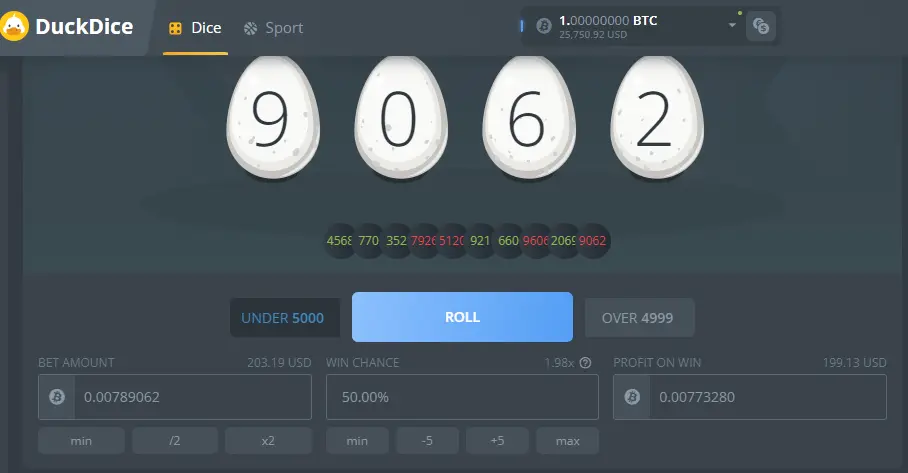
Let's head on over to Duckdice. 50-50 odds. 1 BTC in balance. I've reduced my maximum bet to 1/128th of my total. Let's see where we get. We're playing a simple martingale meaning we double the bet on a loss go back to our starting point on a win. Let's see if on the first try I can make half a BTC in profit.
The chart didn't quite come out legible for a screenshot, but very soon, the bet grew to the point of wagering thousands to recuperate hundreds, leading to a devastating loss streak, which didn't happen immediately, but in comparison to bankroll growth rate, it only took one devastating loss streak to lose an entire bitcoin to recuperate less than 0.8% of one in a single bet. It's important to note that when the bet size grows to a scary amount, that's where most gamblers intuitively deviate from the plan and get greedy, quadrupling their bet in order to scratch the itch for a sizable win from sizable risk, and that is what makes the martingale strategy dangerous; a small start plants the seed of thinking that a win is due, and the risk is increased exponentially over a single bet with no logical reason beyond gambler's fallacy driving the bettor to risk more of their money over a shorter time period.
We think a win is due, because statistically it is. That never applies to a single bet though, and in the heat of the moment, most gamblers act without any sound logic behind their bet increase.
Now despite the odds of that many losses occurring in a row, it definitely happens, every time, and the martingale is a gambler's fallacy for a reason.
What makes a player a smart player then?
Professional gamblers are playing a dangerous game, but the idea behind winning in the "smart gambler's" mind is that the algorithm may be tilted in the casino's favour, but that careful play and aiming big with small bets can and does result in more wins than losses. Such gamblers mix it up, and capitalise on the high-risk high-reward nature of playing, whilst employing the aspect of the law of large numbers that the casino doesn't cover: The discrepancies in the short term.
Discrepancies in the short term are those moments that things go in favour of the player for long enough to make a significant profit. A smart gambler might make his goal to use 1000 dollars to make another 1000, and do so by betting 100 carefully and systematically on odds that in the short term prove favourable.
That being said, as the author of this post I have interviewed 5 professional gamblers, people who stay in profit, and been privvied to their so-called secrets. And the result of these interviews showed a variety of philosophies, playing styles, choices of game and dice multiplier automatic bet settings. Now, I'm not rich, and despite consistent profits, not one of my interviewees managed to carve out a set strategy that makes money on autopilot.
So how did they gain a consistent enough advantage to beat the house edge? Here's what professional gamblers tell you to do, and to keep in mind, if your goal is to turn a profit playing as they do.
1. It's all about your bankroll. You have a certain amount to play with, and as such you need to use it carefully.
"Depending on how much I have in balance, I aim for a multiplier of roughly 100X and I'll bet my balance once I've halved it 3 to 6 times."
This is what one pro had to say. And consistently the core of his advice applied across the board.
2. "If you can't turn small into big, you can't turn big into huge."
This piece of wisdom was dished out by a professional with over a million dollars in total profit. When he played, he played to make more money than anyone on the site, taking the leader boards on gambling sites that incentivise competition between bettors as a challenge. Go big or go home. Yet even he insisted that playing a big amount is a stupid endeavour, as you begin to immediately swing with more weight than you should. Start small, and aim to make 10 times your money not twice your money. If ten times your money feels like a ridiculous goal, reduce the amount you're playing with and play ten times.
This leads in to our third key point.
3. Play risky only when you're playing profits. This means, play small amounts, aiming for high multipliers, and build your balance back in a conservative way. In a practical sense this could mean doing the following:
Play with 20$. Bet half a dollar on 2x. Win. Bet ten cents on 50x. If that doesn't work, repeat the bet, and capitalise on the likelihood of a rare multiplier coming up and hitting big with small profits. If you really want to play smart, continue setting aside money. Play with that 20, and when you get to 40, take out your start. Now it's free play.
The likelihood of winning a martingale however the goal and starting bet are set up is exactly the same as placing one single 50-50 bet, minus the house edge. This means, the longer you play, the less difference it makes to the casino, you'll lose. Or you'll get lucky to the tune of exactly how much you bet, once again, deducting only the house edge.
The likelihood of hitting a big multiplier is much lower, but because RNGs are actually fair methods of generating outcomes - small enough play sustained over a long enough period aiming for a high enough multiplier with a realistic approach to bankroll management is the only proven way of using the odds in your favour. One should look at winning at a casino being about choosing your own luck, and the best way to do this fearlessly is to bet small enough to rebuild your balance, yet aim high enough with what you have to make a heck of a lot more than you expect on a single bet.
The perfect example of this is how a popular gambling site rewards users for hitting a 99999X multiplier. Doing so had me leaving my PC to run almost 50 thousand bets, in several windows running several instances, and my results over multiple playthroughs was that 8 of my 10 windows managed to hit the multiplier before running into a negative balance.
This shows the balancing act, as 99999X your bet is attractive to aim for like a lottery ticket, but only having the funds to play in favour of it hitting with extreme patience will yield a profitable outcome.
So the lesson is, gamble responsibly, and if you wish to be one of the 5% of gamblers who stay in profit, don't let your emotions get the better of you, play small and aim high, and change multipliers like you change lanes on the highway, as no one method stands up in the short term. You can play risky and fast, or carefully and calculatingly strive to keep that 1% edge at bay with a regenerative approach to managing your bankroll and the desire to win a lot with a little. Your results will vary tremendously, and that's what makes gambling the highest grossing form of entertainment worldwide. You can win, and you can win consistently, but it takes patience and practice, and a resignation to the fact that betting with the odds is reinforcing the house edge. If you want to win, bet against the odds, repeatedly, and often enough to feel like a 1% edge can be kept at bay with manual correction when the tide of luck finally turns. Nothing wins against the law of large numbers in the long term, given a consistent playing style, so don't play too fast, but even more importantly, don't hang around and overstay your welcome once you win.
To learn more about probabilities offered by crypto casinos, check out my post comparing two leading crypto casinos and choose where you're happiest placing your next recreational bet. After all, there's more of a difference than the interface in the online gambling world. House edges vary, and not all claims hold up when put to the test. Check it out.






