
If you ever spend any time trading your favorite coins, you may have heard people refer to a buy wall or a sell wall.
First, let's talk about the scenario you will encounter these. When you trade currencies in a professional capacity, it will be on an exchange that has expected market pairs, like ETH/USDT, XRP/BTC and the sort. A good exchange will have good volume and thus liquidity. These two are tightly intertwined, as volume is the result of healthy consistent buys and sells, and the more of them we have, the closer the match between the two becomes. Liquidity, in it's simplest form, means it is easy to buy and sell at the given desired cost. It means that everyone is able to hot-potato their positions right around the current market price and that's all good.
Often, when trading, you will notice a coin is developing a fairly recognizable range of movement from a few different low positions to higher ones, over and over again, perhaps for many hours on end. As this happens, especially with the most popular coins, you will often see increasingly larger position just below where anyone has been buying or selling. As an example, let's say a coin is currently around the price of $100. It drops as low as $98 and as high as $102 and tends to do this over and over again. People are placing buys at $97, 98, 99 and there are sells everywhere above. Suddenly, you will see a position for $100,000 at $97.99. Perhaps it stays there for an extended time, or perhaps you notice this pops up, disappears, drops by a few cents, a few higher, etc. This is creating what we would call a buy wall. The logic behind this, if it is an intentional whale manipulation, is to create a true mathematical and psychological block that the price will not likely go any lower than this wall.
The success, and even purpose, of such a wall, is partly dependent on the experience of the whale, and also whether it is an algorithm placed through bot programming, meaning it is AI or a simple algorithm set using the exchange's api calls. If the user is very sophisticated, there is little concern that they are setting it correctly, but if it is careless, it is very possible for a buy wall to actually coax the direction of the coin to go down, grab up all of those trades, and then continue back up via market buys and OTC trades. All of that will be covered in other articles.
If it the buy wall is created intentionally, the purpose is to tend to prevent the position from going any lower, and if a lot of trading is taking place on the coin, people will tend to get anxious about getting a buy position in. They will start just above the wall, and continue upwards, and if there simply isn't any sell action low enough to provide instant liquidity, people will start placing market buys just to get in, and the price will rise. Often, this is driving the price directly into the hands of the same person who created the buy wall. There may already be a lot of small sell orders already placed, or there may suddenly be a sell wall'; surprise! This does take many forms, and most of them are beyond this simple introductory article on the topic.
A sell wall is the same thing as a buy wall, but tends to create a barrier where it is hard for the coin to go higher than that point, because it takes an enormous amount of buys orders to match the math needed to clear out the sells. Why would someone want to do this? There are several reasons, some complex some easy to understand. It can depend on just how much of the coin a person is trying to clear, but if we're talking hundreds of thousands of dollars, it isn't always easy to get that much liquidity when the price is right. People who have a lot of money invested and are savvy to manipulating the order book don't see the point in taking risks. They know that psychology is a strong element to trading, and there is always someone to dump on, and there is always someone desperate to get in on the appearance of action.
If you imagine the price of a popular coin being like waves in an ocean, and you understand the simple principle of buy low, sell high, then think of someone with a huge amount of funds who wants as close as a guarantee as possible. It makes sense for them to intentionally box the price in so they know they can get their entire amount bought, and they know the price will drive up until it sells. Again, the more sophisticated whale manipulator or algorithm will know the action points that people are most likely going to respond to; an even number that people are anticipating a coin to sell at, a percentage it tends to change, the affect from other coins people aren't currently watching and other factors. One can easily create channeled activity, preventing a coin from getting outside the range of their sell orders by placing a ton of orders lower than they are certain the coin will go, but certain to cause others to desire getting in on the action. A person can be certain the coin is about to go way up in value and they want to get all of their buys in before that happens, typically just trying to buy in will cause the price upwards. A sell wall can easily give the impression, and place mathematical weight against the coin's ability to rise beyond a certain point, which pushes pressure against lower sell orders and drives up the market price towards that position. Boxing in the buys or sells makes it possible to get large buy orders in at their lowest price, and allows the person to add artificial psychological pressure on the opportunity to buy in, so that the price rises just with the right timing to sell those positions at a quick profit.
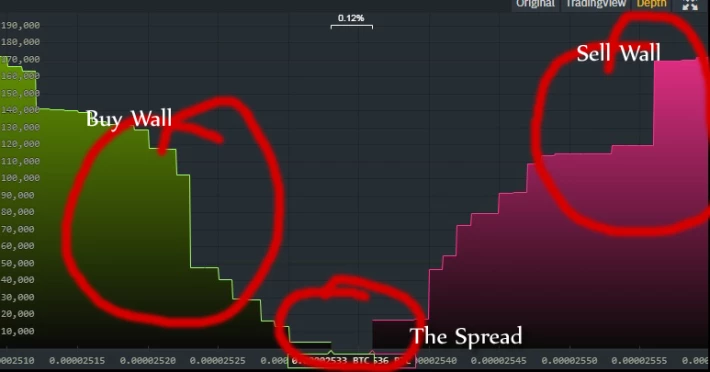
A final point, and thought, is that buy and sell walls also happen as a normal action on exchanges big and small. The larger the coin, and the higher the price for a coin, the less likely these occur. It takes millions of dollars to force the price of Bitcoin extremely high, and there is rarely more than a penny spread between buys and sells. Hundreds of thousands of dollars can pass through Bitcoin's order book in seconds. But, with some smaller value coins, the spread between positions get larger and larger by design. Coins near the lowest value against Bitcoin might be 5-7% value just to move one tick, so if people are certain they want to get in, you will see huge orders build up in the buys and the sells, and since the value is pushed very low, every move that Bitcoin makes adds pressure downward. Everyone who gets their positions in will be stuck too high, so there are natural buy and sell walls building up in the hundreds of Bitcoins at every price. This is a natural occurrence on the market for coins that are in trouble or simply have to break out of the lowest end of the value hierarchy.
I hope you find this a benefit. If so, TIP! :-)
Gordon Freeman Out.
For the funny stuff, go here:
https://www.publish0x.com/crypto-satire-fake-news-ripped-from-the-headlines






