
What is tokenomic? For investors, tokenomic is to find sustainable investment options. For traders, tokenomic is to find a trading strategy to gain short-term profits. For developers, tokenomic is a way to find a sustainable long-term growth solution to create a better community. However, there is much more than just growing your wealth and gaining more profits. Tokenomic is a test of the economy that potentially can be implemented nationwide through policy implementation and helps nations to grow in the future.
Let’s explore.
Table of Content
Trilemma
Tokenomic Trilemma
Over Design
Further Readings
In Conclusion
Trilemma
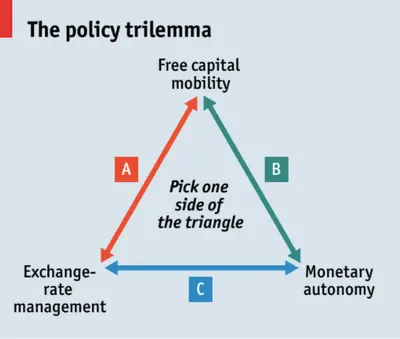
Image credit: https://www.economist.com/schools-brief/2016/08/27/two-out-of-three-aint-bad
Let’s examine how a nation plays its tokenomic. The central banks play a role to control (manipulating) three factors:
Free capital mobility: open to foreign investment
Monetary autonomy: low-interest rates
Exchange-rate management: peg its national currency exchange rate against the standard (US dollar)
If you live in a rich country, you have the flexibility to adjust to all three factors. However, other countries may not be that lucky to do so.
Moreover, only two factors out of three are possible. You can A) fix the exchange rate and open to accept cross-border capital flows while they diminished your monetary autonomy or B) can open to accept cross-border capital flows and have monetary autonomy but loss controlling of exchange-rate management or C) can fix the exchange rate and have monetary autonomy but losing opportunities to open to foreign investment.
For example, the Fed in the United States can A) boost their foreign investment and fix the exchange rate to expand their domestic economy or B) boost foreign investment and domestic investment through a lower interest rate environment and keep the exchange rate fluctuating or C) fix the exchange rate and have monetary autonomy to print more money while driving foreign investment away.
Just to note here that we do not examine how effective those actions result after the implementation here.
Tokenomic Trilemma
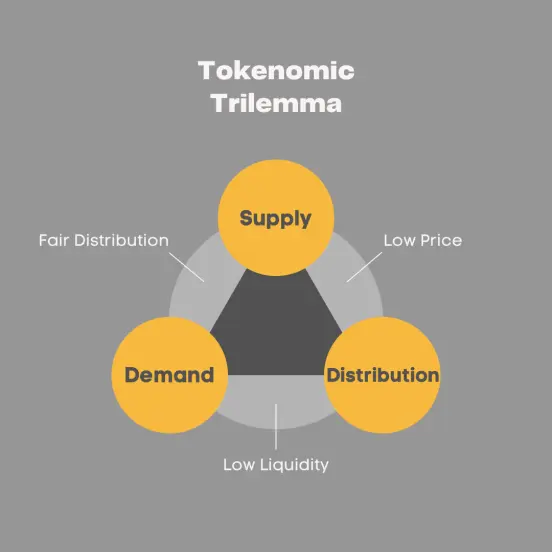
We may only realize there are two factors for tokenomic as supply and demand. However, there is one more factor to influence your tokenomic model: distribution.
You can easily accomplish supply through the creation of more tokens by increasing the supply or burning tokens to diminish supply. Such manipulations then hopefully influence the demand side which is less likely to be controlled by token creators. There is a third factor of distribution from token creators either through airdrops, or assigned contributors through paying for their performance, or utilized into treasury through investment, Defi, funding future projects, and many more ways.
Of course, you will have certain constraints on your ability to manipulate tokenomic.
You can control supply and indirectly influence demand to reach a fair distribution result of a more sustainable community. Or you can create financial incentives to increase the demands for tokens through staking as one example.
Once you try to manipulate distribution, then the equilibrium system will shift. Increasing more supply will lower your token price since tokens will likely distribute more to powerful players in the system. Or lower supply to increase the token price while sacrificing your token liquidity.
Carefully adjusting tokenomic is necessary to build a sustainable community without possibly being labeled as a rug pull project.
Over Design
3 categories of the design of tokenomic:
Platform economic: Token integration
Tokenomic: monetary policy
Treasury management: investment, play to earn, incentives models to users
But rather, my opinion is that if you design everything, you are entering into a centralized zone to manipulate so many factors to try to yield the best results while losing opportunities to let the system digest itself into the optimization process.
You will run into incentive misalignment, manipulation of the token, and losing token productivity.
It went back to the discussion on how one can interfere with another's property rights. Such philosophical debate continues discussing but continuing practicing through trial and error helps to determine the better solutions.
Further Readings
Here are further readings to enrich your understanding of the tokenomic in different aspects.
All You Need to Know About Tokenomics | by Ehsan Yazdanparast
Tokenomics 101: The Basics of Evaluating Cryptocurrencies - DeFriday #19 | by NAT ELIASON
Tokenomics Report: The Major Exchange Tokens | by Mattison Asher, Laurence Smith
Understanding Token Economics (Tokenomics 101) | by ANATHA
What Is Tokenomics and Why Is It Important? | by Robert Stevens
What is Tokenomics? | by Matt Hussey
The law of tokenomics, revisited | by Louis Lehot
Video Guide: What Gives Cryptocurrency Value? – Tokenomics Pt. 1 | by Bhaneeta Chadha
Video Guide: What Gives Cryptocurrency Value? – Tokenomics Pt. 2 | by Bhaneeta Chadha
The Three Tokenomics Problems and a Productivity-Linked Tokenomics Design | by Jack Chong
In Conclusion
Tokenomic model is not a set topic that people continue exploring more possibilities. Maybe you can find a better way to implement it that works for everyone the best.
Join BitDAO to earn a $BIT token here or more here.
Photo by Shubham Dhage on Unsplash
Note: the post was shared on multiple platforms here.

You can refer my previous article lists here and here
------------------------
2022 Prediction
2022 Prediction #1: L1 Scalability
2022 Prediction #2: L2 Bridges
2022 Prediction #3: Zero-Knowledge Proofs or ZKPs
2022 Prediction #4: Regulated Defi On-Chain KYC
2022 Prediction #5: Institutional Crypto Adoption
2022 Prediction #6: Defi Insurance
2022 Prediction #7: NFTs-Based Communities - DAO 1.5
2022 Prediction #8: Metaverse and NFTs
2022 Prediction #9: Web2 Companies’ FOMO
2022 Prediction #10: Time for DAO 2.0
------------------------
DAO The Way
DAO The Way Part 1
DAO The Way Part 2
DAO The Way Part 3
DAO The Way Part 4
DAO The Way Part 5
DAO The Way Part 6
DAO The Way Part 7
DAO The Way Part 8
DAO The Way Part 9
DAO The Way Part 10
DAO The Way Part 11
DAO The Way Part 12
------------------------
Learn How To Defi
Learn How To Defi Part 1
Learn How To Defi Part 2
Learn How To Defi Part 3
Learn How To Defi Part 4
Learn How To Defi Part 5
------------------------
Crypto Comics
Crypto Comics
Crypto Comics - PoW
Crypto Comics - Who is Satoshi
Crypto Comics - What is Token
Crypto Comics - What is DeFi
Crypto Comics - What is Wallet
Crypto Comics - What is HODL
Crypto Comics - What is Coinbase
Crypto Comics - What is PoS
Crypto Comics - What is DAO
Crypto Comics - What is A Block
Crypto Comics - What is NFT
Crypto Comics - What is Fork
Crypto Comics - What is Web3
Crypto Comics - What is DeFi-2
Crypto Comics - What is Yearn Finance
Crypto Comics - What is Degen
Crypto Comics - What is Aping
Crypto Comics - What is Cold Wallet
Crypto Comics - What is Hot Wallet
Crypto Comics - What is Airdrop
Crypto Comics - What is DYOR
Crypto Comics - What is 65537
Crypto Comics - What is RC4
Crypto Comics - What is WAGMI
Crypto Comics - What is Bagholder
Crypto Comics - What is Decentralization
Crypto Comics - What is Wallet Address
Crypto Comics - What is Plagiarism in Web3
Crypto Comics - What is Bart Pattern
Crypto Comics - What is Encryption
Crypto Comics - What is Consensus
Crypto Comics - What is Protocol
Crypto Comics - What is Stablecoin
Crypto Comics - What is ApeCoin
Crypto Comics - What is FOMO
Crypto Comics - What is Tokenomics
Crypto Comics - What is APR
Crypto Comics - What is to The Moon
------------------------
Learn Web3 in 100 Days
Learn Web3 in 100 Days - #1 What is the Internet and How Relevant to Web3
Learn Web3 in 100 Days - Day 2: What are the Browsers and Servers
Learn Web3 in 100 Days - Day 3: What are HTTP Status Code
Learn Web3 in 100 Days - Day 4: HTML and CSS and JS
Learn Web3 in 100 Days - Day 5: What is programming
Learn Web3 in 100 Days - Day 6: Markup, Elements, Tags, and Hyperlinks
Learn Web3 in 100 Days - Day 7: Style Your Web
Learn Web3 in 100 Days - Day 8: JS
Learn Web3 in 100 Days - Day 9: SQL
Learn Web3 in 100 Days - Day 10: Front-End
Learn Web3 in 100 Days - Day 11: Front-End Framework
Learn Web3 in 100 Days - Day 12: More HTML
------------------------
Modern Economic Nonsense
Modern Economic Nonsense - Inflation and Incentives
Modern Economical Nonsense - The Astrologist's Way
Modern Economical Nonsense - The VUCA World
Modern Economical Nonsense - Zug Tax and How to Run your Own Monopoly
Modern Economical Nonsense - Participatory Economy
Modern Economical Nonsense - Economic Models
------------------------
Yearn Finance Comic
Yearn Finance Comic - Part 1
Yearn Finance Comic - Part 2
Yearn Finance Comic - Part 3
-------------------------------------------------------------------------------------
Disclosure: The article was written by a delusional author who is possibly a nut job without any questions whatsoever about expertise in the subject matters. You should not believe any words this author wrote or you may experience similar symptoms or even possibly become a nut job.






