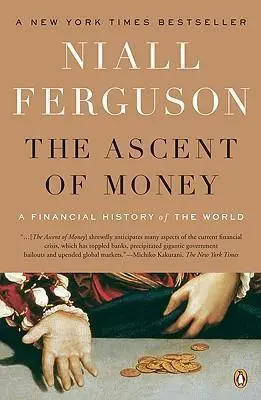
Money has played an important role in our lives and continues to do so. Along with the relentless technological innovation, we are witnessing financial innovation before us. The cryptocurrency revolution can second this phenomenon along with an increasing cashless payment ecosystem led by the ascending economies of India and Nigeria. This is a continuous series of articles that explains the financial evolution phenomena, partly inspired by Niall Ferguson’s acclaimed book “The Ascent of Money”.
The first part is sort of an intro to Ferguson’s work and his view on Bitcoin. Although the above book(see image) was written in 2008(one of the landmark years in the financial history of the world), it subtly explains to us how finance is the backbone of history, highlighting in dramatic style the following events: the Renaissance enabled by Italian exchange dealers, the French Revolution derived back to a stock exchange bubble, the 2008 crisis derived from America’s bankruptcy capital, Memphis, to China’s boomtown, Chongqing. The subsequent edition contains the advent of bitcoin and the trade war between US and China. He discusses the qualities that make Bitcoin a significant advance and the broader importance of decentralization and sovereignty. It is observed that Bitcoin is gradually being adopted not primarily as a means of payment but as a store of value. Though the book has been critical of the various financial bubbles that took place throughout the recent centuries, Ferguson is bullish on Bitcoin not being a bubble as observed in his recent Bloomberg article.
You may disagree with some of the points in the book: like the emphasis on Western economic development and sort of a glorification of mercantilism. But the way various crucial aspects of finance are explained through fascinating stories makes the material readable. I ask to go get that book now! Because then you can understand the movie Big Short as well as know what happened with GME.
(This commentary on financial history will be continued in further parts.)