
As the USA Congress meets later this month to decide the fate of the ITC "Investment Tax Credit" for Energy Storage ESN: ITC for Energy Storage in Congress, currently written just for Solar, an expected bipartisan "yes" decision bodes well for "Crypto" and "Distributed Ledger" centric Energy market management service solutions like:
#Powerledger https://www.powerledger.io/
Based in Perth, Australia (34 employees present and past listed on linkedin)
Powerledger was an early entrant into the crypto space from Australia making a big stride forward with its Energy Trading Platform starting an 8 month "P2P" Peer to Peer "PoC " Proof of Concept in Malaysia with SEDA
Highlights
- Power Ledger partners with the Sustainable Energy Development Authority Malaysia (SEDA).
- The pilot trial aims to demonstrate the feasibility of solar energy trading in the Malaysian energy market using Power Ledger’s platform.
- Using Power Ledger’s peer-to-peer (P2P) energy trading platform the trial will enable participants to choose fossil fuel or renewable energy sources.
- The trial is expected to commence by the end of 2019 and run for eight months of which the alpha run will be two months and beta run will be six months.
Powerledger licenses, deploys and supports their tech to Enterprises (directly at the moment) interested in running a distributed energy trading platform secured on the"blockchain" which in Powerledger's case is a distributed "private" ledger which according to Wikipedia is a dual coin/token system POWR and Sparkz :
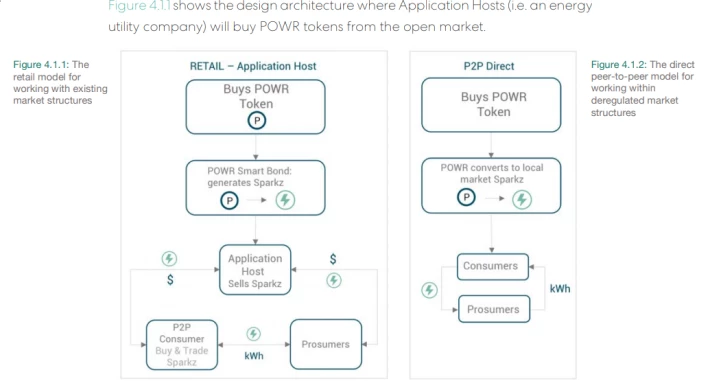
"The platform provides consumers with access to a variety of energy markets around the globe and is meant to be scalable to various energy infrastructures and regulations. The market is based on a dual-token ecosystem operating on two blockchain layers, POWR and Sparkz. POWR tokens allow consumers and hosts providing energy to interface with the ecosystem and are protected through Smart Bond technology. POWR tokens can be converted into Sparkz tokens, which can be used for friction-less transactions in the energy exchange market.[1] The initial coin offering for POWR tokens became the largest crowd funding project in Australia and the 14th highest in the world." the Wikipedia link is here
Ok, my first instincts being a software architect is I smell a lot of complexity in Powerledger's software design.
That's ok, as distributed peer to peer retail energy trading is not a simple challenge.
Since I first started tracking Powerledger's initial offer in late 2017, Powerledger has devolved into a three pronged market focus "Go to Market" thrust, so their sales and marketing "Dragnet" is quite broad covering:
Energy Trading with three offerings
- VPP 2.0 : Households and businesses can sell their battery electricity in peak demand periods to pay back their investment faster. Environmental commodities trading Renewable Asset Ownership
- xGrid : You can sell energy generated from your solar panels to other households connected to the electricity grid.
- µGrid : If you manage a shopping center or an apartment complex, you can sell energy from rooftop solar to your tenants and neighbours, or allow your tenants to be the masters of their own energy supply. Monetizing your roof space has never been easier.
Environmental commodities trading
- C6: uses blockchain technology as a measurement, reporting and verification tool for carbon and renewable energy credits.
- C6+: uses blockchain technology to create a digital marketplace and exchange for carbon and renewable energy credits.
Renewable Asset Ownership
- Asset Germination Events (not open to use, currently WIP)
Powerledger's ambition is big, really big. Aim high, deploy something, learn and adjust is clearly their strategy, outside looking in.
A "Go to Market Strategy" which begs the obvious investor question, "It might be too broad a dragnet given the resources required to effectively drive the development, test, deployment and support of the above?"
Market Hurdles, bigger than one might think?
Now for the "investor" reality check.
Does Powerledger really have the horsepower and the tech to enter into the utility market segment of energy trading guarded by the collective gatekeeper EPRI (becoming a bigger and ever expanding worldwide entity for sharing R&D effort costs among its utility members). EPRI Members pay a lot of money to EPRI to carefully and securely plan the roll out of such services among their members (and keep would be startup competitors out, given the Utility sector deploys capital in the trillions, and is the world's largest equity and debt based "Main Street" market sector with the world's biggest investors). EPRI's pace and the pace of the utility market generally is often described as "glacial", that said glaciers have been melting rapidly these days with EPRI trying to be more responsive to member demands. The slowness of EPRI's response to their smaller members, or lack of a footprint in non-members is likely Powerledger's opportunity.
Let's have a look at Powerledger:
The PowerLedger Team: Well rounded with a decent chance of success
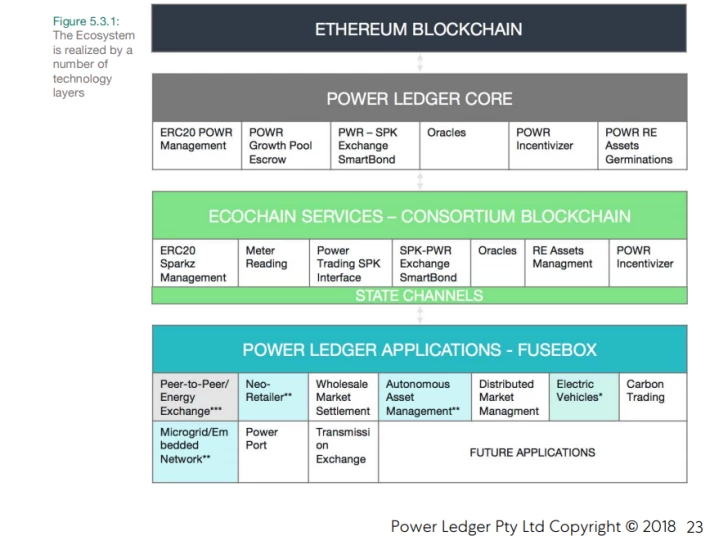
A Quick dig on the executive team and advisors listed, suggests to me Curtin University, based on the CEO's profile) is providing some of the development horsepower (maybe) to the leaders who are experienced enough bring enough expertise to Powerledger so they can reach their lofty goals. Powerledger is not as such, an open sourced project (at least I could only find a Powerledger "SmartContract" and "Demo"https://github.com/search?q=powerledger, so the Powerledger funding raise has to pay for development and test, and QA and support. That said Powerledger is a hard fork of Ethereum with two layered chains. (see the diagrams below, and visit their site at powerledger.io to understand more.)
Given I have personally setup and run a few software development startups myself, it's hard to get a feel for what the "cash-burn" is at Powerledger and, what their "runway" looks like. The recent Powerledger win in Malaysia, yields some revenue and takes the edge off the "cashburn" at Powerledger. It's hard to rate the velocity of development ( watching Github commits is one way to gain some measure of development velocity and competency). Power is trading at near an all time low https://coinmarketcap.com/currencies/power-ledger/#markets , as are most "boutique" cryptos. Since there are signs of life at Poweledger with this recent announcement, time will tell in the next 8 months or so whether they are making real progress.
That said Powerledger have had their ICO money for 2 years (Powerledger raked in US$ 24 million during the Fall of 2017 hysteria, https://icowatchlist.com/ico/powerledger).
IMO Powerledger need to start delivering on the lofty promises made earlier, otherwise most investors will liquidate and check out (take their huge losses if they got in at the peak). Interestingly most of the trading volume of #POWR is on #Bithumb, a South Korean crypto exchange trading platform.. https://coinmarketcap.com/exchanges/bithumb/
The Power Ledger Tech
I struggled finding their original whitepaper on their site through their menu system, (WTF) so simply did a Bing search and found it here. It's a big read, I ploughed through it given the paper has had a May 2019 update, and here are my takeaways:
On first scan, (it's been awhile) I miss a strong set of Vision and Direction statements and an "Executive summary" at the front of the document, and well, feel like I am looking at "tech spaghetti", lots of it, thrown against the wall, where the writers are hoping something will stick with the reader.
Generally though, Powerledger's Ethereum forked energy trading software architecture has merit, with dual and convertible ERC20 tokens POWR and Sparkz.
To the reader, it should be known, I am not a fan of gas tax in #Ethereum nor it's abysmal "tps" transaction per second performance (1.0 is around 15 tps) even though I am a Canuck. I much prefer the fee-less transaction model #IOTA has delivered in this regard with what appears to be linear performance (sans the #Coordinator and running #Shimmer for consensus) , but I will save that comparison for another blog in the context of building smart cities. If #ETH 2.0 can be delivered in a reasonable time frame with 3rdd party tested and proven tps AND, the Poweledger team successfully migrates their 2 layered chain ledger solution to a hardfork of 2.0, Powerledger will be in a good position to achieve their goals. That said, Powerledger is deployed "a la carter" for each customer, and they can choose to charger for gas or not, in theory.
Digging into the whitepaper of Powerledger they are certainly customer solution focused, lots of potential applications listed, however my read is Poweledger is tech really aimed at the integrator software developer, serving the utility energy trading market sector. In that world, documentation is king, as is training to get adoption.
Ok, what is really powering the solution at Powerledger? One look at one of their recent job postings https://www.powerledger.io/job/senior-blockchain-developer/ tells me everything I need to know, Powerledger's architecture needs only "blocking and tackling" (and some times mind numbing) software development (and test, lots of testing) on Java application servers, with a web front end talking to a relational database, where the Powerledger solution is equipped with restful APIs to facilitate 3rd party edge and back office system integration, none of it rocket science. Most of the development and test effort can and probably is being "off-shored" or 'near shored" at relatively low cost, IF, and its a big IF you have experience managing such a setup, your documentation is really good, and your distributed software development management tool chains are good.
So per project development costs of Powerledger based projects should be relatively easy to resource (lots of java developers out there) and keep within a well estimated budget target.
Check!
Here is an Overview of how Powerledger works from their whitepaper...
And the competition is?: IBM & LARGE SYSTEM INTEGRATORS DEPLOYING HYPERLEDGER..,

It's clear a Powerledger integrator can mould the basic capabilities of Powerledger and integrate them as they like into a decent retail energy trading platform, so in many respects, Powerledger's main competitor is really #Hyperledger, which is fully championed by IBM. Hyperledger is open source with a large community AND, is also being deployed in the same utility market segments and for the same purpose here in North America, by very large, competent system integration partners (for lots of money). I won't be doing a direct comparison, since Hyperledger is like silly putty, and you can mould it into any solution you want.
The Powerledger Opportunity: Small to Medium Utility Clients, with a modest budget and retail energy trading focus, peer to peer.
IMO, for now, prospective Utility clients looking to create next gen retail energy trading capabilities, especially those which are embracing energy storage as part of the mix, will be those clients with smaller with fewer resources are more likely to lean toward Powerledger for an almost "Out of Box" solution with less integration cost and support overhead.
Powerledger appears to require not much in the way of customization to be deployed given the tech on which it is built, most of which requires little modification and the integration points are simple. Clients with large complex utility clients needing a lot of customization to implement their nextgen energy trading capabilities wired into multiple legacy generation and future large format storage systems are likely to opt out for Hyperledger solutions built by IBM or similar integrators, both of which have many years of utility expertise developing the solution on Hyperledger and who more often are not march to the beat and pace of EPRI.
Powerledger Investor outlook? POWR Hodl, Sell or Buy?
The choice is yours.
I personally have no interest in and, have never held PWR the listed coin of Powerledger .
I was however interested early on in Powerledger integration points and remain interested in Powerledger's progress in this regard, myself being a technology licenser of edge and off-grid Power Generation and Storage solutions. My interest in Powerledger is mainly a technical one (APIs) supporting my licensees' integration of Harvistor's Starwind5 and TWINDPower low mount wind powered attached battery charging systems equipped with Lithium or ZincAir based large format storage systems.
TK note- I design SCADA software power input monitoring and control integrations into the charging systems of VIZN (USA), MGX Renewables (CAN), Redflow(AUS) and Nant Energy(USA) ZincAir large format systems where the latter are configured to be primer mover energy sources to either or both the public grid and local use of power "behind the fence". (and compete directly and effectively at 1/2 the cost in large format with Lithium energy storage vendors such as #Tesla, #SAFT, etc..,)
Powerledger IMO, will need to really focus all their resources and their development "brights" and energy to really deliver and bring their market value to market over the next year, especially doing so to ensure their demonstration PoC in Malaysia is a big success. I wish them the best.
Thereafter (or concurrently), the team at Powerledger have an even bigger Integrator channel development set of hurdles. Powerledger must work hard to create more awareness, higher levels of education and create a baseline level of integrator support to effectively grow their business and the use of both the POWR and Sparkz tokens. It's not easy reaching software developers focused on the medium and small sized energy trading opportunities scattered across the globe. The good news is there are lots of them, and it looks as if they have a strong yet small business development presence to do so.
Next Step? Powerledger USA? (or at least California..,)
There is definitely an emerging market for Powerledger's value proposition as a distributed energy trading platform in the retail energy trading market space (consumer facing), That said their early forays into Korea, Thailand and Malaysia and home efforts is just a starting point.
In the USA, when the ITC for energy storage gets passed this year AND there are plenty of storage solutions hitting the market, the opportunity to realise Powerledger's lofty goals does start to look most bright in the B2C, peer to peer retail energy trading market place, so maybe they will take the next step and catch a Qantas flight the USA "left" coast where "home" and small business solar is big. (They do have a cryptocurrency trader based in San Anotnio, TX, USA) :)
A little bit more on Powerledger's funding https://www.crunchbase.com/search/funding_rounds/field/organizations/last_funding_type/power-ledger
TK over and out.
*****






