
For you, regardless of trader or holder, portfolio management is essential to know how and where to allocate your resources and where to pay attention. From what I've been researching, few professionals know what the term "portfolio management" means and the importance of implementing this practice to understand how to improve their financial results. Performing a good portfolio management means achieving the goal you want without exceeding the limit of resources you have, with this, you need to know how to organize and use techniques and skills to successfully manage all available resources and distribute them correctly.
In this article I intend to do an applied study based on the "perfect" portfolio described by Ray Dalio as well as some macroeconomic indications that can affect this management
1 - "Perfect" Portfolio
It is necessary to say that there is no perfect allocation of resources, ideally, your allocation of resources should vary according to the macroeconomic scenario (I will explain in more detail how and why later), however, Ray Dalio when asked about a fixed portfolio where you would only have to rebalance over time, left the following image exposed:
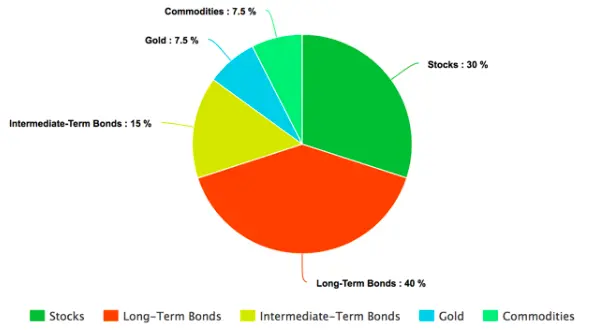
Initially, I will explain my interpretation of why the allocation according to him should be done in this way.
Intermediate/Long-term Bonds
Say you want to allocate your funds to government bonds issued by a government or company in your country, you find a 30-year bond with an annual yield of 10%. When you buy this bond you are making an agreement with the government that in 30 years it will repurchase this bond from you with due interest, HOWEVER, in the meantime you can sell this bond to another person who is interested in the market price. As time passes, governments tend to lower the benchmark interest rate in order to warm up the economy, as these bonds are based on this benchmark rate if someone wants to buy a 30-year bond, that bond will no longer yield 10%, but the lowest amount defined by the government. So, when you choose to sell this title to the market, its value will be much higher than what you paid for it.
In summary, if you decide to sell a long-term bond after the central bank reduces the benchmark rate your bond will undergo an appreciation
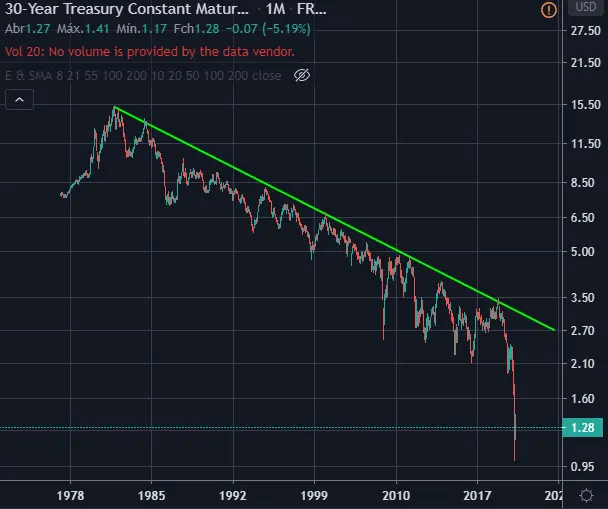
Pegango the graph of interest of 30 years of the Treasury of the United States we have that the interest rate tends to decrease periodically, so regardless of the moment when you buy the security, it tends to appreciate in the long term, we have as another example the Japan that has negative interest.
So the 40% allocation on these bonds is taken as the major part of the allocation because of the "security" that you can either sell in an overvalued way or receive interest at the end of the contract.
Stocks
Stocks are variable income assets with very high volatility so why allocate 30% of the resources here? This question can be answered by viewing the following chart:
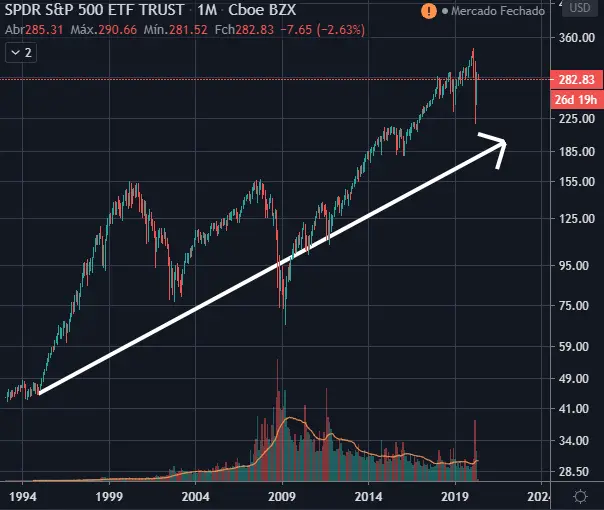
Conversely, the interest rate, stock exchanges and companies tend to increase, making the economic cycle work so as to always expand the quality of life.
Here we have the question that this portfolio was built for the long term, in the short term it does not work because the volatility and macroeconomic events make the risk / return totally unfavorable. For example, if you had bought shares in 2008 to sell in 2009 you would have been in despair, now, if you had bought shares in 2008 to sell in 2018, surely you would have profited a lot.
Commodities
The 7.5% in commodities (such as oil) generally suffer appreciation when the economic cycle is reaching its high point because there is a lot of money being moved to buy and sell this type of product and this can counter a possible fall in shares when it reaches negative pricing at the end of the economic cycle.
Gold
The 7.5% in gold serves as a counterpoint to commodities, protection for when the variable income goes bad or in times of global crisis, there is the 2008 crisis that can be seen in the graph shown in "Stocks" as an example, during that period while the whole financial market was going badly, gold was appreciating
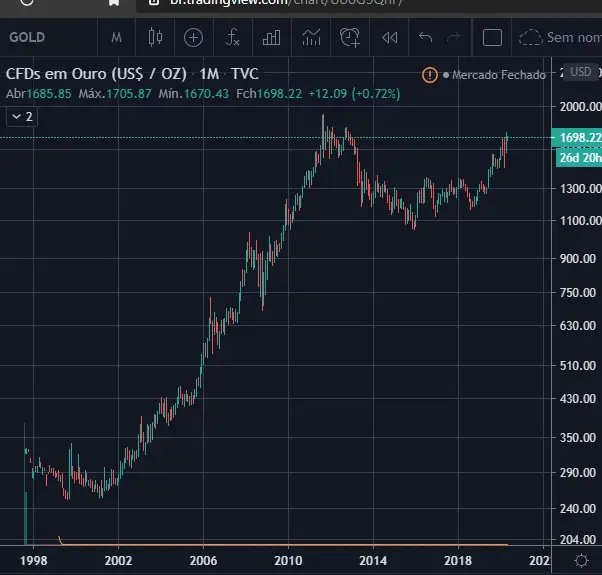
The period from 2008 to 2011 was the period in which the economies took to recover from the crisis, note that it was exactly the last kick off of gold before starting a brief corrective period.
2 - "Perfect" portfolio for cryptos
Again there is no perfect portfolio, you should vary according to the macroeconomic scenario, in the case of this portfolio for cryptocurrencies it should vary with the macroeconomic scenario of bitcoin and the events that can possibly affect it (I spoke a few times about the scenario of four years of bitcoin, if you want to comment that I update that study).
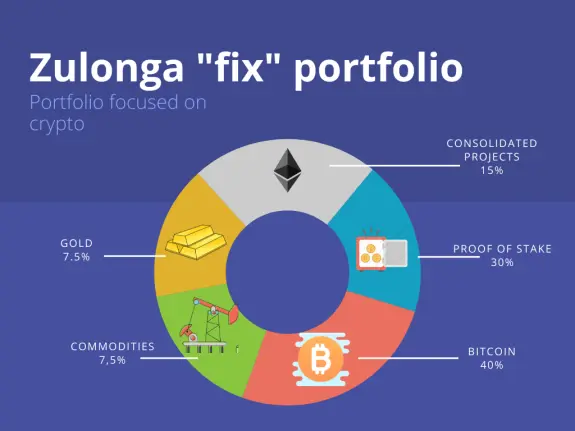
Disclaimer: Remembering that, despite being based on the fixed portfolio proposed by Ray Dalio, from now on it is something that I use and I am improving with time, so if you have any suggestions or constructive criticism of change I ask you to comment. The big problem in setting up a fixed portfolio for cryptocurrencies is the incessant need to research the ideal projects, exactly because of that from now on I intend to show the direction and I will not say the exact projects that you should have in your portfolio, only the paths that you can take to have a consistent cryptocurrency wallet that doesn't "break" easily.
Bitcoin
Bitcoin occupies 40% - perhaps it could occupy an even bigger slice - of the portfolio because it is the currency that (whether or not it dictates) the market, if BTC goes up, altcoins also go up. In the same way as the chart of any stock exchange, there is an immense appreciation in the long run
Then I place again the importance of the study on the configuration of the market and of the cycles that permeate bitcoin, this configuration loses all sense when bitcoin enters bearmarket on the charts of the longest time and, for my analysis in the macro scenario, we are a few years ago to enter the first big and real bear market in bitcoin.
Proof of Stake
Proof of stake is the alternative that projects that are already consolidated and have a use value in reality (such as ethereum) are finding themselves to keep up with the race for the largest market capitalizations. PoS when done in cryptocurrencies that you rely on VERY long-term potential can bring you speculative returns with the convenience of receiving passive income through the stake, it is recommended that these 30% of portfolio be subdivided into more than one project.
Consolidated projects
Before I start why it is important to have consolidated projects in your portfolio, I would like to talk a little bit about altcoin MATIC. This altcoin started to be traded on a major exchange and had a 280% appreciation in about 4 weeks and in 48 hours it returned that 280% because of a misleading twitter post saying that the project's developers intended to liquidate 15 % of tokens. The biggest problem in this story is that only one person said something without providing evidence and the price plummeted due to the herd effect, this shows the artificial price not only for this project but for countless others, so now suppose they made a post exactly the same with the ethereum, the price could have a dump, but it wouldn't be that big and it would recover quickly, because ethereum is useful in real life and the public's confidence.
The projects already consolidated (which are at least among the 40 largest in market capitalization) and which have real use value in real life or partnerships with very strong companies in the world market (such as Chainlink) are the target of this part of the portfolio, this gives you the security to stay active even if you suffer a speculative attack like the altcoin MATIC mentioned earlier.
Gold and Commodities
These assets are very important to be in your portfolio for simple protection (perhaps in the current situation because of the corona virus it would not be ideal to have commodities). If the market makes a totally unexpected move as it did in bitcoin recently, part of its capital is protected in gold and commoditties.
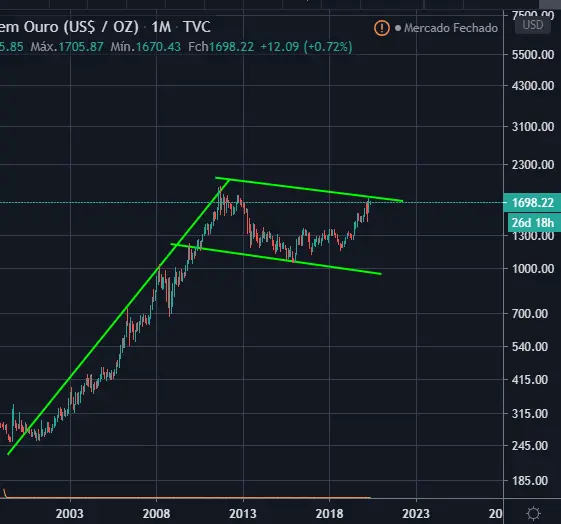
In addition, in the very long term gold is forming a bullish flag (we can also see a possible beginning of cup formation) that can protect you a lot during the big bear market of bitcoin a few years from now.
3 - Portfolio based on the economic cycle
So far we have had a study on fixed portfolios where you would just reallocate resources in the long run, now we are going to enter a slightly more complex study that needs an understanding of economic cycles (from here on down is what I do today)
Initially you need to identify the bitcoin cycles
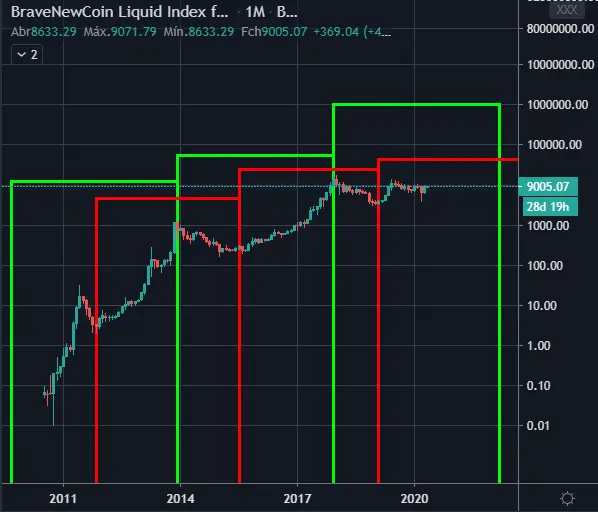
On top of that, bitcoin shows a pattern of highs and lows since the beginning of its trades, if you turn on the first top in 2010 (which has no graphs because it was not yet traded on exchanges) you reach the top of 2014 and the same in 2018 and the next projection is in 2022. As well as the funds are linked for 4 years. This gives you a general sense of what to expect from one year to the next.
Realizing that we are in the bitcoin bullmarket, you can look at the international market, see how the economic cycle is in the largest economies in the world because it is there that whales (people with more than 1000 bitcoins in their portfolio) and institutional investors who trade are concentrated there. bitcoin futures contracts. In a scenario where inflation is rising and markets are heated (top of the cycle) people tend to rush to safety as they are already predicting the future decline, these assets being government bonds, gold and bitcoin that has already started to be seen as a safe haven, this scenario already foresees the weakening of the economy. Here you should see bitcoin's dominance over other cryptocurrencies (in tradinview the code is BTC.D) and this will show you whether they are entering and staying in bitcoin or going to other currency options. If the dominance remains too high you can allocate a higher percentage of your equity in bitcoin, falling dominance will further diversify your portfolio and make room for other projects with interesting graphics.
Still in the bitcoin bullmarket, when you notice inflation falling and a new economic incentive is the opposite, the eyes of institutional traders mostly turn to the traditional market with buying opportunities coming back, then it's time to take a stand more defensive by decreasing the amount of bitcoins and betting on the cryptocurrency stake that you believe in the potential for appreciation in addition to returning to buy commodities since the warming of economies will make them appreciate again.
In the bitcoin bearmarket the strategy I use is different, aggressively negotiating futures contracts while keeping most of the capital in stablecoins and depending on the international situation I increase the position in commodities or gold based on the criteria mentioned above.
Deep down, doing all this is a pretty big job, I don't think I managed to pass on everything I know about the portfolio in this small study. I hope this little introduction to the subject can help in some way, thanks for reading so far :D






