
Lebanon will observe a three-day period of mourning after the capital city of Beirut was shook by a massive explosion that claimed at least 78 lives and injured well over 4,000 others. Officials believe that the death toll will continue to rise as some of the injured may pass away, and new bodies are expected to be found. At just after 18:00, a fire at Beirut's port triggered a powerful blast that devastated the area and could be felt 240 kilometres (150 miles) away on Cyprus. The United States Geological Survey said that the blast was recorded.
According to Lebanese President Michel Aoun, the fire detonated about 2,750 tonnes of ammonium nitrate that had been unsafely stored in a warehouse since 2013. The ammonium nitrate was unloaded from a ship impounded over 6 years ago, and had been stored but not removed from the port. The president announced that the government will release 100,000,000,000 lira worth the equivalent of about 66 million United States dollars in emergency funds. He also called for an urgent cabinet meeting, where officials will decide whether or not to call for a 2-week state of emergency.
The total economic and property damage is still unclear, though local media reports suggest that thousands could face homelessness while power, gas, and water pipelines are not functioning in many areas close to the blast. As of now, the exact cause of the explosion is still unclear, but is under investigation. The nation's Supreme Defense Council announced that those responsible for the disaster will face the "maximum punishment".
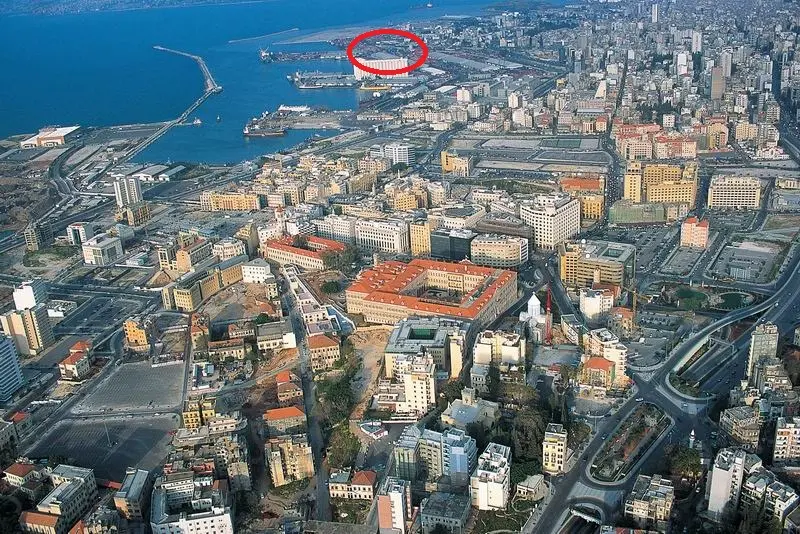
Note: All photos in this article were retrived from the public domain, and do not require attribution or citation for commercial use. The first photograph shows the port of Beirut prior to today's explosion. The circled area shows the area at the epicenter of the blast, which happened behind the grain elevator (The white rectangular building).






