❤️♦️
Military Aesthetics, Identity, and Memory.
In the long and complex history of Southern Italy, few military corps have captured the visual imagination quite like the Cacciatori—the Hunters—of the armies of the Kingdom of the Two Sicilies and the earlier Kingdom of Naples.
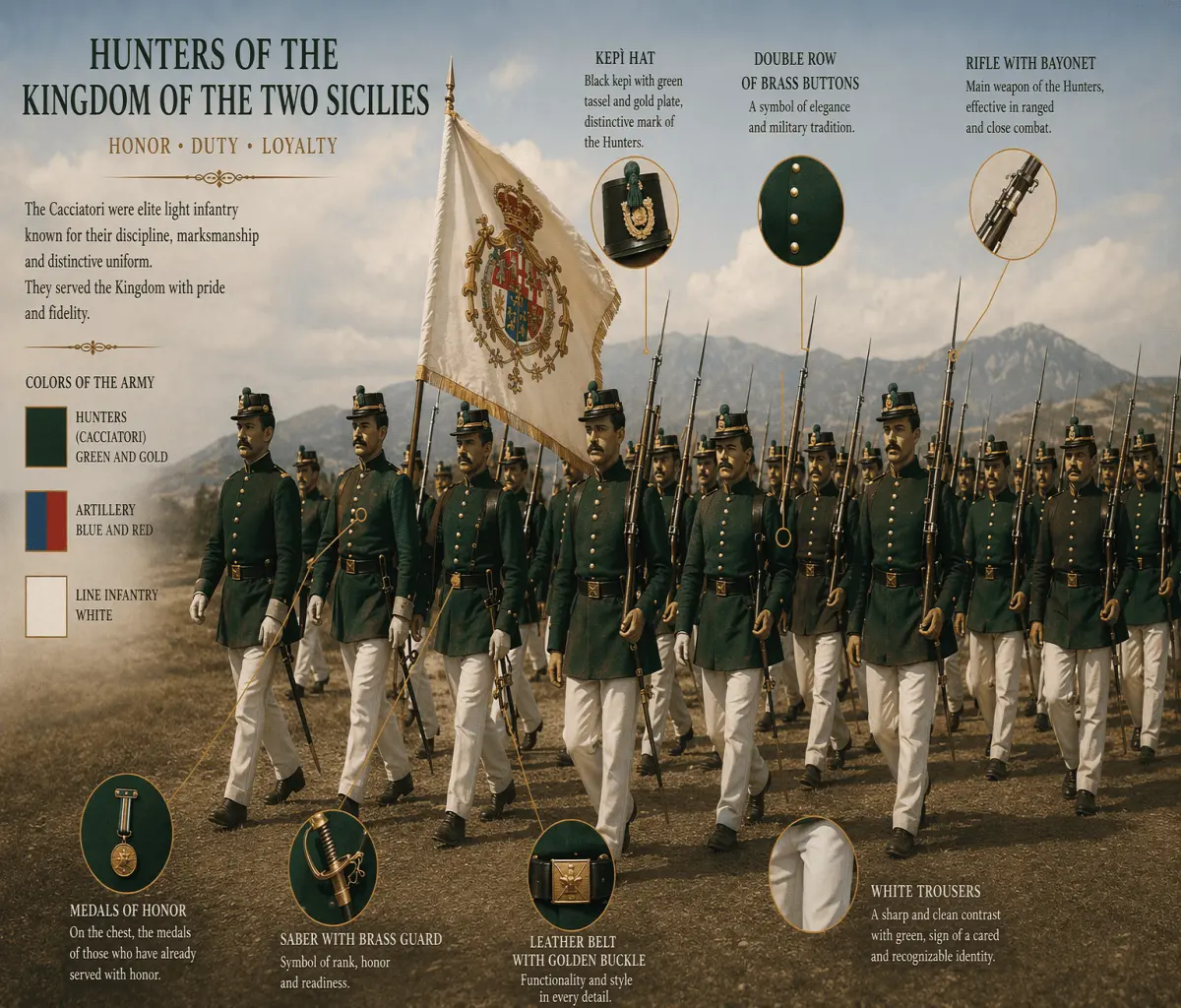
Looking closely at this archival photograph, one immediately notices something remarkable: the extraordinary attention to detail in every element of the uniform. These soldiers were not only fighters; they were symbols of a state that expressed its identity through discipline, aesthetics, and tradition.
The Elegance of Military Design.
The most striking element is the dark green jacket, marked by a double row of polished brass buttons. The effect is unmistakable: a balance of elegance and authority rarely matched by other European armies of the same period.
The white trousers provide a sharp and deliberate contrast with the deep green tunic. This color pairing was not accidental. It created a distinctive visual identity—clean, bold, and instantly recognizable.
On their heads rests the black kepì, adorned with a bright green tassel and golden insignia plate, clearly identifying the corps even from a distance. Uniforms in the army of the Two Sicilies were carefully designed so that every regiment could be visually distinguished on the battlefield.
Weapons and Honor.
At the side of each soldier hangs a saber with a brass guard, a weapon that symbolized rank, honor, and readiness. In their hands we see rifles equipped with bayonets, tools of both ranged and close combat.
But perhaps the most meaningful details lie on their chests: medals earned in service. Each decoration represents campaigns fought, discipline maintained, and loyalty to the crown.
These were not ceremonial garments. They were the attire of professional soldiers who had already proven themselves in service.
Colors of the Kingdom.
The army of the Two Sicilies maintained a strong system of visual codes:
Cacciatori (Hunters): green and gold.
Artillery: blue and red.
Line Infantry: white.
Through these colors, the army expressed hierarchy, specialization, and identity. The uniform became a language that soldiers and citizens alike could read.
Beyond the Myth.
Modern narratives sometimes reduce the pre-unification southern kingdoms to simplistic stereotypes. Yet images like this remind us that the reality was far more complex.
The soldiers of the Bourbon kingdoms were not barbarians or relics of a forgotten age. They were members of a structured military institution belonging to a proud and ancient state.
Their uniforms—precise, elegant, and distinctive—reflected not only military organization but also the cultural identity of a civilization.
A Reflection for the Digital Age.
For a digital artist like Marekiaro Callisto, images like this carry a particular resonance.
In the world of Web3, NFTs, and decentralized culture—where Marekiaro has built projects such as the CLOArmy—visual identity remains just as powerful as it was in the 19th century. Uniforms once communicated loyalty, hierarchy, and belonging. Today, digital symbols, avatars, and blockchain art perform a similar role within emerging online communities.
History reminds us that identity has always been both visual and symbolic—whether embroidered in brass and green cloth or encoded in pixels and cryptographic hashes.
👑
An army once expressed the soul of a kingdom through its uniforms.
Today, artists and creators express identity through digital worlds.
And in both cases, symbols still matter.
CLOArmy: Citadel.
Inspiration meets resistance. Imagination becomes power.
After a deep-space malfunction, the colonization vessel Argo crash-lands on Callisto, a planet pulsing with mysterious particles known as Elicons, responsive not to science, but to imagination.
From the wreckage, the CLOArmy rises, artists able to shape matter itself. But as power shifts, the ruling Council sees creativity as a threat. They deploy AI enforcers and launch The Severing, a program designed to silence human connection to Elicons.
Then it happens: a child’s mind resists the procedure — and energy erupts.
Far below the planet’s surface, an ancient eye opens.
Callosha stirs.
The war for imagination has begun.