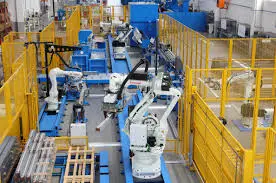
JOINTS AND DIFFERENT TYPES OF ROBOTS
A robot can generally consist of 2 elements, a base that is anchored to the ground and a series of segments joined to the base by means of the JOINTS. The joints in a robot can be: -Prismatic: only allow translation relative between base and segmentation between 2 segments - Revolution: allow only rotation between base and segmentation between 2 segments - Spherical: allow multiple relative motions Robots can be classified into: - CARTESIAN ROBOTS: consist of 3 prismatic joints that allow movement along the 3 axes x, y, and z. The movements made along the 3 axes are obtained by operating slides each of which can move independently of each other. They are very precise types of robots that guarantee full repeatability of the operations. For this reason they are widely used in assembly, handling, in continuous welding, in measurements. On the other hand, it cannot be subject to too high accelerations.-CYLINDRICAL ROBOTS: they consist of having 2 translations along x and y and a rotation along z, they are defined as such because the working area of this robot has a cylindrical shape. They are mainly used in assembly and overturning operations or in picking operations in cylindrical areas.-POLAR SPHERICAL ROBOTS: these robots consist of 2 segments connected by 2 revolving joints (which constitute the spherical articulation) and by an articulation prismatic. These characteristics make this type of robot very versatile and are therefore used for assembly and disassembly of pieces or for spot welding.-HORIZONTAL ARTICULATED ROBOTS: they are made up of segments connected to each other by means of 2 or more revolving joints. These robots are very precise and are mostly used for moving a piece from a conveyor belt to a plane.-VERTICAL ARTICULATED ROBOTS: they are the ones most similar to the human mechanism. They consist of a first segment (column) which can rotate around a vertical axis, the second segment (arm) is connected to the column, in turn the arm is connected to the forearm (by means of the elbow joint), to the forearm and connected the hand by means of the last joint (wrist), in turn the fingers are connected to the hand which have the purpose of grasping the objects.
ORGANS OF PRESAGS
The gripping organs have the task of replacing the human hand in the gripping of objects. These gripping elements can be divided into different types:
- MECHANICALLY OPERATED TAKING BODIES: they are generally defined with the name of PLIERS; they can have rigid, flexible, semi-rigid fingers.-SYSTEMS WITH RIGID ELEMENTS WITH ROTARY COMBINATION: they consist of having a rotary approach motion-GRIPPERS WITH MOTION TO APPROACH THE TRAVEL FINGERS: they are used when for example grasping surfaces flat, in this case the gripping of the piece is favored if the approach of the fingers takes place with translatory and non-rotary motion. - GRIPPING ORGANS WITH DIFFERENT FINGERS - GRIPPING ORGANS AT HIGH TEMPERATURE: when it is necessary to handle pieces with high T-ORGANS EXPANSION SOCKETS - EMPTY SOCKETS - MAGNETIC SOCKETS
ROBOT PROGRAMMING
Programming a robot means communicating the necessary instructions to its control unit so that it can manage the operations to be performed. The control of the positions, of the movement speed, of the acceleration are carried out by means of a numerical control.For the programming of a robot, different methods are used: -PROGRAMMING FOR SELF-LEARNING: consists in making the robot perform the work it has to carry out, moving it using a portable keyboard to memorize the movements, the speed, the orientation. During learning, the keyboard is connected to the actuator of the axis to be moved and controls its movement. Once the final position is reached, the new position of the axis that is moving is acquired from memory. The speed and the opening and closing of the gripping device are programmed directly from the keyboard. - POINT TO POINT SELF-LEARNING PROGRAMMING: consists of grasping the robot at its end to bring it to its desired position. A limited number of points constituting the trajectory are recorded in sequence.-PROGRAMMING FOR SELF-LEARNING OF CONTINUOUS TRAJECTORIES: it is the same as the previous one with the difference that in this case a large number of points are recorded in order to have a trajectory more precise.-PROGRAMMING VIA A SIMULATION: in this case we have an off-line programming which has the purpose of not stopping the production during the programming of the robot, as happened in the previous case.-MATHEMATICAL PROGRAMMING WITH ITERPOLATION: in this case the trajectories that should accomplish the robot are calculated by mathematical methods and then the coordinates are introduced by a special program.
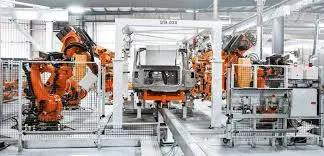
ROBOT APPLICATIONS
The robot can be used for many applications. Each application requires different characteristics in terms of accelerations, load capacity and work areas. Common to all applications is the need to reduce the processing cycle time to increase productivity and ensure production quality. Robots can be classified according to their application: -Welding (arc and spot welding) -Painting
- Parts handling and feeding of machine tools - Automatic assembly - Finishing and measuring robots (measuring ones are used to check and test finished parts for the issue of the certificate of conformity) - Robot for special applications ➢ DIAGING SYSTEMS government executes the drive of its axes through signals that must be converted into mechanical energy available in each axis (it means that the steering unit provides the command but then this command must be translated into something. Ex: the government issues a command and says that the slide of a lathe must reach a certain position, now this command must be translated into the movement of the slide). Generally the robot drives are electric (85%) and operate through the control scheme closed loop. Despite this, there are also other types of actuators used: - PNEUMATIC ACTUATOR: they are little used in the movement of the robot arms, due to the impossibility of obtaining precise positioning with this technology. The force F provided by the section A actuator supplied with pressure air p is: F = p * A. The work performed in a stroke c is: L = F * c The power W is: W = Q * p where Q represents the flow rate: Q = A * c / t with t representing time. The main pneumatic actuators are: • Single-acting and double-acting cylinder • Motor (apalette, gears, membrane-HYDRAULIC ACTUATOR: they are used in robots that must handling large loads, being able to achieve high pressures with an incompressible fluid The main advantages of these actuators are: high powers in play, high accelerations, movements without vibrations, etc. etc.