

Hey readers, what’s up? Actually, hold that thought because I’m going to answer that question. You’ve seen it, coins called UPX (pronounced up-ex), properties in sizes of of UP² (pronounced up-squared) all in a land called Upland (pronounced up-land).
But the UP is the important part. The UP is the makeUP of all that is in UPland. It’s on the ground, in your wallet and probably in your sock drawer. It makes the market go UP (never down, there is no DOWNland; see how absurd that sounds?) and everything looks UPpity. Or just Up.
As far as coinage goes it’s a nice little way to designate a token that wants to be crypto but is not really on any exchange. You’ll recall in an early article that this UPX is not the same as UPlexa, a coin with value even more miniscule than a dollar’s worth of UPX is to UPX .
But UP! It’s the fundamental measure of this metaverse. The most common place you’ll see it is in the size of properties. This property is 23 UP², that property is 192 UP², the price is 500UPX / UP². Go to Upland and zoom in. I mean, REALLY zoom in. At some point you’ll see a faint grid on the streets and parks. See those squares? Each individual one of those is 1 UP².
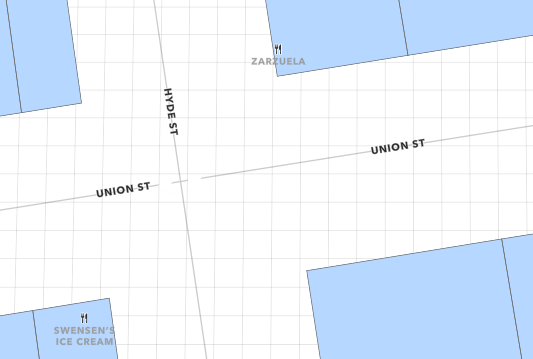
By extension then, we’ll call the sides of a square 1^. Get it? The carat points up. Since a square is UP squared, it’s an UP times an UP. Or ^x^. Makes total sense right? Let’s try with some real world dimensions.
The UPs are based off of lat-long coordinates. That’s right, Upland is so forward thinking that they made sure their mapping will cover the globe! These squares are made small enough that they are essentially square. One degree of latitude or longitude is broken into 60 units called minutes. Each of those minutes is broken into 60 units called seconds. A ‘second’ in this case is ~101'. Each of these squares are 1/10 of 1 second, making them right about 10'. For the rest of the world that’s about 3 meters.
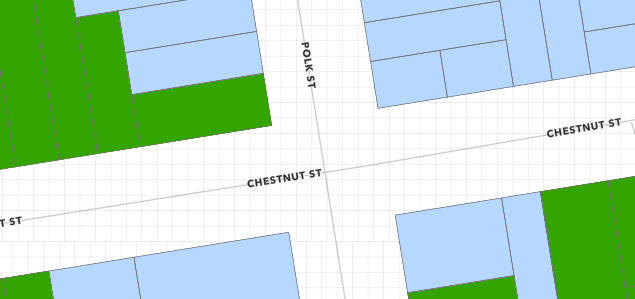
See the grid change here? It’s at the south part of the intersection. Since you can’t perfectly cover a globe with tiny squares, the next best thing is to reduce the number of squares going around the globe every so often to make sure that you can create a sphere from flat pieces.
This is especially relevant right now as Upland just released building development in Sandbox mode! This is super exciting as it’s a HUGE update and a HUGE benchmark. This is going to pave the way for businesses and so many other mechanics. We’re finally going from property speculation to SimCity!
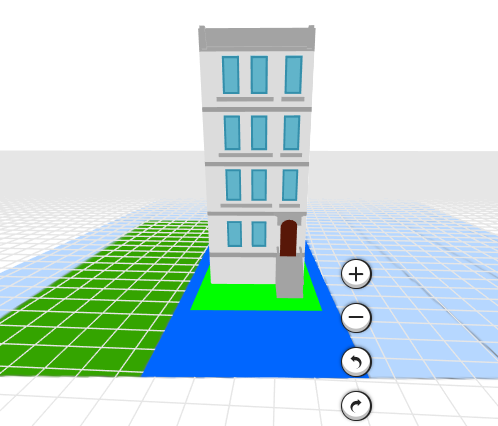
Oceanview is one of the best neighborhoods to see UP in action. It’s blocks are almost perfectly aligned to the underlying lat-long grid. In the below screengrab you can see the green property on the left side of Plymouth (339 Plymouth) spans 4^, therefore it is ~40' or 12m. The corner property (97 Farallones) on the right is 2.5^ x 8^ which is ~25' x 80', or, 7.5m x 24m. Total size, 20 UP², right?
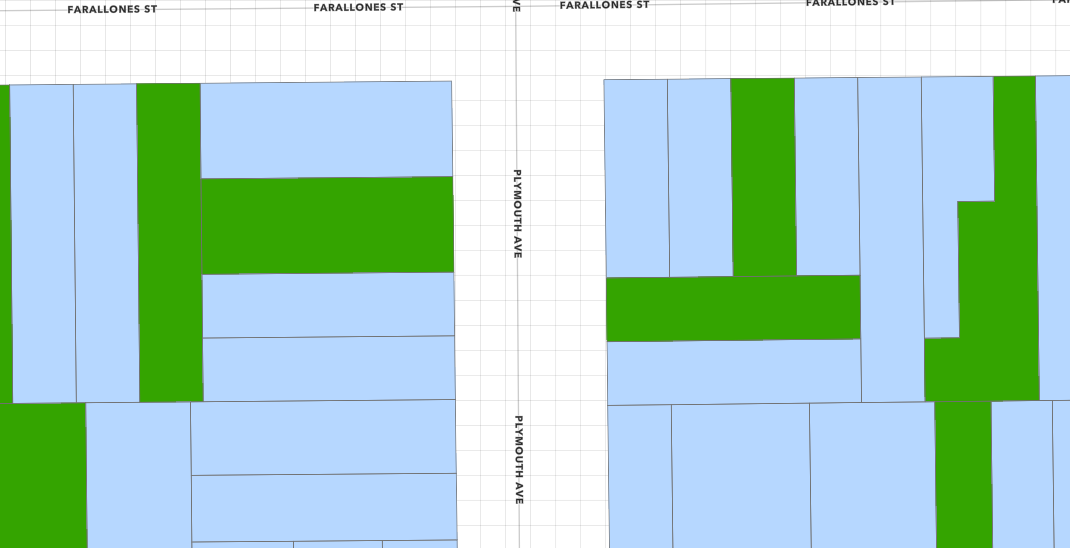
Wrong. And here’s where it gets weird. The actual size of a lot is not dictated perfectly by the dimensions. Rather, it is dictated by the amount of squares whose center the lot covers. Since 97 Farallones ALMOST runs right down the center of the square, but is off a tiny bit in angle, it doesn’t pick up some of the square centers in the north half, but does pick up more in the south. Five to be exact. The other 3 in that column would then belong to the neighbor, making it 19 UP².
Why is UP important compared to UP²? While UP² determines the cost of a property, the UP is more important for building placement. You can have a completely unbuildable lot of 100 UP², if the dimensions are 1.5^ x 66.67^. Or you can build an apartment on a property that is 36 UP², as long as it meets the minimum 6.6^ x 6.6^ dimensions.
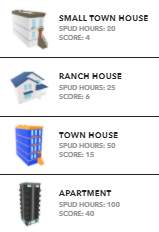
In the upcoming Sandbox Wars we’ll be able to place one of these 4 buildings on our properties. Through rigorous testing and lots of tax map gazing I’ve decided that these 4 buildings need the following minimum lot sizes:
Small townhouse fits on a 20'x66' lot — 2^x6.6^
Ranch house fits on a 40'x50' lot — 4^x5^
Townhouse fits on 33'x66' lot — 3.3^x6.6^
Apartment fits on 66'x66' lot — 6.6^x6.6^
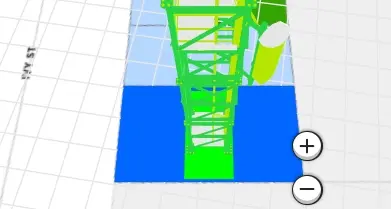
Upland recently added a new building, the Cell Tower! Cell Towers are meant to nullify building points in the Spud Wars but will not be a permanent feature. I tried placing one on my smallest property at 417 Ivy St. That property is 7 UP² but is also 20x35' IRL, or 2^x3.5^. It fits with a little room to rotate side to side but not much. My best assessment is that it could fit on a lot of about 1.5^x1.9^. Technically this could be anything down to a 2 UP² lot but more likely a 3 or 4 UP² lot. Remember, lot size is based on number of UP square centers it covers.
As building development progresses further along we’ll have more building types available and even be able to bring in our own buildings! I would encourage you to get into Upland as soon as you can. It’s only going to get more competitive as time goes on. The best way to join is through my referral code, discover.upland.me/bdag. There’s nowhere to enter a referral code if you go to the website, you need to use the link above. When you make your first purchase of in game cash (UPX) you’ll get a 50% bonus and I will too! Want to buy in for $20, you’ll get 20,000 UPX + 10,000 UPX and I’ll get an extra 10,000 UPX too. Looking forward to seeing you inside!






