For decades, we have associated music with instruments.
Guitars.
Pianos.
Violins.
Drum kits.
Later came turntables, vinyl records, CD players, synthesizers, samplers, and digital audio workstations.
Every generation expanded the definition of what a musical instrument could be.
Today, another transformation is quietly taking place.
Some musicians are no longer performing with traditional instruments.
They are performing with code.
From Instruments To Systems
Throughout history, musicians learned how to master physical objects.
A guitarist learned finger positioning.
A drummer learned rhythm and timing.
A pianist learned touch and expression.
The instrument was the interface between imagination and sound.
Technology gradually changed that relationship.
Electronic music producers began working with software.
DJs transformed playback into performance.
Laptop musicians turned entire studios into portable devices.
But live coding introduces something different.
Instead of manipulating sounds directly, performers create systems that generate sound in real time.
The performance becomes a conversation between human creativity and computational rules.
The musician is not simply playing notes.
They are shaping the logic that creates them.
What Is Live Coding?
Live coding is a form of performance where artists write and modify code while the audience watches.
That code generates music, visuals, or both.
The audience does not simply hear the result.
They witness the process.
Patterns evolve.
Rhythms mutate.
Mistakes become part of the performance.
Improvisation remains central, just as it does in jazz or traditional live music.
The difference is that the instrument now looks more like a programming environment than a guitar.
For many people, the first reaction is confusion.
Then curiosity.
Then the realization that the code itself has become part of the art.
Enter Strudel
One of the most accessible tools in the live coding world today is Strudel.
Inspired by the influential TidalCycles ecosystem, Strudel brings algorithmic music performance directly into the browser — a JavaScript port of the same pattern language, without installing Haskell or a full studio stack.
No complex installation.
No expensive hardware.
No professional studio required.
A musician opens a browser, writes a few lines of code, and immediately begins shaping rhythms, melodies, samples, and entire musical structures.
Try it: strudel.cc
Source: codeberg.org/uzu/strudel (active repo; the old GitHub mirror is archived)
What makes Strudel particularly interesting is that it lowers the barrier between music and programming.
People who enjoy music can begin exploring code.
People who enjoy code can begin exploring music.
The result is a creative space where both disciplines meet.
Watching Code Become Music
For someone seeing a live coding performance for the first time, it can feel almost surreal.
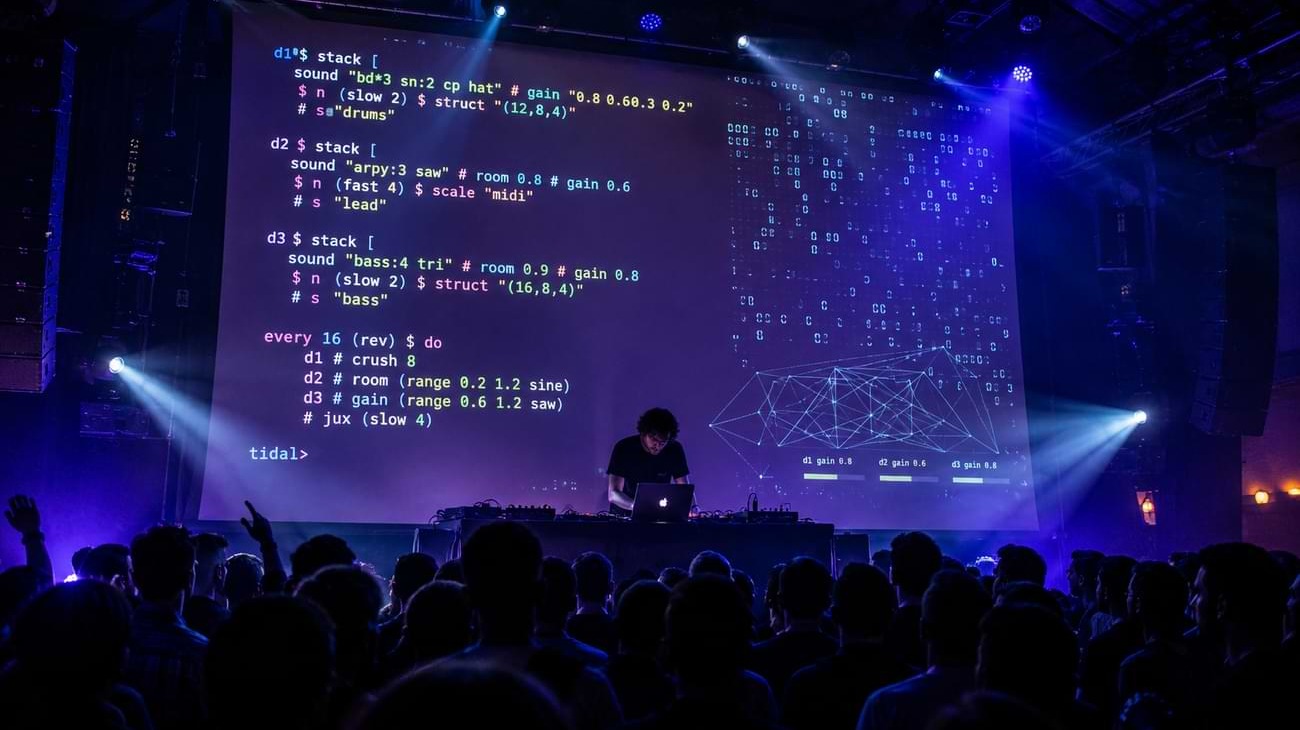
A performer stands behind a laptop.
A large screen displays lines of code.
The audience watches text appear, disappear, and transform.
Yet somehow the room fills with music.
What initially looks like software quickly reveals itself as performance.
Every line represents a creative decision.
Every change affects the sound instantly.
Every pattern becomes part of the evolving composition.
Unlike traditional music production, where the audience only hears the final result, live coding exposes the creative process itself.
The code is no longer hidden behind the application.
It becomes visible.
This Isn't The Future. It's Already Happening.
If this sounds futuristic, it isn't.
Thousands of musicians, programmers, and live coders are already performing this way.
Some stream directly from their homes, explaining every line of code as the music evolves in real time.
Others perform on stage in front of live audiences, where the code itself becomes part of the show.
What makes live coding fascinating is that the audience gets to see both the music and the mechanism behind it.
The performance is no longer hidden.
It happens in public.
Live Coding Examples
Live Stream Session #1
Live Stream Session #2
Switch Angel — Live Coding Session
From Bedrooms To Clubs
For decades electronic musicians performed with vinyl records, CDJs, drum machines, synthesizers, and laptops.
Live coding introduces a different relationship between performer and audience.
The audience doesn't just hear the music.
They can often see how the music is being created.
That shift changes the performance itself.
A coding session from a bedroom can attract viewers from around the world.
The exact same techniques can later appear inside clubs, festivals, galleries, universities, and concert halls.
What began as an experiment among programmers has evolved into a legitimate performance medium.
And increasingly, audiences are embracing it.
Live Performance Example
Live Coding Performance In Front Of An Audience
Beyond Music
Live coding is not limited to audio.
Many artists combine music, visuals, animation, generative art, interactive systems, and real-time collaboration into a single performance.
The boundaries between musician, programmer, visual artist, and designer begin to blur.
A live coding artist often occupies all of these roles simultaneously.
What emerges is not merely a concert.
It is a demonstration of creativity made visible in real time.
Why This Matters
Live coding may look like a niche corner of experimental culture.
It points to a larger shift: some musicians are learning systems, not only instruments.
They design rules; processes generate sound dynamically.
That does not replace the guitar or the piano.
It adds a new category alongside them — a programmable instrument.
One Last Example
If you're still imagining programming as something that happens silently behind a screen, live coding may feel almost absurd.
But that's exactly the point.
The boundaries between software, performance, art, and music are already dissolving.
What looked impossible a decade ago is now happening on livestreams, in clubs, festivals, and concert halls.
The future didn't arrive with robots.
It arrived with musicians opening a text editor in front of an audience.
One example that captures this spirit is Switch Angel's Destroy! Destroy!
Not because of its title.
Not because it was written with code.
But because it represents a simple idea:
Sometimes a new medium doesn't improve the old reality.
It replaces it.
Closing
For decades, we learned to think of code as something hidden behind applications.
Today, some artists are putting it on stage.
Not to build software.
To perform.
Live.
And if that sounds unusual, remember:
Many people once believed synthesizers were not real instruments.
Many people once believed DJs were not real musicians.
Many people once believed computers had no place in music at all.
The future rarely arrives looking familiar.
Sometimes it arrives as a wall of code projected onto a screen while a room full of people dance to it.
And somewhere in that room, someone realizes that music has changed once again.