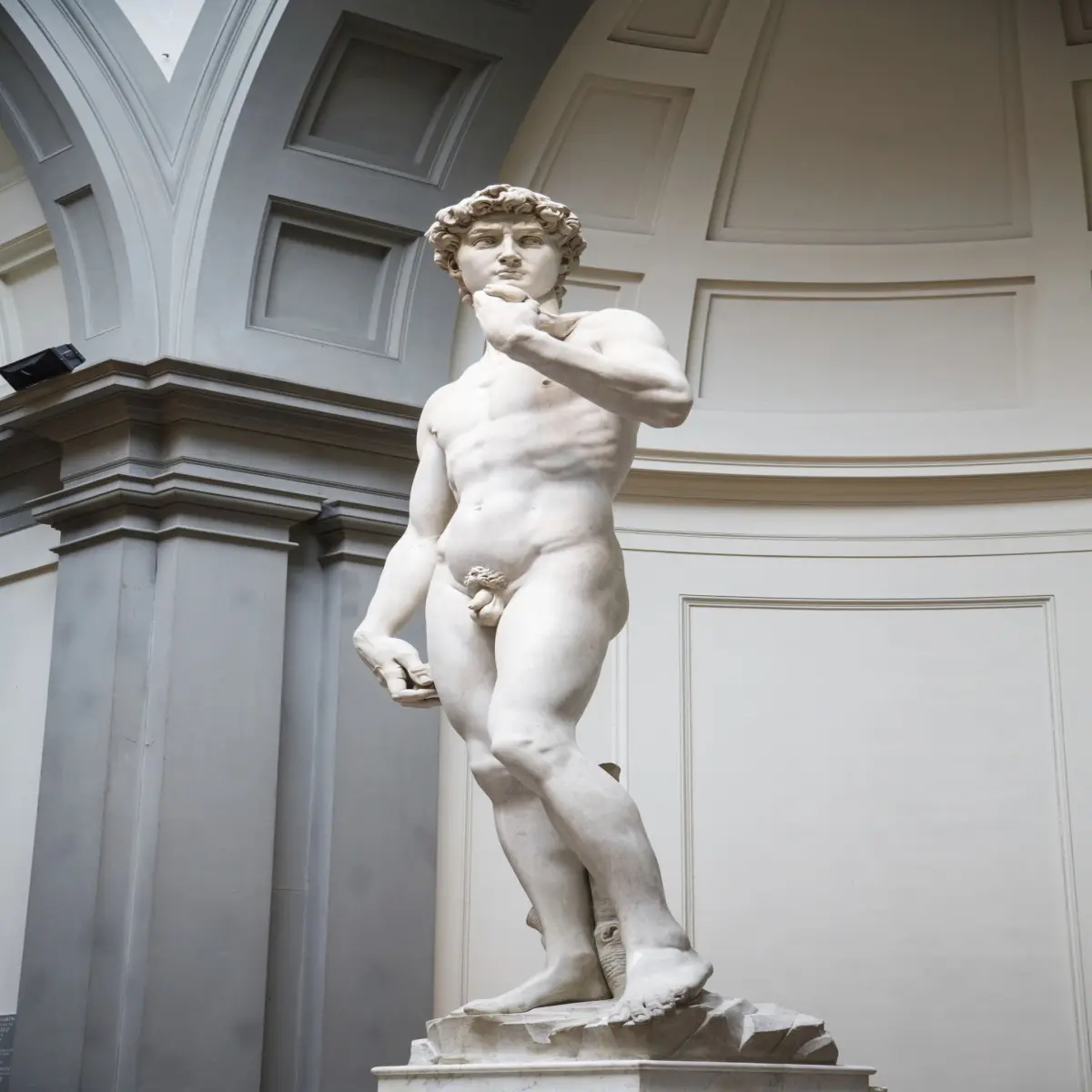
Florence, the capital of Tuscany, is home to many masterpieces of Renaissance art and architecture. One of the most famous places is the Duomo, the cathedral with a tiled dome designed by Brunelleschi and Giotto's bell tower. The Accademia Gallery displays Michelangelo's David sculpture while in the Uffizi Gallery are Botticelli's Birth of Venus and Leonardo da Vinci's Annunciation.
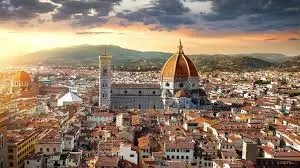
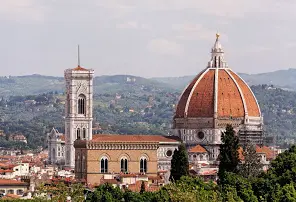
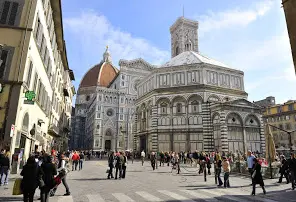
The metropolitan cathedral of Santa Maria del Fiore, commonly known as the cathedral of Florence, is the main Florentine church, symbol of the city and one of the most famous in Italy; when it was completed, in the fifteenth century, it was the largest church in the world, while today it is believed to be the third in Europe after Saint Peter in Rome and Saint Paul in London. It stands on the foundations of the ancient cathedral of Florence, the church of Santa Reparata, in a point of the city that has hosted religious buildings since Roman times. The construction of the Cathedral, ordered by the Florentine Lordship, began in 1296 and ended from a structural point of view only in 1436. The initial works were entrusted to the architect Arnolfo di Cambio and then stopped and resumed numerous times over the decades. After the completion of Brunelleschi's dome followed the consecration by Pope Eugene IV on March 24, 1436. The dedication to Santa Maria del Fiore took place during construction, in 1412. The plan of the Cathedral is composed of a basilica three naves welded to a huge triconic rotunda that supports the immense Brunelleschi dome, the largest masonry dome ever built.
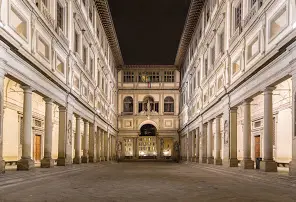
The Uffizi Gallery, currently called the Gallery of Statues and Paintings, is part of the Florentine museum complex called The Uffizi Galleries and which includes, in addition to the aforementioned gallery, the Vasari Corridor, the collections of Palazzo Pitti and the Boboli Gardens. The four unified museum realities constitute one of the most important museums in the world in terms of quantity and quality of the works collected. There are the most conspicuous existing collection of Raffaello and Botticelli, as well as fundamental nuclei of works by Giotto, Tiziano, Pontormo, Bronzino, Andrea del Sarto, Caravaggio, Dürer, Rubens and others. While the Pictorial works of the sixteenth and baroque periods, but also of the Italian nineteenth and twentieth centuries are concentrated in Palazzo Pitti, the Vasari corridor housed until 2018 part of the Self-Portraits Collection, which will soon be housed in the Gallery of Statues and Paintings.
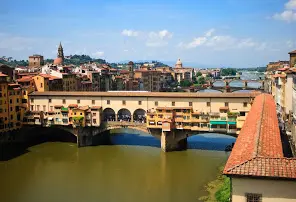
The Ponte Vecchio is one of the symbols of the city of Florence and one of the most famous bridges in the world. It crosses the Arno river about 150 meters downstream of the area where the river naturally presents one of the points where the riverbed is narrowest within the city of Florence in its stretch upstream of the Cascine. The area in question is the Canottieri under the Uffizi. In ancient times there was a ford.
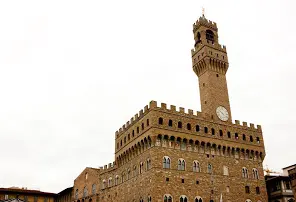
Palazzo Vecchio is located in Piazza della Signoria in Florence and is the seat of the Municipality. It represents the best synthesis of the 14th century civil architecture of the town and is one of the best known civic buildings in the world. Originally called "Palazzo dei Priori", in the 15th century it became "Palazzo della Signoria", from the name of the main body of the Republic of Florence; in 1540 it became Palazzo Ducale, when Duke Cosimo I de 'Medici made it his residence; finally the name Vecchio took it after 1565 when the court of Duke Cosimo moved to the "new" Palazzo Pitti. From 1865 to 1871 it was the seat of the Parliament of the Kingdom of Italy, while today it houses the Mayor of Florence and various municipal offices. There is also a museum, which allows you to visit the magnificent rooms where, among others, Agnolo Bronzino, Ghirlandaio, Giorgio Vasari worked, and where works by Michelangelo Buonarroti, Donatello, Verrocchio are exhibited.
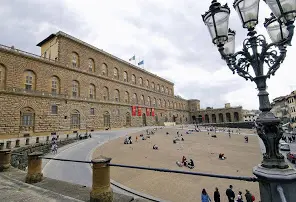
Palazzo Pitti was the residence of the Grand Duchy of Tuscany, already inhabited by the Medici, the Habsburg-Lorraine and, after the unification of Italy, by the Savoy. It is located in Piazza dei Pitti at number 1, in the Oltrarno area. Inside there is a museum complex composed of galleries and museums of different nature: the Palatine Gallery arranged according to the criterion of the eighteenth-century picture gallery, the Royal Apartments, the Duchess of Aosta Apartment and the Prince of Naples district, the Gallery modern art and other specialized museums: the Treasury of the Grand Dukes, dedicated to applied art, the Museum of fashion and costume, the largest Italian museum dedicated to fashion, the Porcelain Museum and the Carriage Museum. The Boboli monumental gardens are one of the best examples in the world of Italian garden. The entire museum complex of Palazzo Pitti, which also includes the Boboli Gardens, in 2019 was visited by a total of 2,030,108 people, making it, after the Uffizi and the Academy, the third most visited Italian state museum in Florence.
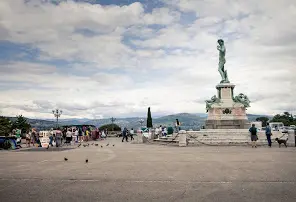
Piazzale Michelangelo in Florence represents the most famous observation point of the city panorama, reproduced in countless postcards and an obligatory destination for tourists visiting the city.
Piazza del Duomo is located in the heart of the historic center of Florence. It is dominated by the bulk of the cathedral of Santa Maria del Fiore and related buildings such as Giotto's bell tower and the baptistery of San Giovanni, although the hypothetical line between via de 'Martelli and via Calzaiuoli divides the square into two sections, with the baptistery in the homonymous piazza San Giovanni.
The Accademia Gallery is a museum in Florence, located in via Ricasoli. The museum, fourth in Italy for the number of visitors after the Uffizi, displays the largest number of Michelangelo sculptures in the world, including the famous David. Inside the Gallery there are also other sections, including the largest and most important collection in the world of pictorial works with a gold background, and the Museum of musical instruments, where many artifacts belonging to the historical collection of the Luigi Cherubini Conservatory are exhibited. In 2016 the museum circuit of the Accademia Gallery and Museum of Musical Instruments registered 1 461 185 visitors. In 2018, there were 1,719,645 visitors.
Florence is an Italian town of 379 194 inhabitants, the capital of Tuscany and the center of the metropolitan city, the eighth Italian municipality by population and the first in Tuscany, the heart of the metropolitan area of Florence-Prato-Pistoia.
In the Middle Ages it was an important artistic, cultural, commercial, political, economic and financial center; in the modern age it covered the role of capital of the Grand Duchy of Tuscany from 1569 to 1859 which, with the rule of the Medici and Lorraine families, became one of the richest and most modern states. The various political vicissitudes, the financial and mercantile power and the influences in every field of culture have made the city a fundamental crossroads of Italian and European history. In 1865 Florence was proclaimed capital of the Kingdom of Italy (second, after Turin), maintaining this status until 1871, the year that marks the end of the Risorgimento.
Important university center and UNESCO World Heritage Site since 1982, it is considered a place of origin of the Renaissance - awareness of a new modern era after the Middle Ages, a period of cultural and scientific change and "rebirth" - and of the Italian language thanks to the vernacular Florentine used in literature. It is universally recognized as one of the cradles of art and architecture, as well as renowned among the most beautiful cities in the world, thanks to its numerous monuments and museums including the Duomo, Santa Croce, Santa Maria Novella, the Uffizi, Ponte Vecchio, Piazza della Signoria, Palazzo Vecchio and Palazzo Pitti. The artistic, literary and scientific legacies of geniuses of the past such as Petrarca, Boccaccio, Brunelleschi, Michelangelo, Giotto, Cimabue, Botticelli, Leonardo da Vinci, Donatello, Lorenzo de 'Medici, Machiavelli, Galileo Galilei and Dante Alighieri, of inestimable value in the historic center of Florence one of the places with the highest concentration of works of art in the world. The richness of the historical-artistic, scientific, naturalistic and landscape heritage make the center and the surrounding hills a real "widespread museum".





