One thing that is almost guaranteed to happen with digital photography is that a hobbyist or professional is going to quickly need a lot of storage space on a computer or cloud account to keep photos for reference, display and archiving. The typical RAW format file for a single photo can easily take up 10 to 15 MB per file, especially if there is a lot of detail and post-camera processing on it. Add in the secondary Adobe Photoshop file and various versions of an image tweaked with photo-editing software and now a single image could take up 50MB or more by the time one is done and ready to publish or print. Simply put, digital photography is a data pig that follows a saying I once heard:
Data storage is like new underwear; at first, it fits great, but over time everything gets uncomfortably tight.
Of course, the cloud in the form of services like Amazon Web Services as well as others have very useful and scalable storage solutions.
But these are not tailored per se to the photographer. Figuring out the use of an S3 Bucket in AWS takes a bit of doing, and the organization features of data in that environment are not necessarily intuitive (a big peeve I have with AWS cloud account administration even though it's extremely powerful from a LAMP stack perspective and similar).
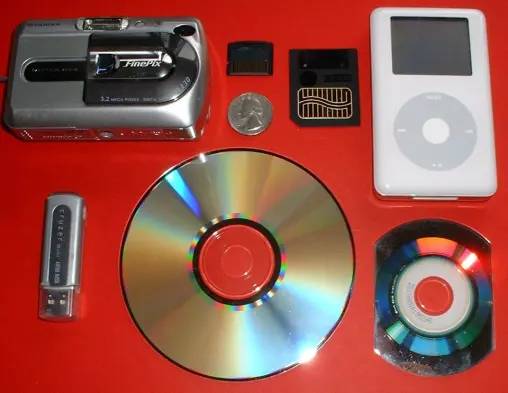
Old data storage formats, Photo by OS, Wikipedia, 2005, CL with Attribution
So, this is where decentralized storage comes into play. First, it's big and can easily take on the largest of image libraries needed. Second, the security level of blockchain is intense and extremely hard to break (it is breakable as seen in the classic case of Ethereum Classic, but damn, that takes effort). Third, the concept is a win-win for all involved, photographer and crypto-miner, so it has sustainability to support its ongoing integrity. Okay, these are all positives for blockchain to be the solution for photography storage. So why isn't it already used en masse? The answer is in the case studies.
Arcane Photos
Offering itself as the “replacement” of Google Photos, Arcane Photos is an offshoot of Arcane Office. It’s platform is supported by Blockstack, but the service is intended to basically look like a website cloud portal for the end user (photographer). It’s easily accessible; one just signs up, creates an account, and gets started trying it out with a freebie 10GB. Of course, that’s nothing for a power-user photographer generating 50 images a day, but it’s enough to at least try the system and see if it works. Unfortunately, Arcane Photos is a bit limited on the expansion options, which is where this one wasn’t quite ready for prime time.
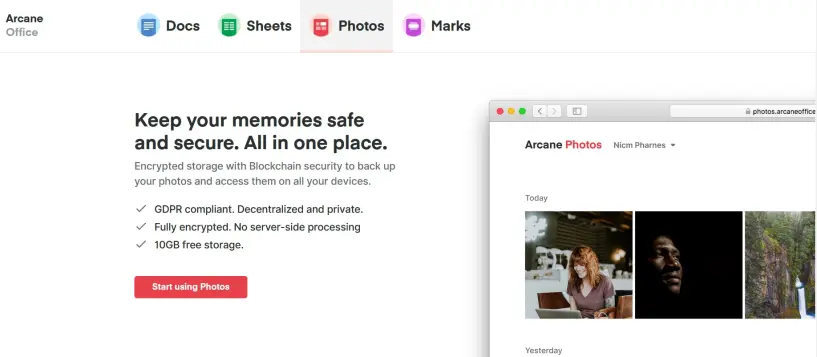
Arcane Photos Home Page, 2021
References:
Arcane Photos General Page, https://photos.arcaneoffice.com/
Arcane Photos Account Starter, https://photos.arcaneoffice.com/app/
Blockstack or Stacks, https://www.stacks.co/
SIA Blockchain
The next option is SIA as a cryptocurrency. SIA functions as an open source platform for cloud space, but it tends to be incredibly cheap versus other cloud options for storage. In 2019 the network was charging about $2/month per TB. This lease exchange basically converts cost into a cryptocurrency exchange for Siacoin financially. There’s plenty of space to work with for new accounts; the SIA network was working with at 2.4 PBs of space as of 2021, and only 592 TBs have been consumed. It's an open playground for photographers, basically.

SIA Logo, SIA Homepage, 2021
More importantly, the network is self-sustaining which is a big issue for photographers or anyone archiving on the cloud; the question of whether the service will be available in the future is always a risk with contracting out support. But being a decentralized network on blockchain, SIA can continue even if the administration falls down being open-source in the first place.
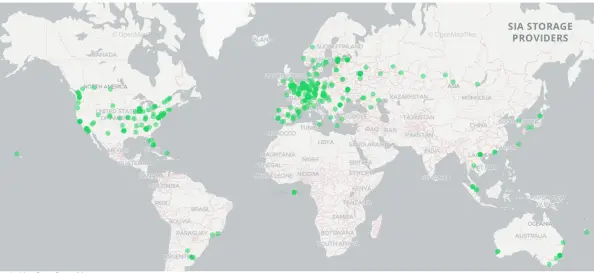
SIA Network Infrastructure, SIA, 2021
The system also has plenty of nodes for connection as well, at least per their information and map, but they are heavily concentrated in Europe and the U.S.
References:
SIA home page, https://sia.tech/
More to Come Next Post
I'll continue my review of sites and option based on blockchain in part 2, but if anyone has suggestions of what to include in this series, please make suggestions in the comments below. My goal and focus for this series is really to build a full reference of cryptocurrency resources for photographers, many of whom I talk to regularly who are just waking up to the potential of blockchain-based photo support resources.
Cheers!






