
The theory of cognitive dissonance, introduced by American social psychologist Leon Festinger in 1957, proved to be pivotal in how we generate research on human behavior (Cooper, 2007; Harmon-Jones & Mills, 1999). Ironically, this groundbreaking theory was first conceptualized in the aftermath of an earthquake. Back in the 50’s, Festinger was reading about how a community who had just experienced an earthquake in India feared that another, larger earthquake was imminent despite evidence that showed this was not likely. He hypothesized that these folks may have justified their widespread fear by confirming rumors of an impending disaster rather than changing their belief that another earthquake was unlikely. This helped form dissonance theory’s main assumption: inconsistent information will cause psychological unease that people will actively try to reduce. More generally, dissonance theory is “essentially a theory about sense making – how people try to make sense out of their environment and their behavior – and thus, try to lead lives that are (at least in their own minds) sensible and meaningful” (Aronson, 1992). In 1956, Festinger and his colleagues began to test this hypothesis, which gave birth to this powerful theory that continues to evolve.
Original Theory
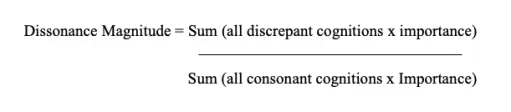
The foundational assumption of cognitive dissonance theory is that people hold cognitions, such as “knowledge, opinions, or belief” that may be consistent, inconsistent, or unrelated to one another (Festinger, 1962, p. 3). He defines dissonance as a feeling of psychological discomfort caused by conflicting or inconsistent cognitions. It can occur when faced with a new experience or information that does not fit with held cognitions, or it can arise from contradicting elements of everyday affiliations and decisions that aren’t clear-cut. Furthermore, it can arise from (1) logical inconsistencies, (2) failure to act within the bounds of cultural norms, (3) specific opinions that betray more general ones (worldviews, in-group knowledge), and (4) past experience failing to align with the present (Festinger, 1962, p. 14). Cooper (2007) points out that people do not simply prefer consonance over dissonance, but are driven to assuage their dissonance. To achieve consonance, one may either make a behavioral change or adjust knowledge of one or more inconsistent elements. This may be difficult to do if the change involves pain or loss, if the present behavior is “otherwise satisfying,” or if the change is not possible (Festinger, 1962, p. 25-6); in such cases, the dissonance may endure. Dissonance will vary in magnitude depending on the importance of the held cognitions and the level of discrepancy between them – the higher the magnitude, the more one is pressured to reduce it. Thus, we can formulate the magnitude of dissonance as such (Cooper, 2007):
Impact and Paradigms
Since its introduction to the field of social psychology, dissonance theory has generated well over a thousand studies and have revolutionized experimental methodology. Eliot Aronson (1992) argues, “Because of the nature of the hypotheses we were testing, we were forced to develop a new experimental methodology” to overcome the constraints of the artificial environments used for experiments. Furthermore, dissonance theory undermined prevailing theories and hypotheses at the time such as reinforcement theory, which claims that people will become infatuated with their own statements if reinforced; psychoanalytic explanations of catharsis; and the notion that people must change their attitudes before they change their behaviors – a notion that dissonance theory flips on its head (Aronson, 1992). On top of putting these problematic ideas to rest, it has also helped blossom breakthrough ideas in social psychology, and has evolved to inform other fields such as marketing (Telci, Maden, & Kantur, 2011; Shahin Sharifi & Rahim Esfidani, 2014), psychotherapy (Olson & Claiborn, 1990; Axsom, 1989), education (McFalls & Cobb-Roberts, 2001; Wheatley, 2002), and communication studies (Babrow, 1992; Iyengar, & Hahn, 2009). While its heuristic value has served multiple disciplines, it has developed into five distinct paradigms that each provide nuanced inquiries into human behavior, namely the free-choice, belief-disconfirmation, effort-justification, induced-compliance, and hypocrisy paradigms.
The free-choice paradigm is predicated on the assumption that people will likely experience dissonance after making a decision. While the pros of the chosen alternative and the cons of the rejected one will cause consonance, the cons of the chosen alternative and the pros of the rejected one will arouse dissonance (Harmon Jones & Mills, 1999). Following the formula provided above, the more difficult the decision is to make, the more important the discrepant cognitions will be, and the degree to which the negative aspects outweigh the positive one, a person will feel a greater magnitude of dissonance. One can reduce post decision dissonance by making an attitude change about the accepted and rejected alternatives; the accepted one becomes more attractive, the rejected one less attractive (Cooper, 2007). This paradigm developed out of a study by J. W. Brehm in 1956 that utilized predictions that developed from dissonance theory (Chen & Risen, 2010). In this study, the experimenters had women rate eight different products (such as small kitchen appliances), choose between products of close desirability and easy desirability (difficult and easy decisions) and then rerate the items afterwards. Predictably, the women faced with a more difficult decision had rated the product they chose more positively and the rejected product more negatively.
The belief-disconfirmation paradigm refers to the body of dissonance research that finds dissonance is aroused when people are introduced to information that does not align with their beliefs. If the person does not mitigate this dissonance with belief change “the dissonance can lead to misperception or misinterpretation of the information, rejection or refutation of the information, seeking support from those who agree with one’s belief,” or attempts to persuade others of one’s held belief (Harmon Jones & Mills, 1999). Two other ways that dissonance can be reduced under this paradigm are transcendence and belief maintenance (Burris et al., 1997). Transcendence occurs when a person uses a higher order belief to rationalize a conflicting cognition, such as using religion to reduce dissonance about a tragedy. Harmon-Jones (1999) found that Christian participants who read a tragic newspaper article that challenged their belief in God were able to reduce dissonance if they had a chance afterwards to transcend before measuring affect. Those who reported their affect without transcending reported a higher level of dissonance. Belief maintenance occurs when a person revises an existing belief in the face of inconsistent information. In a follow up study, he measured religious beliefs before or after the article and again had all participants fill out an affect measure. Again, those who were able to affirm their religion after the article felt less dissonance. Furthermore, he found that disconfirming evidence explained by cherished beliefs can actually make the beliefs stronger.
In the effort justification paradigm, dissonance is aroused when a person acts in an unpleasant way because it brings about a desired outcome. Axsom (2007) claims that “when people make sacrifices to pursue a goal, the effort is often rationalized by elevating the attractiveness of the goal” and that “people sometimes come to love what they suffer to achieve.” It helps explain the process of how goals are made more or less worthwhile. The more unpleasant the effort put forth to achieve an outcome, the higher dissonance will be, and the more one exaggerates their desire for the outcome, the more they can reduce that dissonance (Harmon-Jones and Mills, 1999). The initial experiment this paradigm emerged from was Aronson and Mills (1959) study of how members who go through an unpleasant initiation process value the group more than those who do not. They had women experience a severe, mild or control condition by having them read or not read embarrassing material prior to entering a sex discussion group. They found that those who went through severe initiation conditions valued the group much more than those who went through a mild initiation or none at all. Later research has shown that not all effort enhances desirability of goals. The person must feel as if she is freely choosing to pursue that goal.
The induced compliance paradigm assumes that people feel dissonance when they behave in a way that contradicts held attitudes or beliefs. Given the person feels personal responsibility for the potential negative outcomes of a compelled behavior, they will change their attitude to align more with their behavior to reduce their dissonance (Lieppe & Eisenstadt, 1994). This paradigm evolved from Festinger and Carlsmith’s (1959) study, which has become one of the most famous studies in social psychology for its creative experimental design and findings. The participants were told that they were going to be evaluated on their level of performance for two tasks that turned out to be incredibly easy and boring – turning a series of wooded pegs on a board and then removing and replacing spools of thread from another board. Then the experimenter tricked the participant into thinking he or she was a member of a control group and they were running a more complex experiment. In order to induce the participants to say the activity was enjoyable, they convinced them to be a confederate that would talk up the activity to the next participant (really a confederate) in the waiting room. Afterwards the participant took a survey. Then, they replicated the experiment and added in a new variable. Some participants were incentivized either $1 or $20 for participating. Because the lower dollar amount created less incentive for the participant, it caused more dissonance, and in order to reduce that dissonance they had to adjust their attitude towards the task. The participants who got the dollar reported the task was much more enjoyable than those in the control group and the $20 group. It goes to show that making a counterattitudinal statement can urge one to align their attitude with compelled behaviors.
The hypocrisy paradigm was presented as an alternate explanation of the induced compliance paradigm. Fried and Aronson (1995) challenge the notion that participants can “freely choose” to do an experimental task and that the measures for this type of study is not strong – it measures attitudes and justification rather than behaviors. They propose the hypocrisy paradigm in which dissonance is aroused by “advocating a position one supports and being made mindful of one’s failure to act in accordance with that advocacy” (Fried & Aronson, 1995). When people make an advocacy claim to a behavior with positive consequences, they will be more likely to align their own behavior with that claim if they are reminded of their past behaviors that do not align with that claim. Evidence for this paradigm was provided by two studies in which participants were asked to deliver a speech on video advocating condom use (Aronson et al, 1991; Stone et al., 1994). The participants were told the video was going to be shown to high school students in an AIDS-education course. After the recording, they were asked to make a list of all the times they failed to use a condom. The participants of the first study were found more likely to use condoms and those in the second study bought more condoms afterwards. This demonstrates that by making people face up to failings of their past by making hypocritical claims to the public can cause positive behavior change.
The Self & New Models of Dissonance
One of the prevailing questions in dissonance theory is asking when dissonance is most likely to occur. Ever sense Aronson introduced the idea in 1960, the role of self-concept has been a key mediating variable in dissonance arousal that has been given various explanations. Three of the dominant models to explain it are the “new look,” self-consistency, and self-affirmation models. Eventually these the explanations were synthesized into a self-standards model of dissonance. In this section I will briefly explain the first three and then introduce how they were synthesized into the prevailing model of dissonance.
The new look model does away with Festinger’s original assumption that dissonance is aroused by inconsistent cognitions and posits a new formula: dissonance is aroused only when an individual feels personally responsible for an aversive or unwanted outcome” (Thibodeau & Aronson, 1992). That is, when somebody freely behaves in a way that has a foreseeably negative outcome, they will feel dissonance and reduce it primarily by change in attitude. Cooper (2007) argues that inconsistency is still a powerful heuristic, but does not present an accurate explanation of how conflicting cognitions arouse dissonance. Thibodeau and Aronson (1992) argue that the new look model underestimates the value of self-concept and proposed we move towards a self-consistency model. In this model, an aversive consequence can arouse dissonance, but it is not necessary. Rather, they believe that one’s behaviors are linked to his or her self-concept, and when behaviors are not consistent with their self-conception (what they believe is moral or competent) dissonance is aroused. The last of the three models was not proposed to argue against the previous two models, but to offer an alternative explanation. The self-affirmation model claims that “thought and action are guided by a strong motivation to maintain an overall self-image of moral and adaptive adequacy” (Aronson et al., 1999). Information that threatens the one’s self competence and sense of moral righteousness motivates him or her to restore a sense of self-worth and self-integrity.
After observing there was no consensus in the influence of the self on dissonance arousal and reduction, Stone and Cooper (2001) introduced the self-standards model to synthesize the different perspectives. In this model, they assume that “dissonance begins when people commit a behavior and then assess the behavior against some meaningful criterion of judgment” (Stone & Cooper, 2001). Each person will have their own set of criteria for specific situation that inform what counts as a threat to the self, and thus, guide a person’s behavior. The model also incorporates how self-concept factors such as self esteem will affect dissonance. Four predictions can be made through the model:
"the conditions under which self-attributes will operate as an expectancy and cause more dissonance among people with high versus low self-esteem, (2) the conditions under which most people regardless of their self-esteem will feel the “bite” of dissonance arousal, (3) the conditions under which most people will be motivated to reduce dissonance via self-justification processes, and (4) the conditions under which self-esteem differences will moderate the reduction of dissonance arousal using a direct (i.e., justification) or indirect (i.e., affirmation) strategy" (Stone and Cooper, 2001).
In short, there is a normative and personal standard of judgment that behaviors are measured against. The former can include group norms from as limited to one’s family or broadly as society. The latter consider the values, desires, and judgments of individuals, which may or may not align with those in the normative dimension (Cooper, 2007).
Works Cited
Aronson, E., & Mills, J. (1959). The effect of severity of initiation on liking for a group. The
Journal of Abnormal and Social Psychology, 59(2), 177.
Aronson, E., Fried, C., & Stone, J. (1991). Overcoming denial and increasing the intention to use
condoms through the induction of hypocrisy. American Journal of public health, 81(12),
1636-1638.
Aronson, J., Cohen, G., & Nail, P. R. (1999). Self-affirmation theory: An update and appraisal.
In Harmon-Jones, E. E., & Mills, J. E. (1999). Cognitive dissonance: Progress on a
pivotal theory in social psychology. Washington, DC. American Psychological
Association
Axsom, D. (1989). Cognitive dissonance and behavior change in psychotherapy. Journal of
Experimental Social Psychology, 25(3), 234-252.
Axsom, D. (2007). Effort justification. In R. F. Baumeister & K. D. Vohs (Eds.), Encyclopedia of social psychology (pp. 277-278). Thousand Oaks, CA: SAGE Publications Ltd.
Babrow, A. S. (1992). Communication and problematic integration: Understanding diverging
probability and value, ambiguity, ambivalence, and impossibility. Communication
Theory, 2(2), 95-130.
Chen, M. K., & Risen, J. L. (2010). How choice affects and reflects preferences: Revisiting the
free-choice paradigm. Journal Of Personality And Social Psychology, 99(4), 573-594.
doi:10.1037/a002021
Cooper, J. (2007). Cognitive dissonance: 50 years of a classic theory. Sage.
Festinger, L. (1962). A theory of cognitive dissonance (Vol. 2). Stanford university press.
Festinger, L., & Carlsmith, J. M. (1959). Cognitive consequences of forced compliance. The
Journal of Abnormal and Social Psychology, 58(2), 203.
Fried, C. B., & Aronson, E. (1995). Hypocrisy, misattribution, and dissonance
reduction. Personality and Social Psychology Bulletin, 21(9), 925-933.
Freijy, T., & Kothe, E. J. (2013). Dissonance‐based interventions for health behaviour change: A
systematic review. British journal of health psychology, 18(2), 310-337.
“GoodTherapy.org.” Leon Festinger Biography, www.goodtherapy.org/famous-
psychologists/leon-festinger.html.
Harmon-Jones, E. E., & Mills, J. E. (1999). Cognitive dissonance: Progress on a pivotal theory
in social psychology. Washington, DC. American Psychological Association
Harmon-Jones, E. (1999). Toward an understanding of the motivation underlying dissonance
effects: Is the production of aversive consequences necessary?. In Harmon-Jones, E. E.,
& Mills, J. E. (1999). Cognitive dissonance: Progress on a pivotal theory in social
psychology. Washington, DC. American Psychological Association
Iyengar, S., & Hahn, K. S. (2009). Red media, blue media: Evidence of ideological selectivity in
media use. Journal of Communication, 59(1), 19-39.
Leippe, M. R., & Eisenstadt, D. (1994). Generalization of dissonance reduction: Decreasing
prejudice through induced compliance. Journal of personality and social
psychology, 67(3), 395.
McFalls, E. L., & Cobb-Roberts, D. (2001). Reducing resistance to diversity through cognitive
dissonance instruction: Implications for teacher education. Journal of teacher
education, 52(2), 164-172.
Olson, D. H., & Claiborn, C. D. (1990). Interpretation and arousal in the counseling
process. Journal of Counseling Psychology, 37(2), 131.
Shahin Sharifi, S., & Rahim Esfidani, M. (2014). The impacts of relationship marketing on
cognitive dissonance, satisfaction, and loyalty. International Journal of Retail &
Distribution Management, 42(6), 553-575.
Stellefson, M., Wang, Z., & Klein, W. (2006). Effects of cognitive dissonance on intentions to
change diet and physical activity among college students. American Journal of Health
Studies, 21(3/4), 219.
Stone, J., Aronson, E., Crain, A. L., Winslow, M. P., & Fried, C. B. (1994). Inducing hypocrisy
as a means of encouraging young adults to use condoms. Personality and Social
Psychology Bulletin, 20(1), 116-128.
Stone, J., & Cooper, J. (2001). A self-standards model of cognitive dissonance. Journal of
Experimental Social Psychology, 37(3), 228-243.
Stone, J., & Focella, E. (2011). Hypocrisy, dissonance and the self-regulation processes that
improve health. Self and Identity, 10(3), 295-303.
Telci, Maden, & Kantur. (2011). The theory of cognitive dissonance: A marketing and
management perspective. Procedia - Social and Behavioral Sciences, 24, 378-386.
Thibodeau, R., & Aronson, E. (1992). Taking a closer look: Reasserting the role of the self-
concept in dissonance theory. Personality and Social Psychology Bulletin, 18(5), 591-
602.
Wheatley, K. F. (2002). The potential benefits of teacher efficacy doubts for educational reform. Teaching and Teacher Education, 18(1), 5-22.






