
The inflation numbers are out. According to the official reports, the U.S. inflation rate for September 2022 was reported as 8.2%. This number includes many types of products and services that are included in this number, however, the majority of items that normal people buy on a regular basis are things found in a grocery store. With that in mind, I decided to look at my actual expenses and examine some real numbers. What I have experienced is well over 8.2%.
YCharts.com explains the way the rate is calculated.
"The US Inflation Rate is the percentage in which a chosen basket of goods and services purchased in the US increases in price over a year. Inflation is one of the metrics used by the US Federal Reserve to gauge the health of the economy. Since 2012, the Federal Reserve has targeted a 2% inflation rate for the US economy and may make changes to monetary policy if inflation is not within that range. A notable time for inflation was the early 1980's during the recession. Inflation rates went as high as 14.93%, causing the Federal Reserve led by Paul Volcker to take dramatic actions."
I didn't have receipts to compare exactly 12 months, but I pulled what I could on identical items bought at the same store so it would be a fair comparison. I included any item that I had receipts for whether the cost increased or decreased. None of the items I personally had decreased in cost... not that there were things that did, but I didn't find any on my receipts. Based on my personal purchases here is what I found. Except for gas at the top of the table, I organized them in order of increase from lowest to highest.
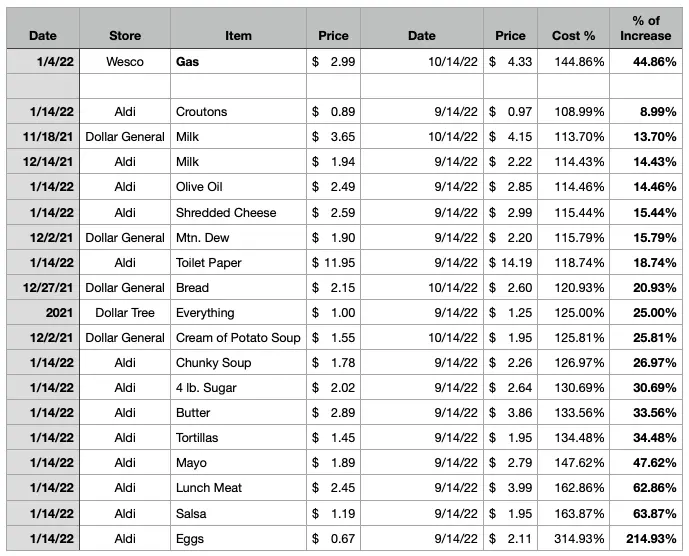
As you can see, I did not find ANY that were 8.2% or less. The lowest increase I found was croutons at 8.99%. The largest increase was a dozen eggs which had an increase of 214.93%. So they now cost 314.83% to buy the same eggs. So the eggs that cost 67 cents in January, now cost $2.11. (At Dollar General they are currently $3.95 and at another grocer near me, they are over $8.00 a dozen. I don't have the earlier receipts from those stores to compare though.) I realize that this is an unusually high jump and there are reasons why there was such a large hike (such as bird flu and scrambled supply chains), but, it is also a main staple for many people and regardless of the reason there was still inflation. And another main staple, bread. The bread I bought went from $2.15 to $2.60 (20.93% higher).
I also went to "Dollar Tree" recently and discovered that every item in the store went up 25% from the last time I was there. Every item in that store used to be $1.00 and now they are all $1.25.
The increase in restaurant prices is noticeable too, however, I don't have the figures to calculate those percentages.
For those on Medicare Part B, the cost went up 14.5%, from $148.50 in 2021 to $170.10 in 2022. Again way above the 8.2% average.[1]
OBERLO shows the Median average income rose about 4.9% from weekly pay of $996 to $1,030, however, that doesn't even keep up with the supposed 8.2%.
The majority of the politicians in Washington DC don't seem to care how much this is hurting American voters. Speaker of the House, Nancy Pelosi said, "The fact is that when I hear people talk about inflation … we have to change that subject." Instead of addressing this pressing issue that affects the average American (and she's so wealthy she doesn't notice), she just wants to change the subject. I believe Democrats have caused this with their policies. But instead of fixing the problem, they are more concerned about getting your vote and maintaining power.
Disclaimer: I began this article on 10/14/22 and have not adjusted any prices.
[1] Current and Past Medicare Part B Premiums

(The images are public domain from pixabay.com.)






