
Hello boys and girls, remember when we talked about options and yields? For seasoned traders or regular defi degens, current option trading strategies available on the market might just be too….vanilla (pun intended). What if you wanted to be able to customize more advanced trading strategies to earn superior yields?
Now you can! Introducing Cega, the decentralized exotic derivatives protocol on Solana. This week we’ve partnered up with Cega to bring you all the ins and outs of exotic derivatives. As usual, this is not financial advice but only educational content. Please don’t be dumb and always DYOR on any crypto projects.
Table of Contents
1. Summary
2. Overview of Cega
3. Technical Features
4. Cega FCN Vault Scenarios
5. Roadmap
6. Q&A
7. Concluding Thoughts
Part 1. Summary
The TL;DR for all of you who’s too lazy to read through the whole thing.
- Cega is the first DeFi protocol focused purely on exotic derivatives.
- It recently raised a $4.3M seed round led by Pantera Capital, Coinbase Ventures, Alameda Research, Solana Ventures, and more.
- The current product Cega is building is a structured note, users are guaranteed daily fixed coupons.
- The FCN is comprised of 2 or 3 short puts, a Knock-In barrier, and a Knock-Out barrier.
- Simulation shows in a bear market, losses are way less since they are offset by the daily coupon yield which is paid regardless of market conditions.
- Cega membership NFT has utilities like exclusive access to low supply vaults, access to Cega swags, invites to events, etc.
- Cega plans to launch its own token in the future, $CEGA token holders can influence future product offerings.
Part 2. Overview of Cega
In TradFi, derivatives dominate the financial markets. The total value of financial derivatives is estimated to be 10x larger than global GDP. DeFi derivatives on the other hand, is still a newborn baby in comparison. The TVL of the DeFi derivatives market makes up around 3% of the total DeFi market.
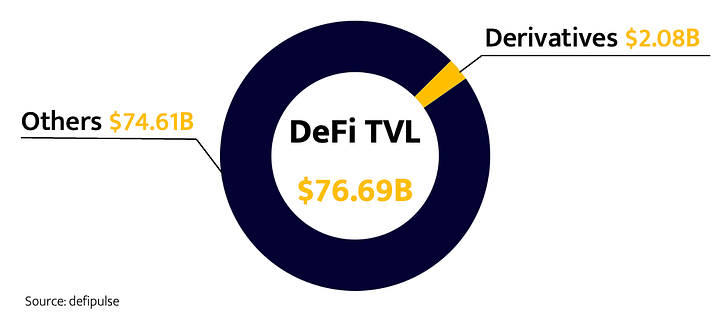
No less, the growth of it has been impressive. DeFi derivatives TVL has more than tripled since 2020. A trend that we’re seeing now is TradFi products entering the DeFi landscape.
Cega is a prime example, being the first DeFi protocol focused purely on exotic derivatives. Its mission is to create superior, flexible, and diversified investment opportunities for every Web3 investor.
If you don’t know what exotic derivatives are, make sure to check out our previous article to get up to speed. In short, they are a class of options products that combine basic options (calls & puts) with advanced options characteristics to create packaged offerings for investors.
Cega is now live on devnet, with the purpose of gaining as much user feedback as possible for its mainnet launch. It recently raised a $4.3M seed round led by Pantera Capital, Coinbase Ventures, Alameda Research, Solana Ventures, and more.
The team behind Cega is made up of a former derivative trader, experienced developers, and former Y combinator founders, as well as a community of experts in the field. This expertise will allow for the development of exotic structured products that generate high yields with built-in downside protection for investors.
Part 3. Technical Features
Cega aims to solve 4 key issues:
1. Yields are declining in the market as institutional players come in.
2. Existing consumer-facing option products lack in strategic diversity.
3. Crypto project UX can be difficult to navigate.
4. Ape in and achieve the above without getting rugged.
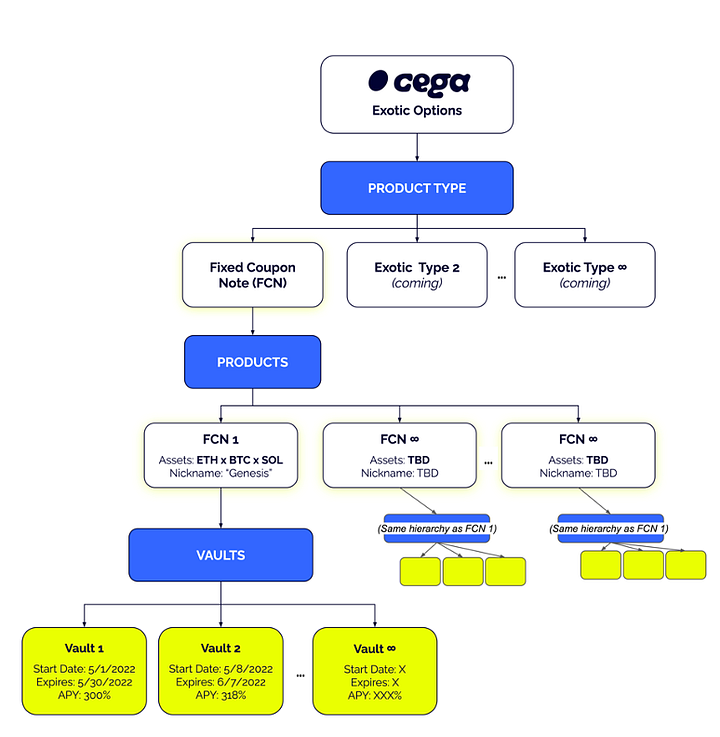
The current product Cega is building is a structured note, which is a product that behaves like a bond with underlying option baskets. Users are guaranteed daily fixed coupons (the yield that you make daily on the position), with a high yield generated through a put selling strategy.
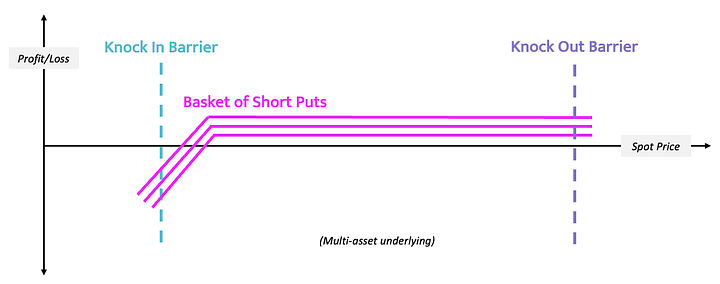
The FCN is comprised of:
• 2 or 3 short puts to generate yield
• Knock-In Barrier to provide downside protection against market downturns
• Knock-Out Barrier to improve investor liquidity and increase compounding of yield when markets rally
Every Cega product includes a full product spec outlining the details of the investment. Let’s use the Genesis vault as an example.
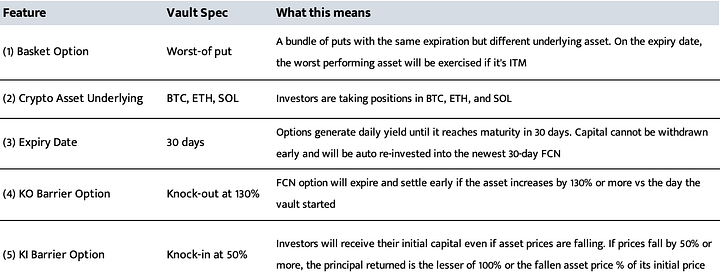
The vault lifecycle is directly correlated with how funds flow through the system:
- Vault starts.
- Deposit window opens — investors have 7 days to deposit capital into a Vault before the trade is processed.
- Vault trade executed — usually 30 days, once an epoch starts, the trade is finalized with market makers. Assets in the vault will be bid on by market makers.
- Yield — investors generate yield everyday as soon as the Vault starts.
- Withdraw window — investors can submit withdrawals throughout the entire life of the vault. Withdrawals take place at Vault expiry.
- Vault expiry — vaults expire after 30 days or early if the trade knocks-out. Deposits are auto-compounded and reinvested into a new vault.
- New Vault — every 7 days there is a new FCN Vault trading a 30 day maturity product.
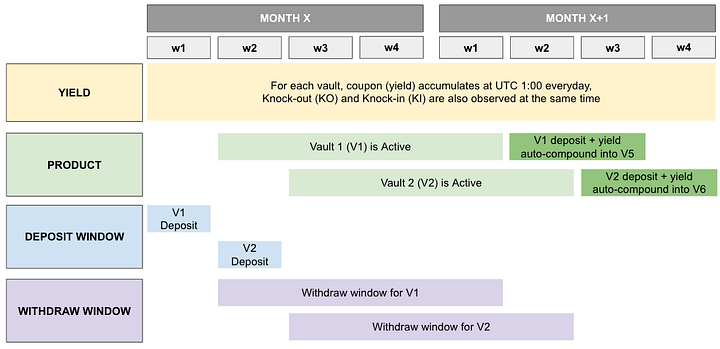 Flow of capital in a Cega Vault
Cega collects a 15% performance fee on profits (not deposits) only if the FCN makes money for investors upon trade expiry. Additionally, a 0.17% management fee on deposits is collected per FCN trade, totalling 2% annually.
Part 4. Cega FCN Vault Scenarios
Let’s assume that you invest $1,000 initial investment into a Cega vault with the following terms:
1. 30 day investment duration
2. Two underlying assets — ETH, SOL
3. 300% APY, 150% APR = $4.20 yield every day
4. Knock-In barrier is 50%
5. Knock-out barrier is 130%
Since the crypto market is just super volatile in general, let me give you 4 scenarios and how it’ll affect the payoffs you get.
Starting off with Scenario 1 — normal expiry, closing spot above 100%.
There’s no KO or KI and the FCN reaches full maturity and expires as normal. The spot price of the underlying closes above 100%.
In this scenario, ETH closes 10% higher than when the vault started, closing at 110% of initial spot price. SOL closes 1% higher, closing at 101% of initial spot price.
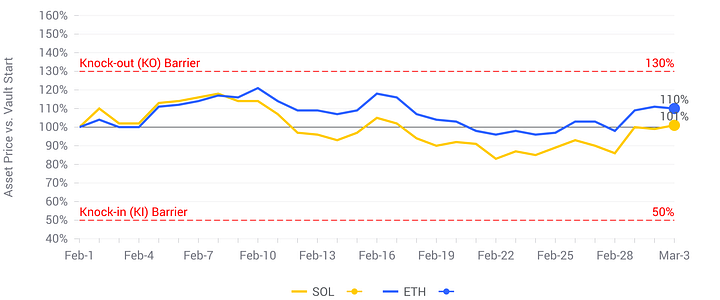
Scenario 1
The total payoff for this scenario would be $126 yield ($4.20 x 30 days) + $1,000 principal returned, you would get $1,126 back after 30 days. The ROI in this scenario is $1,126/1,000 = 12.6% yield in 30 days.
Let’s move on to Scenario 2 — normal expiry, closing spot below 100%.
There’s no KO or KI and the FCN reaches full maturity and expires as normal. The spot price of the underlying closes below 100%.
In this scenario, ETH ended down 13%, closing at 87% of initial spot price. SOL ended down 36%, closing at 64% of initial spot price.
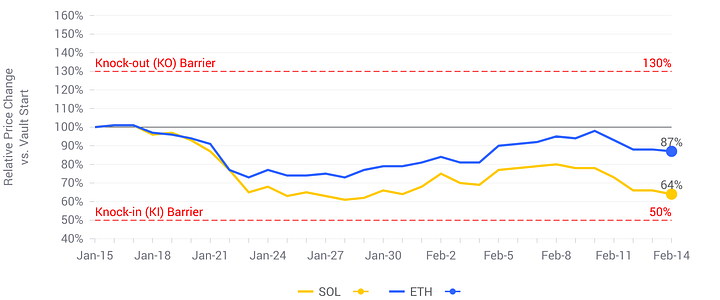 Scenario 2
You will continue to earn daily yield payments despite the poor performances of both ETH and SOL. There’s also no impact on your principal. Scenario 2 will generate the same payoff of $1,126 as Scenario 1.
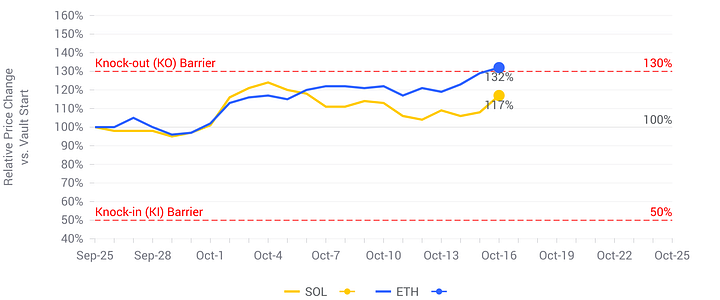
Let’s simulate a knock-out event happening in Scenario 3. ETH prices increase to 132% of initial price which exceeds the 130% knock-out barrier level. The knock-out event happened on Day 21 of the FCN vault’s life.
 Scenario 3
The vault expires earlier because the knock-out event happened, so you got paid immediately. In this case, you would receive a yield of $88.2 ($4.20 x 21 days). Adding that to the $1,000 principal that will be returned, you get $1,088.2 in total. $1,088.2/1,000 = 8.8% yield in 21 days.
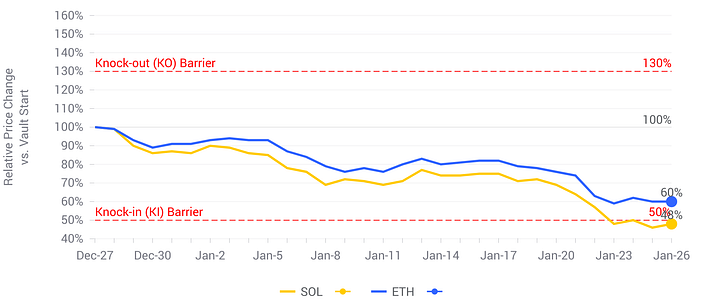
Lastly for Scenario 4, a knock-in event. SOL decreased 52% in total, which puts it at 48% of its initial price. This exceeds the 50% KI barrier level. This one is a bit more complicated since it’s not the same as a knock-out event. The KI event doesn’t cause the vault to expire immediately like KO, it marks the vault as having been knocked-in and causes the principal returned to use the knock-in formula.
 Scenario 4
In this case, the principal returned when the vault expires is calculated using a formula based on the worst performing asset on the final day.
On Day 30, we see that SOL (48%) performed worst than ETH (60%). The principal you get back is $1,000 initial deposit * min(100%, 48%) = $480 returned. You would still receive daily coupons making your total yield $126 for the 30 days. The total payoff would be $606 after 30 days. $606/1,000 = -39% ROI in 30 days.
Even in this scenario, your losses are way better than if you invested in SOL or ETH directly. This is because the losses are offset by the daily coupon yield which is paid regardless of market conditions. This safety feature is also what makes FCNs so attractive to investors.
Part 5. Roadmap
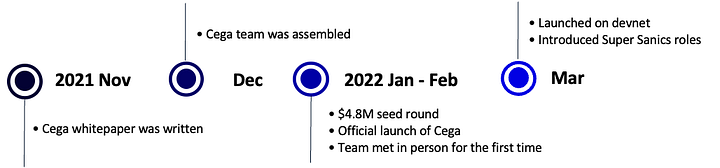 Cega timeline
FCN is only Cega’s first exotic product, with many more to come.
Cega NFT
Users can get a Super Sanics role in Cega’s Discord by being active, and contributing in their community. All Super Sanics by mainnet launch will receive a Cega Membership NFT. The NFT will have additional utility unlocking down the line, such as exclusive access to low supply vaults, access to Cega swags, invites to events, etc.

Governance
Cega wants their investors, traders, quants, and statisticians to influence how the protocol grows. They will be moving towards decentralized governance by developing capabilities like:
1. Vote on future product offerings — $CEGA token holders can influence the baskets Cega creates, as well as risk tolerances. (Cega hasn’t launched a token yet, but plan to in the future.)
2. Impact on the statistical models — allow the community to learn about more exotic derivatives and influence the pricing capabilities that Cega offers.
3. Education —allowing the defi community to understand options trading in the most realistic way.
Part 6. Q&A
Shoutout to Arisa and the rest of the Cega team for agreeing to do this and for answering some of our questions.

Q: How might a new market be introduced? Are there currently systemic parameters in place to determine this?
A: The FCNs will be designed by Cega to best fit user interests in the beginning. we are creating high yield structures as well as stable yield structures, and users can invest in whatever vault they prefer.
Q:When a user enters a Cega contract, what counter-party risk does he/she take? Is Cega the counter-party or are the market makers the counter-party?
A: The counter-party risk for a user is the market maker getting liquidated. Cega does not take any proprietary risk. Cega also helps users by going through Maple Finance to make sure that we are only working with whitelisted market makers who have sufficient capital. Cega will also have an internal treasury for insurance.
Q: With the three current risk profiles, are the price ranges set by Cega? Will users be able to set their own price ranges in the future?
A: The price ranges are set through trades with market makers. In order to create favourable pricing for users, Cega has a pricer that gives indicative bids. we are still exploring customizable structures but happy to discuss further if enough users are interested.
Q: How do you become a market maker for Cega?
A: We only work with institutional market makers (meaning large incorporated market makers). You need enough funds to go through the Maple market maker KYC process. We also do checks on derivatives knowledge because we only want market makers who understand the product to be trading. When you pass the stringent process, you are able to participate in our weekly auctions. If you are a market maker and are interested in exploring partnership, please DM me on twitter. (https://twitter.com/arisatoyo, https://twitter.com/cega_fi, https://discord.com/invite/cega)
Q: Will $CEGA have any additional utilities aside from governance rights?
A: The Cega tokens will also have revenue rewards and a time component. we will be publicizing this information in the coming months so stay tuned on our discord and twitter!
Q: Will there be a DAO in the future to govern Cega?
A: Yes.
Q: What other exotic products are you planning on building down the road?
A: We are currently exploring a few structures. Recently we did the first double no-touch barrier option structures, we are also looking at other popular high yield solutions.
Q: How did you begin the journey of creating Cega?
A: I was a derivatives trader at an investment bank when I started going down the crypto rabbit hole in 2016. I loved derivatives because it’s such a flexible and innovative way to express your views on a market, and thought there would be a huge opportunity for the emerging crypto market. People convinced me then that it was not going to happen. Not going with my intuition and making crypto options in 2016 is the biggest regret of my life. The next natural evolution was exotic derivatives and structured products, and I had thought about this idea for a few years, and finally saw a good time to write a whitepaper last November. I had been wanting to create Cega for a long time and I’m very happy that it’s finally here.
Q: How has it been building on the Solana ecosystem?
A: The development in rust has been tough (according to our technical co-founders, it’s like “chewing glass”), but the community and composability is unparalleled. The experience is also so good with how fast every transaction goes across.
Q: What are some things you’re excited for Cega?
A: I’m excited for our mainnet launch and to see the feedback from our users when they experience the amazing product. I really think Cega is pushing the boundaries of DeFi derivatives and innovating in a way that will forever change the market. I am excited to trigger what i call DeFi 3.0, a market that allows users to invest responsibly, earn sustainable yield and offer flexibility. Cega is ready to be the thought leader and help bring more of these products into the ecosystem.
Part 7. Concluding Thoughts
That’s the end of this one, folks. I’ve noticed that there has been a huge boom of DeFi protocols on Solana, with specific emphasis on bringing TradFi financial products into DeFi. There’s definitely still a lot of room to grow in this area, so protocols like Cega is definitely tapping in the right market.
One major area I was super impressed with while researching and writing about Cega is that they managed to make all of this fun. I don’t know if it’s their UI, or the way they break things down, but I found everything really easy to comprehend and just very fun to navigate. This is something I think is important, there are already a lot of DeFi protocols offering impressive products, but sometimes the learning curve is quite steep for normal crypto users. A colleague of mine with zero financial background, and no prior knowledge to derivatives, managed to not only understand what exotic options are, but also fully comprehend the FCN that Cega is building. This is what DeFi should be doing, providing an ecosystem to empower individuals to leverage their money in ways they wouldn’t have thought possible.
Make sure to follow Cega’s social media so you don’t miss any of their updates.
https://twitter.com/cega_fi
https://discord.com/invite/cega
That’s all for this week, hope y’all enjoyed this project collab piece. Disclaimer: this deep dive is done in collaboration with Cega, however I’m not affiliated with Cega in any way. This article is written with the sole purpose of providing a more in-depth understanding of this project to more users.
As always, this is not financial advice but merely my own honest opinion. I’m not a financial expert so always DYOR on any crypto projects.
Adios Amigos!
-SixOhFour




