
It was reported in 2019 that 47% of Canadians and 78% of Americans live paycheck to paycheck. This is consistent with Tom Lee's comment about household spending:
75% of what a consumer spends their money on is a house, transportation, and eating at home, - Tom Lee, Fundstrat, May 1, 2020
It's common sense that we should be saving money for our retirement, and one of the easiest ways is to transfer a small amount from each of our paychecks into a separate savings account. Some individuals prefer to buy equities, hoping their investments will rise in value over time. Because timing the market is next to impossible for most investors, some individuals prefer to make recurring purchases (dollar-cost averaging) of stocks or mutual funds with their paychecks.
But how would you have fared if you decided to make recurring purchases of Bitcoin?
Many employees receive their paychecks twice a month (on the 15th and the end of each month). These are my findings for those of you who thought of buying Bitcoin on payday in the month of January from 2013 to 2019.
Bitcoin purchases on January 15 from 2013 to 2019
I used coinmarketcap.com to retrieve my data. Unfortunately, the earliest data available for Bitcoin was from April 28, 2013, but I used data from 99bitcoins.com to get the closing prices for the month January 2013*. I then calculated annual gains from January 1 to December 31 for each calendar year. You can also see the performance of a $100 investment on January 15, 2013, and also on each successive January 15 from 2014 to 2019.

Source of Bitcoin pricing: Coinmarketcap and 99bitcoins.com
Bitcoin purchases on January 31 from 2013 to 2019
I used the same methodology to determine the performance of a $100 Bitcoin purchase made on January 31 each year from 2013 to 2019.

My findings
Admittedly, the data is hard to read in this post due to the small font. I decided to make Table 3 below, which summarizes the data.
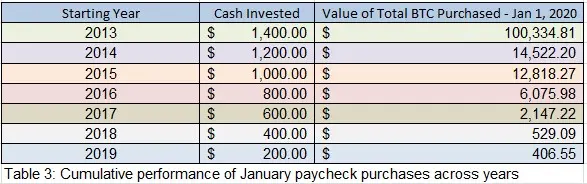
It's notable that the price of Bitcoin peaked in December 2017. Even if you started buying some Bitcoin every January beginning in 2018 as the crypto market started to crash, you would have made more than 32% on your $400 investment if you are a HODL'er (based on BTC price close on Jan 1, 2020). This is significant because that time span includes a -72% yearly change in Bitcoin's value between January 1 2018 and January 1, 2019.
As you can see, it appears that January is a good month to buy Bitcoin if you HODL (based on past performance).**
So how do purchases in January compare to those in other months of the year? Please stay tuned for more, because I'll be looking at the performance of paycheck purchases in February in an upcoming post.
Any special requests?
I'm also taking requests! If you would like an analysis of any specific day (Valentine's Day from 2013 to 2019 for instance, or another day that's meaningful to you), please let me know which one with a request in the comments below!
**Please note that I am not a financial advisor, and that the past market performance of any asset is no guarantee of its future performance. Please be responsible and only invest amounts that you are willing to lose in their entirety.
Thanks for reading!
Good luck, and stay safe!
Last edited August 18, 2020 to include the **disclaimer.
Image of Bitcoin by Sinisa Maric from Pixabay
Original cover art by Damir Spanic on Unsplash. Modified by the author for the purposes of this post.
From the Unsplash Terms of Service:
Unsplash grants you an irrevocable, nonexclusive, worldwide copyright license to download, copy, modify, distribute, perform, and use photos from Unsplash for free, including for commercial purposes, without permission from or attributing the photographer or Unsplash, but this license does not include the right to compile photos from Unsplash to replicate a similar or competing service.






