
Tom Lee hosted a live webinar called "The Economic Reset" on May 1, 2020. He made some excellent points guided by Fundstrat's unique perspective through analytics and research. The following is part 2 of my summary of his hour-long presentation.
Related reading: Deep Dive - The Economic Reset by Fundstrat's Tom Lee - Part 1
3. Why is the market going up? - Continued
Effect of stay-at-home orders on the economy is overstated
Social distance spending categories such as eating out at restaurants, traveling by plane, going to concerts, add up $717 billion (roughly 4%) out of the $17 trillion of the total consumer spending. This is confirmed by a St. Louis Fed study that consumer spending is down roughly 3% if the economy is not re-opened.
75% of what a consumer spends their money on is a house, transportation, and eating at home, - Tom Lee, Fundstrat, May 1, 2020
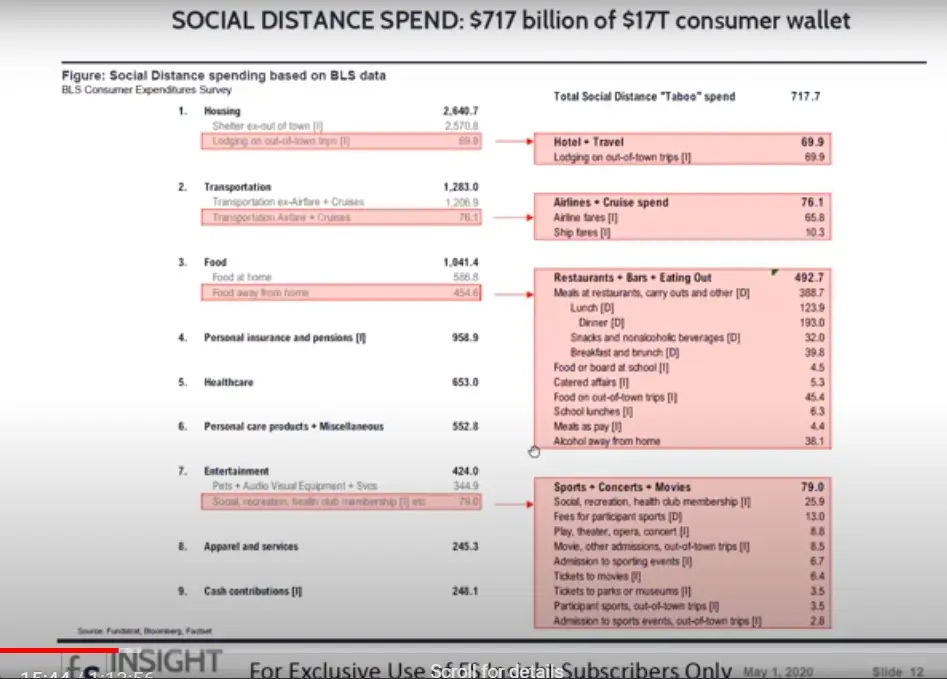
Graphic 3: From FS Insight - The Economic Reset webinar
Even if everyone decides to permanently stops their social distance spending, the economy can recover up to 93%. The economy is not shrinking by as much as most investors currently believe.
My comments: Because I'm writing this on July 31, I have the benefit of hindsight. The latest report from the US Commerce Department shows the American GDP dropping by a record 33% in the second quarter. The question is how much of this is attributed to the rapid, and continuous spread of COVID-19 across the US.
4. What is the impact of Federal stimulus spending (massive printing of money)?
Federal Intervention of Retail Spending
A study by ISI economists and the NY Times shows the $600 Federal Unemployment credit on top of their state unemployment benefits has resulted in most Americans seeing higher incomes compared to when they were working. This is allowing Americans to continue spending despite high unemployment rates across the country.
We're printing all this money...isn't this bad?
According to Lee, government debt is bad if it crowds out private sector spending, and the way it crowds out private sector spending is as interest burden.
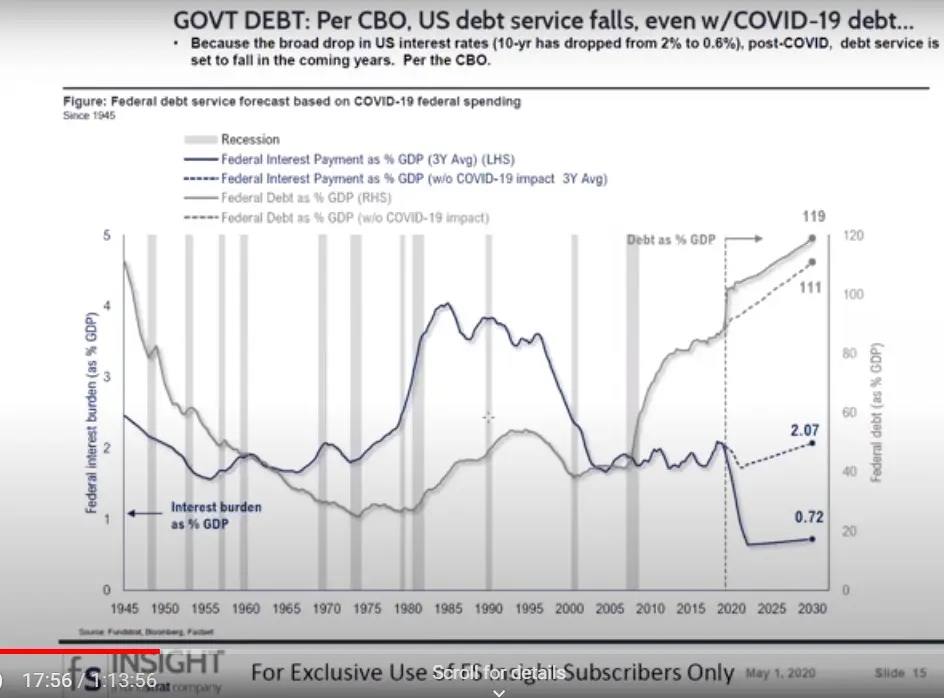
Graphic 4: From FS Insight - The Economic Reset webinar
In the above chart, the dark blue line is the Federal Government's interest payments as a percentage of US GDP since 1945. It was about 2% last year, which was actually near post-World War II lows. Despite the surge in government debt issuance, the US debt service will be lower than before for the foreseeable future due to lower interest rates.
Interest expense on all of the deficit has actually fallen as seen in Graphic 4 above, despite all the stimulus funding. This demonstrates that interest burden has fallen.
My comments: I was a bit surprised that Lee didn't address the potential weakening of the US dollar that would arise due to the US Fed continuously printing money.
5. What can we learn from history?
Retracements
At turning points in a recession, the stock market is going to move before the economy, - Tom Lee, May 1, 2020
Lee suggested that we look at retracements:
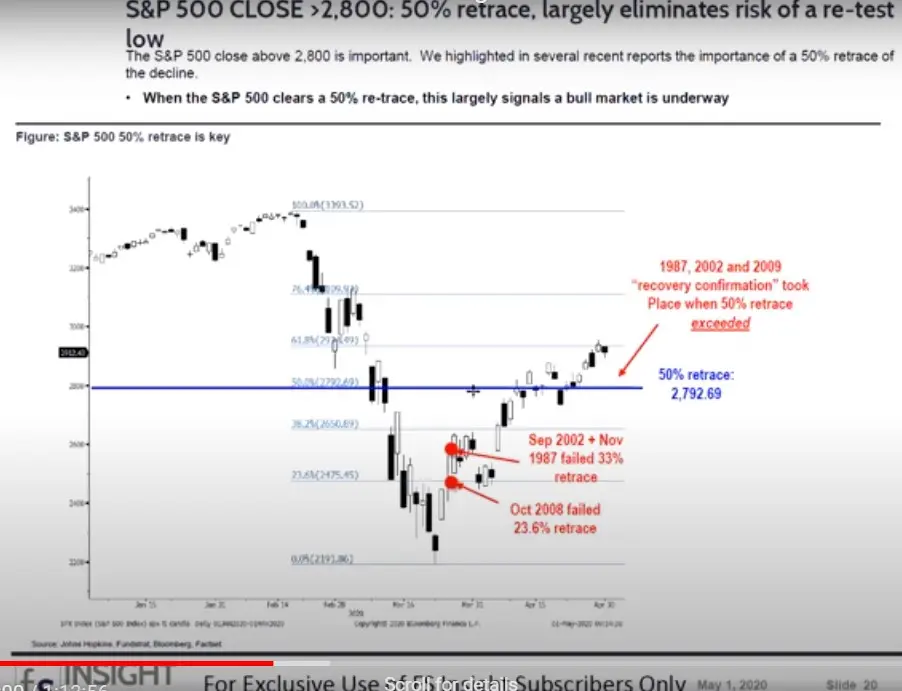
Graphic 5: From FS Insight - The Economic Reset webinar
From the chart above:
- October 2008 - After T.A.R.P., the S&P failed at 24% recovery.
- November 1987 and September 2002 - After the 1987 stock market crash, and after the Dot Com Bubble burst, the S&P failed at 33% recovery.
- In 1987, 2002, and 2008, a 50% retrace occurred during a clear bull market.
The S&P has already cleared that hurdle as of today (S&P recovered by 60%), but it's notable that a lot of stocks have not recovered. Lee suggests that if you want to pick some stocks, it's best to look for ones that have not recovered by 60% yet, because those will simply be catching up to the S&P.
When have stocks bottomed relative to jobless claims?
Lee asserts that stocks bottom before fundamentals do.

Graphic 6: From FS Insight - The Economic Reset webinar
In 2003 and in 2009, the S&P bottomed about 3-4 weeks before jobless claims peaked.
Based on recent data, it appears that US jobless claims peaked on April 2, 2020 at 6.9 million. This would suggest that the market has bottomed already based on previous market behavior.
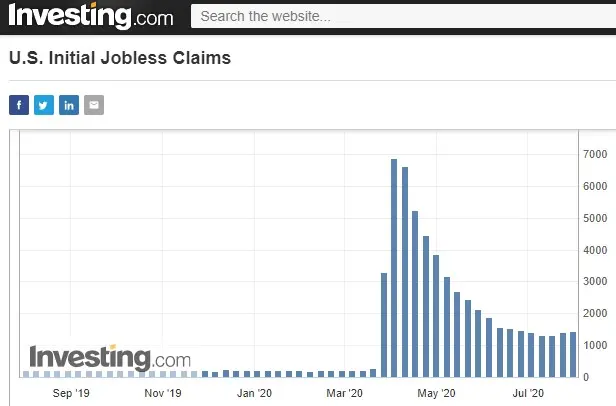
Chart from Investing.com
Please stay tuned for Part 3 where I will review Fundstrat's strategy for picking stocks in this environment!
Thanks for reading, and stay safe!
Cover art by 3D Animation Production Company from Pixabay






