Before societies existed we have the origin story of all of humanity with the creation of the first man Adam. "And the Lord God formed man of the dust of the ground and breathed into his nostrils the breath of life; and man became a living soul. And the Lord God planted a garden eastward in Eden and there he put the man whom he had formed." Now when God had formed Adam and gave dominion to care for the garden he created a helper for Adam named Eve from the rib of Adam's chest.
In Milton's Paradise Lost we get Lucifer's perspective after his fall from Heaven. Here he views the natural beauty of the physical world and the original righteousness and innocence in the newly created beings. He immediately begins to formulate their ruin by recreating his fall but as his doom has been prophesied by the Woman clothed with the Sun and stars and her offspring the man-god. He sizes up the woman because her physical stature is lacking compared to man and also because in encountering her, he can be sure that he is not encountering the man-god.
"And the serpent said unto the woman, You shall not surely die: For God does know that in the day you eat of it, then your eyes shall be opened and you shall be as gods, knowing good and evil." Here is a being that came from a society of implied hierarchies and perceptions, he distorts their harmony by implying God is not to be believed and the enticement to be like a god herself with the knowledge of good and evil.
Without even knowing what has occurred Eve perpetuates the learned behavior to Adam. Adam knows more than Eve about the commandment not to eat of the tree of knowledge of good and evil but he chooses to eat of it because he prefers his companion over obedience to God. At the moment he probably fears the loss of Eve more than the unknown consequence of their actions. Paradise is once again lost as hardship, birth-pains, toil by sweat and the ground itself is cursed because of the corruption that has taken place. So death and sin are propagated into the world because Lucifer sought to destroy the innocent because of his hatred for his creator by proxy of these new creations, he wanted to destroy their relationship with God as he did his own.
Ancient mythology were society's interpretation of why things concerning the world were the way they were. Pandora's Box myth is another origin story of humanity. Prometheus a titan who served the Olympian gods creates humanity out of clay. He steals fire from Olympus and gives it to humanity to aid civilization. Zeus the god of all Olympus punishes Prometheus by having him chained to a rock where an Eagle devours his liver everyday and each night it grows back so the eagle can eat it the next day. Eventually Zeus tells Epimethus, Prometheus' brother that he wants no enmity between himself and his brother. He creates a beautiful woman named Pandora whom no god or man can resist and gives her to Epimethus as a peace offering. Each of the gods of Olympus present Pandora's Box with a gift and Zeus gives the box to Pandora telling her she is never to open the box. Eventually curiosity get the better of Pandora and she opens the box which contains sickness, death and many other unspecified evils which are then released into the world. When she closes the box to stop the torrent of evils she peers back to realize there is something left hope.
Through the evolution of civilization humanity as a culture has had need of the personification of their fears. Myths and monsters represent our fears of the unknown. They constitute those aspects in our societies we see as uncontrollable and menacing. Through their representation we get a mirror image of ourselves, our cultures and the issues that cause concern for society.
FRANKENSTEIN
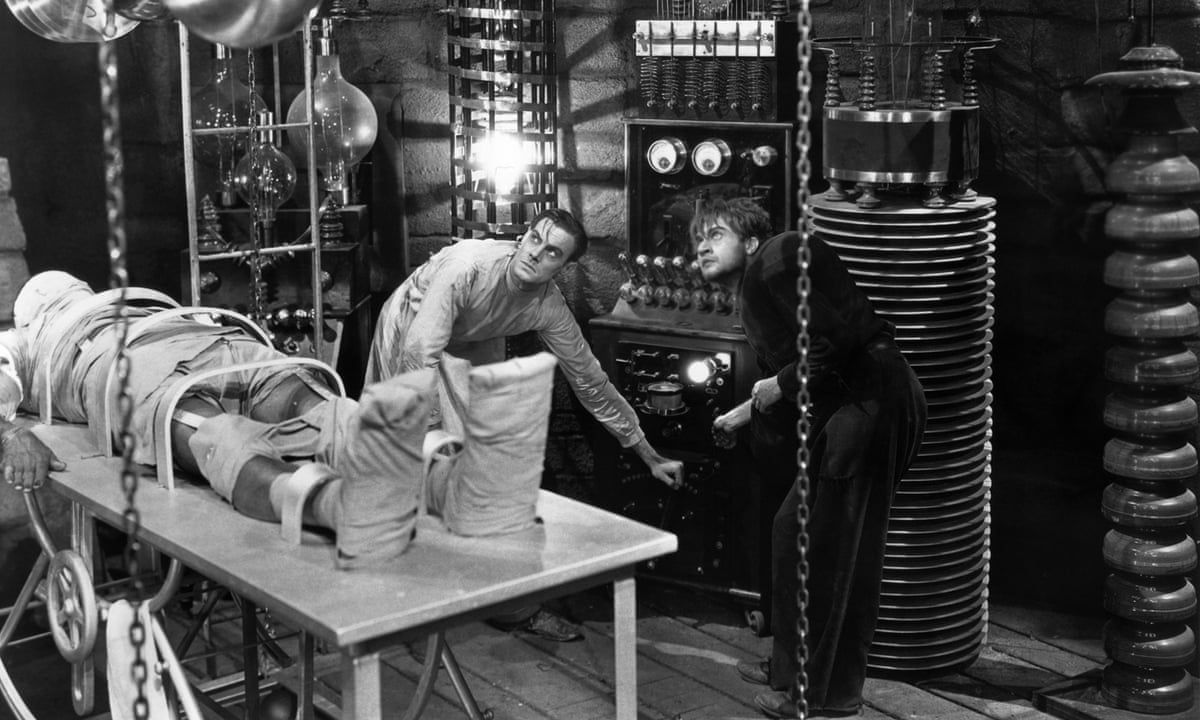
The archetype for Mary Shelley's mad scientist Victor Frankenstein ripples throughout pop culture in characters such as; Doc Brown (Back to the Future), Rick Sanchez (Rick and Morty) and Dr. Moreau (The Island of Doctor Moreau).
"the beauty of the dream vanished and breathless horror and disgust filled my heart" - Dr. Frankenstein
The monster, made of body parts from cadavers and brought to life by unorthodox scientific experiment, Victor enters the realm of God as he creates life from the elements. As he crosses the threshold, Dr. Frankenstein is disgusted with himself and the abomination he has created that he himself has thus released upon humanity. By making the monster a gigantic, exaggerated form of man itself represents the ugliness of humanity.
The Modern Prometheus an 1818 novel written by author Mary Shelley. She loathed the Industrial Revolution that was taking place in Europe at the time. Mary viewed rapid and unchecked modernization as a harbinger for misery and misfortune to society. The Industrial Revolution was a shift of her known way of life which was threaten by: migration from rural areas to urban ones, rapid scientific advancements and the unplanned economic development spreading through all of Europe.
She uses Frankenstein's Creature as a nexus point for her fears about the disregard of human dignity with medical experiments on cadavers, the promulgation of scientific ideology that nature can be conquer through scientific advancement, the phobia that the inventions of the time would replace human labor. Shelley perceived the war against nature and humanity's balance with it shift to a sterile world of industrialization much different from her society's paradigm. The societal representation of Dr. Frankenstein's Monster is unbound curiosity against the natural order and the consequence of the horrors unleashed by crossing boundaries that should not be crossed.
Gojira
In the final year of World War II, the Manhattan Project was initiated by the Allies to focus their full attention to the Pacific War. The project produced by two types of atomic bombs. On August 6, 1945 Little Boy (uranium gun-type fission weapon) was dropped on Hiroshima. Three days later Fat Man (plutonium implosion-type nuclear weapon) was dropped on Nagasaki.
The Aftermath turned once flourishing Metropolises into a nuclear wasteland, bodies of adults and children littered the streets. Roads were blocked by debris and fires and most of the medical professionals died from the nuclear blast and/or from radiation sickness before people could be treated. A large portion of the population were not receiving medical attention and the Japanese government was slow to respond in regards to aid.
Theses events left generational trauma to the psyche of the surviving Japanese people as whole bloodlines were wiped out in an instant. The end of World War II meant immeasurable suffering for the Japanese people and the nation needed a formulation of a way to express their anguish and manifest their collective fear.

The name Gojira is a blend of the words gorira (gorilla) and kujira (whale). Godzilla was created as a Shinto "God of Destruction" used as a metaphor for nuclear weapons that since it's inception begins the cycles of death, destruction and rebirth. Godzilla's signature weapon is its atomic breath, nuclear energy that it generates inside of its body that is concentrated into a laser-like projectile unleashed form its jaw as a blue radioactive beam. The archetype of Godzilla is seen in Hideo Kojima's Metal Gear Solid 1998 stealth game. Metal Gear REX is nuclear-capable mecha. The societal representation of Godzilla is the destructive force of man-made weapons of mass destruction that decimated a nation and left lasting scars on all who remember the retribution of Judgement Day.
Cthulhu
"The Thing cannot be described-there is no language for such abysms of shrieking and immemorial lunacy, such eldritch contradictions of all matter, force, and cosmic order. A mountain walked or stumbled.
If I say that my somewhat extravagant imagination yielded simultaneous pictures of an octopus, a dragon, and a human caricature, I shall not be unfaithful to the spirit of the thing. A pulpy, tentacled head surmounted a grotesque and scaly body with rudimentary wings; but it was the general outline of the whole which made it most shocking frightful." - H.P. Lovecraft, The Call of Cthulhu
Lovecraft created the genre known as Cosmic horror, which was the focal point of his fiction and personal philosophy. Cosmicism is the idea that humanity is an insignificant part of the cosmos and could be obliterated at any moment. Howard had ambivalent views on knowledge and within his literal works expressed a perceived fragility of anthropocentrism. The decline of civilization is also a major theme in his works, as he viewed that the West was in decline during his time.
The cataclysmic events of Lovecraft's era certainly contributed to his paradigm that shaped his lore. The Great Depression was the longest, deepest, and most widespread depression of the 20th century. The economic contagion culminated on Black Tuesday, the stock market crash of October 29, 1929. The economic shock transmitted across the world, impacting countries to varying degrees, with most countries experiencing the Great Depression from 1929. The "Great War" or the First World War, a major global conflict from 1914 through 1918. World War I began as a clash of 20th century technology and 19 century tactics, with the inevitably large ensuing casualties. Of the 60 million European military personnel who were mobilized throughout the war, 8 million were killed, 7 million were permanently disabled, and 15 million were seriously injured. From these two world changing events we can infer why Howard viewed humanity itself as insignificant and the personification of forces beyond comprehension in his creation of the Great Old Ones.
The Great Old Ones are cosmic entities that are too abstract to be accurately described by human perception. Cthulhu is infamously known for his grotesque appearance and gargantuan size, as well as his ability to drive any human that gazes upon his form to insanity. In most of the stories, Cthulhu lays dormant deep under the ocean within the sunken city of R'lyeh, but can still influence the world via telepathic powers, his many cults and other worldly minions. It is said that once Cthulhu is fully awakened, he shall rise from the depths and end the world. An archetype of Cthulhu is re-imagined in Marvel comics' Shuma-Gorath. During Earth's pre-history Shuma-Gorath ruled the world and demanded human sacrifice until eventually banished by time-traveling sorcer Sise-Neg. The societal representation of Cthulhu is the insignificance of humanity during widespread social conflict and the unwholesome survival of global suffrage in the forms of; poverty, famine and nihilism.
ZOMBIES
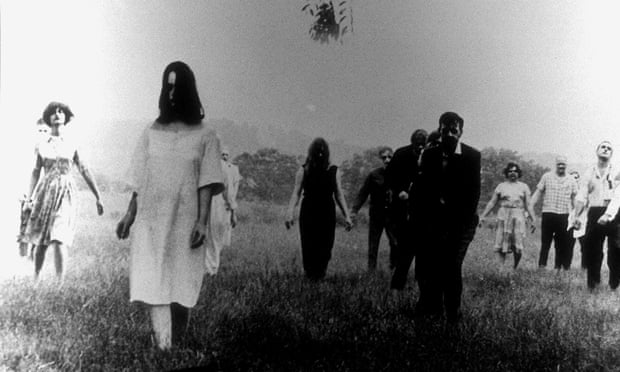
Night of the Living Dead (1968) Romero's zombies were bloodthirsty, shambling, walking corpses. They reanimated and arose shortly after death, spreading like a virus through a small Pittsburgh community. The revolutionary Night's greatness was not just in the way it shocked and disturbed audiences but also in the symbolism of it's time. Romero used the zombie horde to represent the uprising of the youthful hippie generation, swallowing up the classic conservative ways of America. The ending is nihilistic and hopeless for any future with the cause of Ben's death not being zombies, but other men. This theme of men being the true enemy is prevalent through all of the Dead series.
Dawn of the Dead is one of the most entertaining and fascinating satires of American culture: consumerism. The parallel between zombies and consumers as both experiences a loss of sentience and of the individual in the horde. The zombie is a monster of majority, those in our society who are given to the consumer instinct are a majority and the few individuals who criticize capitalism from within it are persecuted in same way that zombie will enclose and attack an uninfected human. The Zombie is a mechanism of annihilation, the horde only exists for the sole purpose of consuming or converting all humans until the species is extinct and the world is one now only inhabited by zombies.
The zombie apocalypse is a fantasy people want to imagine or practice during times of economic crisis. Without the pretenses of modern living, can I survive instinctively through my own resources of food and bullets? Zombies are perfect representation of the urban person living in the rat race among the faceless horde rushing to work on the circulatory system of the transport network of a major city. The skidrow homeless shuffling on the corner of intersection with grasping hands reaching out for something from you. The societal representation of zombies are the overwhelming forces of social change, consumerism and urban representations of ourselves as an anonymous, mindless horde never being fully satisfied always looking to consume.
Pavor and Metus Ancient Hieroglyphs